







Question: Problem 9 . 7 The drag coefficient of a spherical ball varies as a function of the Reynolds number. The following drag coefficients were measured
Problem
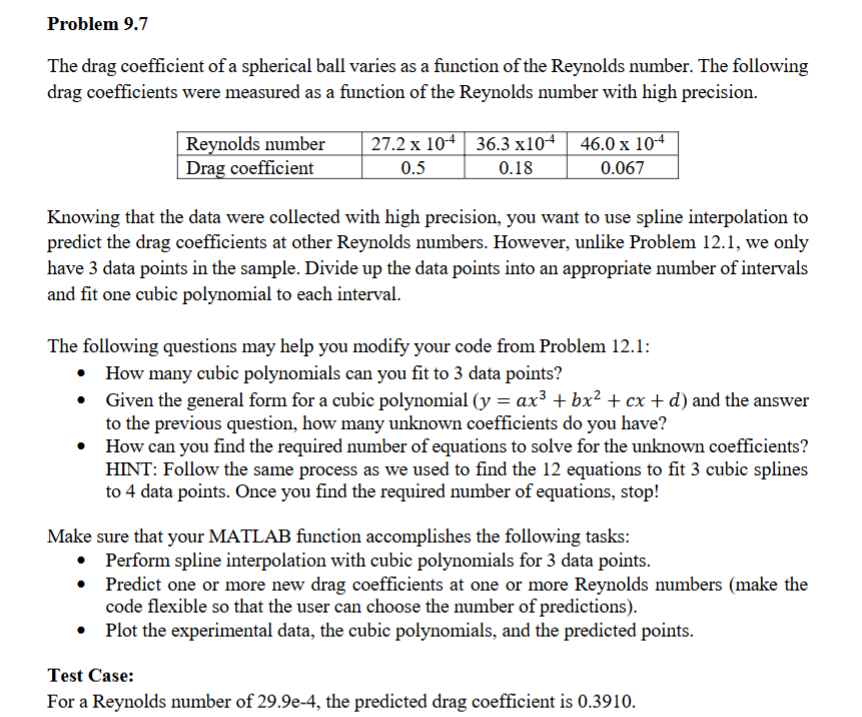
The drag coefficient of a spherical ball varies as a function of the Reynolds number. The following drag coefficients were measured as a function of the Reynolds number with high precision.
Knowing that the data were collected with high precision, you want to use spline interpolation to predict the drag coefficients at other Reynolds numbers. However, unlike Problem we only have data points in the sample. Divide up the data points into an appropriate number of intervals and fit one cubic polynomial to each interval.
The following questions may help you modify your code from Problem :
How many cubic polynomials can you fit to data points?
Given the general form for a cubic polynomial leftya xb xc xdright and the answer to the previous question, how many unknown coefficients do you have?
How can you find the required number of equations to solve for the unknown coefficients? HINT: Follow the same process as we used to find the equations to fit cubic splines to data points. Once you find the required number of equations, stop!
Make sure that your MATLAB function accomplishes the following tasks:
Perform spline interpolation with cubic polynomials for data points.
Predict one or more new drag coefficients at one or more Reynolds numbers make the code flexible so that the user can choose the number of predictions
Plot the experimental data, the cubic polynomials, and the predicted points.
Test Case:
For a Reynolds number of mathrme the predicted drag coefficient is
Step by Step Solution
There are 3 Steps involved in it
1 Expert Approved Answer
Step: 1 Unlock

Question Has Been Solved by an Expert!
Get step-by-step solutions from verified subject matter experts
Step: 2 Unlock
Step: 3 Unlock
 Study Help