







Question: PROBLEM BACKGROUND A hydrogen - powered fuel cell is being developed. At one point in the fuel cell the hydrogen will be flowing over a
PROBLEM BACKGROUND A hydrogenpowered fuel cell is being
developed. At one point in the fuel cell the hydrogen will be flowing
over a nickel plate. But you are concerned about the rate at which
hydrogen may diffuse through this plate, so you want to predict the
steady state hydrogen flux across this plate under various conditions.
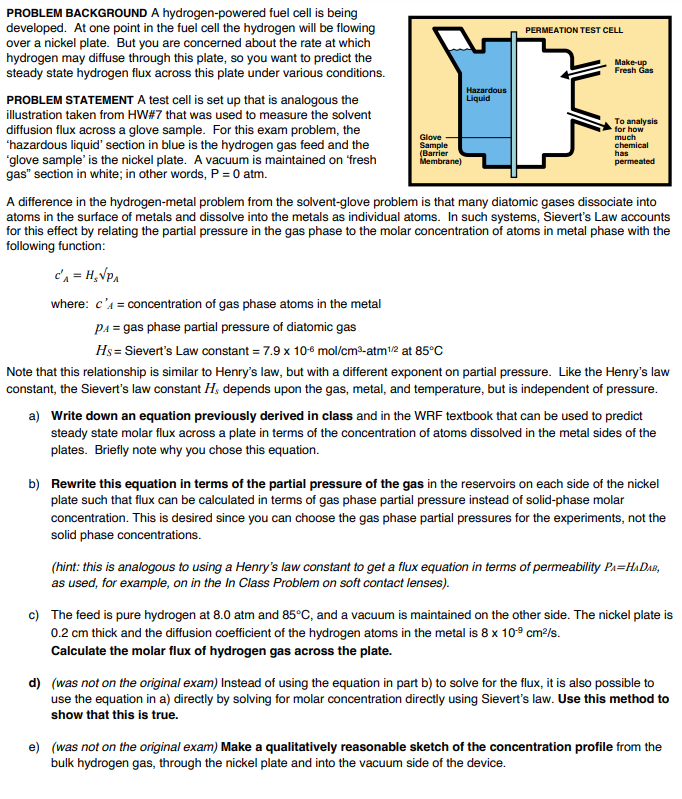
PROBLEM STATEMENT A test cell is set up that is analogous the
illustration taken from HW# that was used to measure the solvent
diffusion flux across a glove sample. For this exam problem, the
'hazardous liquid' section in blue is the hydrogen gas feed and the
'glove sample' is the nickel plate. A vacuum is maintained on 'fresh
gas" section in white; in other words, atm.
A difference in the hydrogenmetal problem from the solventglove problem is that many diatomic gases dissociate into
atoms in the surface of metals and dissolve into the metals as individual atoms. In such systems, Sievert's Law accounts
for this effect by relating the partial pressure in the gas phase to the molar concentration of atoms in metal phase with the
following function:
where: concentration of gas phase atoms in the metal
Step by Step Solution
There are 3 Steps involved in it
1 Expert Approved Answer
Step: 1 Unlock

Question Has Been Solved by an Expert!
Get step-by-step solutions from verified subject matter experts
Step: 2 Unlock
Step: 3 Unlock
 Study Help