







Question: Problem III Consider the following Dirichlet problem in non-divergence form: a(I) +c(x)u = f on U 1= 1 u = 0 on OU. (i) Find
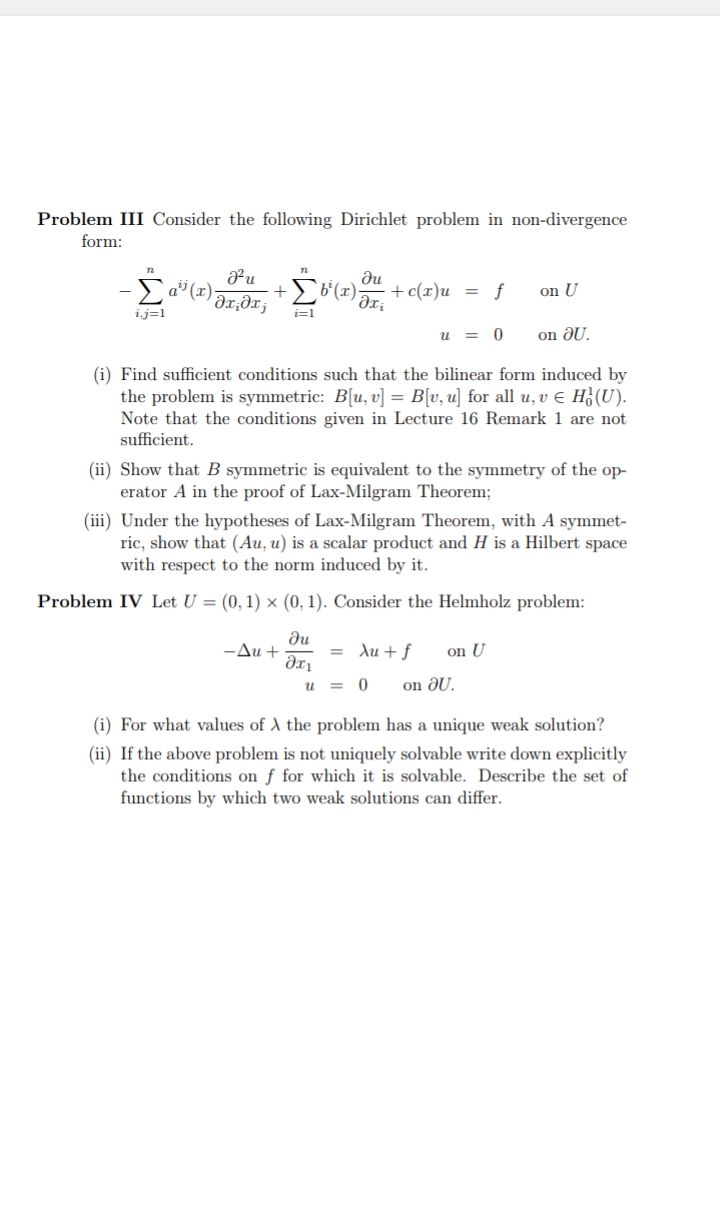
Problem III Consider the following Dirichlet problem in non-divergence form: a"(I) +c(x)u = f on U 1= 1 u = 0 on OU. (i) Find sufficient conditions such that the bilinear form induced by the problem is symmetric: Blu, v] = B[v, u] for all u, v e H; (U). Note that the conditions given in Lecture 16 Remark 1 are not sufficient. (ii) Show that B symmetric is equivalent to the symmetry of the op- erator A in the proof of Lax-Milgram Theorem; (iii) Under the hypotheses of Lax-Milgram Theorem, with A symmet- ric, show that (Au, u) is a scalar product and H is a Hilbert space with respect to the norm induced by it. Problem IV Let U = (0, 1) x (0, 1). Consider the Helmholz problem: du -Aut ari = Xu+f on U u = 0 on aU. (i) For what values of A the problem has a unique weak solution? (ii) If the above problem is not uniquely solvable write down explicitly the conditions on f for which it is solvable. Describe the set of functions by which two weak solutions can differ
Step by Step Solution
There are 3 Steps involved in it

Get step-by-step solutions from verified subject matter experts
 Study Help