







Question: Problem: In a real-world application, the robot may begin in any of the grid positions ( P0,P1,P2,P3), and through the various transitions, the robot can
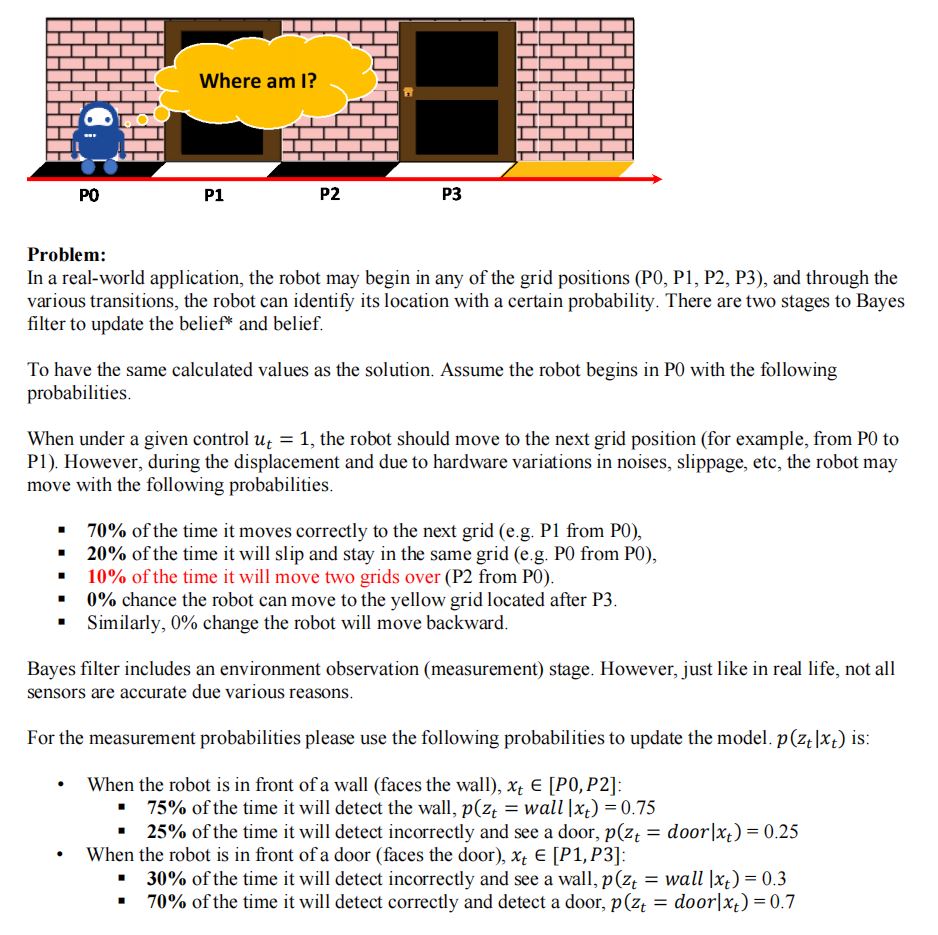
Problem: In a real-world application, the robot may begin in any of the grid positions ( P0,P1,P2,P3), and through the various transitions, the robot can identify its location with a certain probability. There are two stages to Bayes filter to update the belief* and belief. To have the same calculated values as the solution. Assume the robot begins in P0 with the following probabilities. When under a given control ut=1, the robot should move to the next grid position (for example, from P0 to P1). However, during the displacement and due to hardware variations in noises, slippage, etc, the robot may move with the following probabilities. - 70% of the time it moves correctly to the next grid (e.g. P1 from P0), - 20% of the time it will slip and stay in the same grid (e.g. P0 from P0), - 10% of the time it will move two grids over (P2 from P0). - 0% chance the robot can move to the yellow grid located after P3. - Similarly, 0% change the robot will move backward. Bayes filter includes an environment observation (measurement) stage. However, just like in real life, not all sensors are accurate due various reasons. For the measurement probabilities please use the following probabilities to update the model. p(ztxt) is: - When the robot is in front of a wall (faces the wall), xt[P0,P2] : - 75% of the time it will detect the wall, p(zt= wall xt)=0.75 - 25% of the time it will detect incorrectly and see a door, p(zt= door xt)=0.25 - When the robot is in front of a door (faces the door), xt[P1,P3] : - 30% of the time it will detect incorrectly and see a wall, p(zt= wall xt)=0.3 - 70% of the time it will detect correctly and detect a door, p(zt= door xt)=0.7
Step by Step Solution
There are 3 Steps involved in it

Get step-by-step solutions from verified subject matter experts
 Study Help