







Question: Problem One: At time t = 0, a country has a total population P(0) = 80, 000 and has U(0) = 30, 000 urban residents.
Problem One: At time t = 0, a country has a total population P(0) = 80, 000 and has U(0) = 30, 000 urban residents. Some 12 years later, at time t = 12, the respective totals are P(12) = 110, 000 and U(12) = 40, 000. Please find:
(a) The continuous rates of growth of the urban population and the total national population between t = 0 and t = 12;
(b) The pace of urbanization between t = 0 and t = 12. Be sure to explain the pace of urbanization measure that you have used in answering.
(c) If the continuous rates of growth of the national and urban populations stay fixed until time t = 15, what will be the ratio of U(15)/P(15) at that time? By stay fixed, I mean that the rates of growth that were in effect from t = 0 to t = 12 stay in effect until t = 15.
Problem Two: This problem has to do with a two-sector model of manufacturing and agricultural labor markets in equilibrium, with full employment. By "full employment", I mean that everyone in the labor force has a job, whether in manufacturing or in agriculture.
Let DM = 65 ? 4 wM be the demand for manufacturing labor, which depends on the manufacturing wage wM, and let DA = 120 ? wA be the demand for labor in agriculture, with wA being the agricultural wage. There is a total of L = 120 workers in the labor force as a whole.
Please find:
(a) The economy-wide equilibrium wage;
(b) The number of workers employed in manufacturing EM and in agriculture EA;
(c) The total wages paid to manufacturing workers and to agricultural workers (the "wage bills"); and
(d) The total value of production in manufacturing and in agriculture.
(e) Summarize by drawing a carefully-labelled graph depicting your answers to (a)-(d).
Problem Three: This problem extends Problem Two. It also has to do with a two-sector model of manufacturing and agricultural labor markets?the difference is that the economy is not in equilibrium. However, everyone in the labor force has a job, either in manufacturing or in agriculture.
Again let DM = 65 ? 4 wM be the demand for manufacturing labor, which depends on the manufacturing wage wM, and let DA = 120 ? wA be the demand for labor in agriculture, with wA being the agricultural wage. There is a total of L = 120 workers in the labor force as a whole. This is exactly the same set-up as in Problem Two.
Assume that the number of workers employed in manufacturing is fixed at EM = 9. Please find:
(a) The wage rate wM in manufacturing;
(b) The number of workers employed in agriculture EA and the agricultural wage wA;
(c) The total amounts paid to manufacturing workers and to agricultural workers (the "wage bills"); and
(d) The total value of production in manufacturing and in agriculture.
(e) Summarize by drawing a carefully-labelled graph depicting your answers to (a)-(d). (f) Finally, compare your answer to part (d) with its equilibrium counterpart in part (d) of Problem Two. What is the economy-wide loss in the value of production, relative to its value in equilibrium (as calculated in Problem Two)
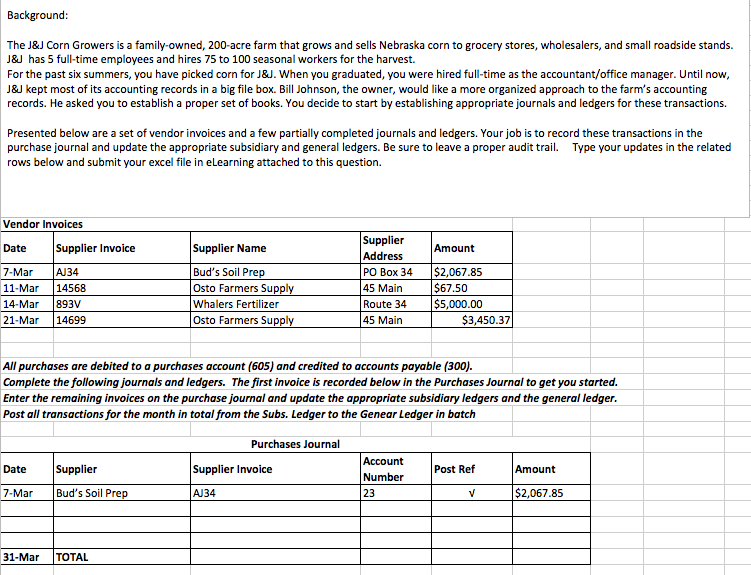
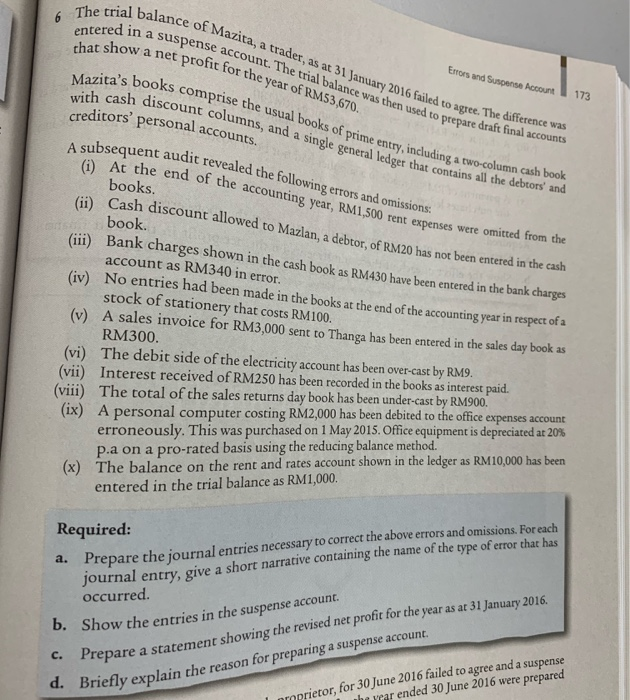
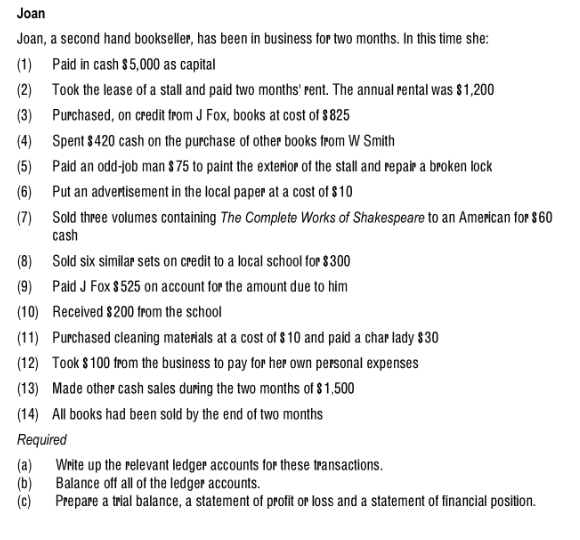
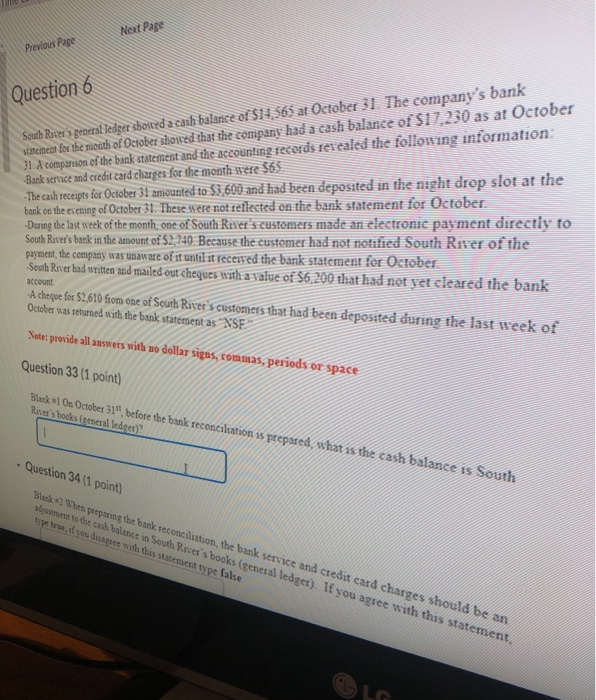
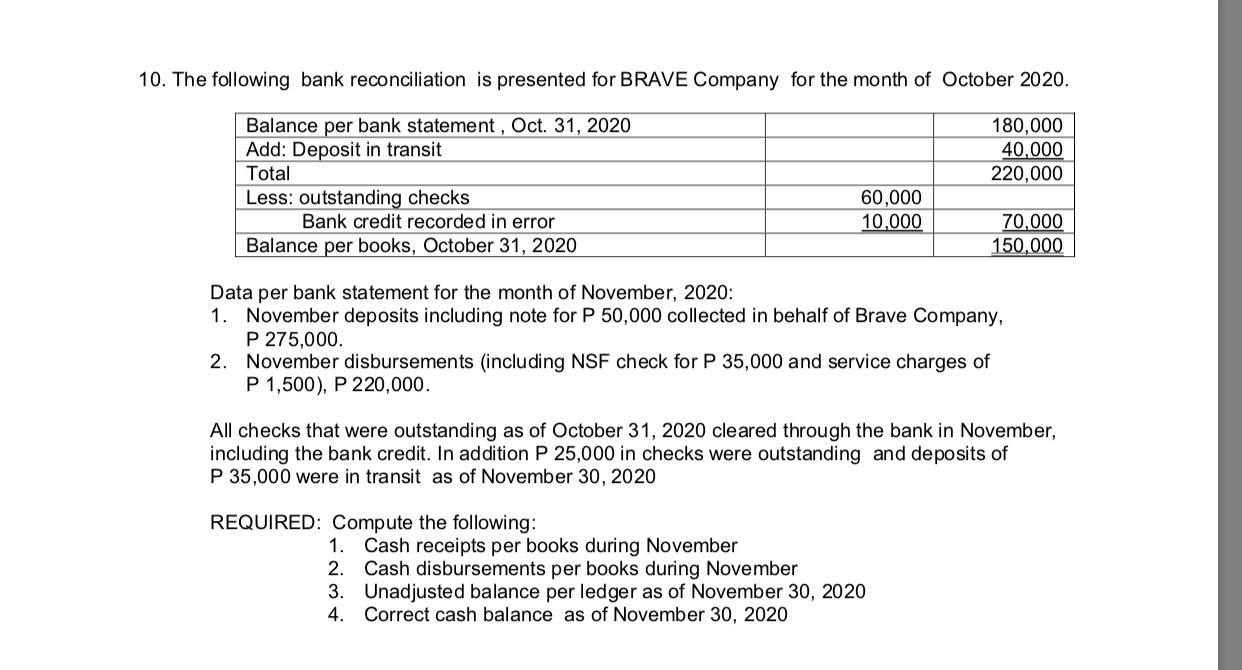
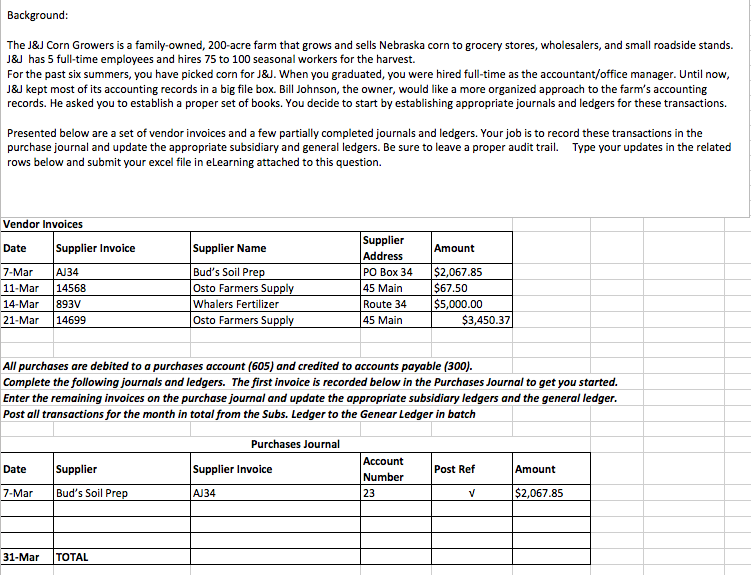
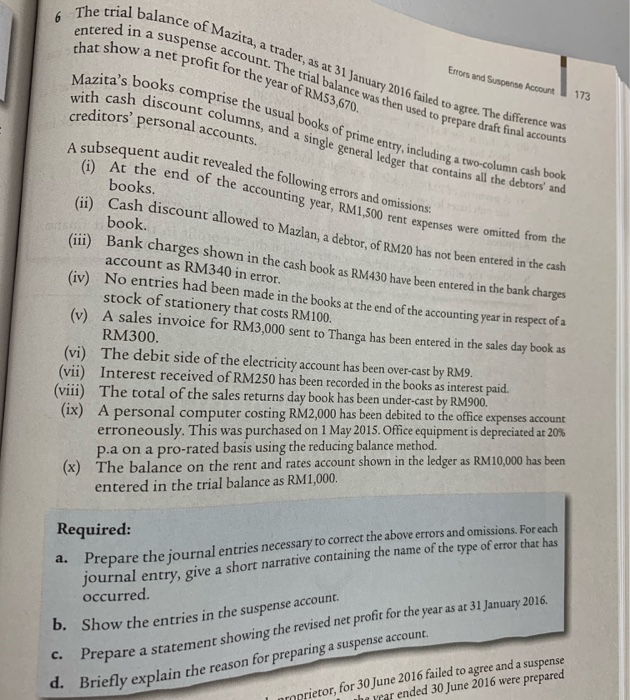
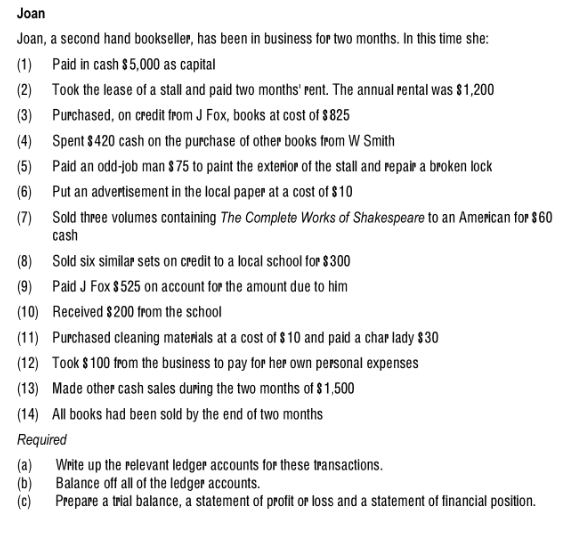
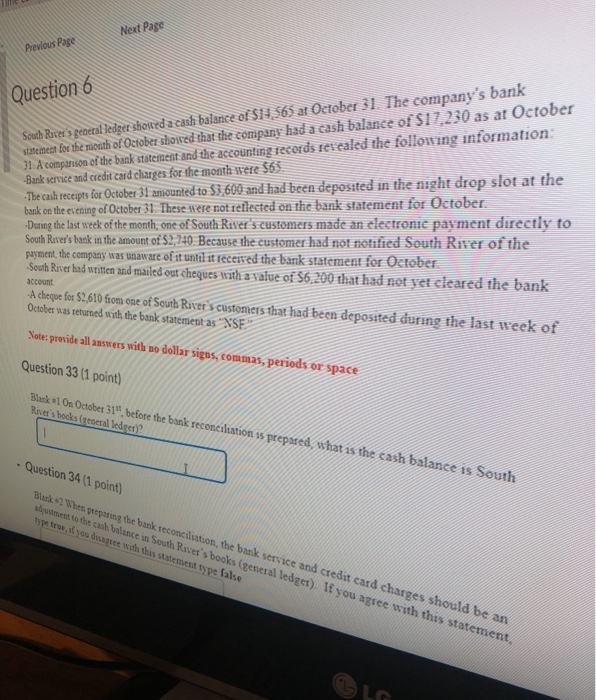
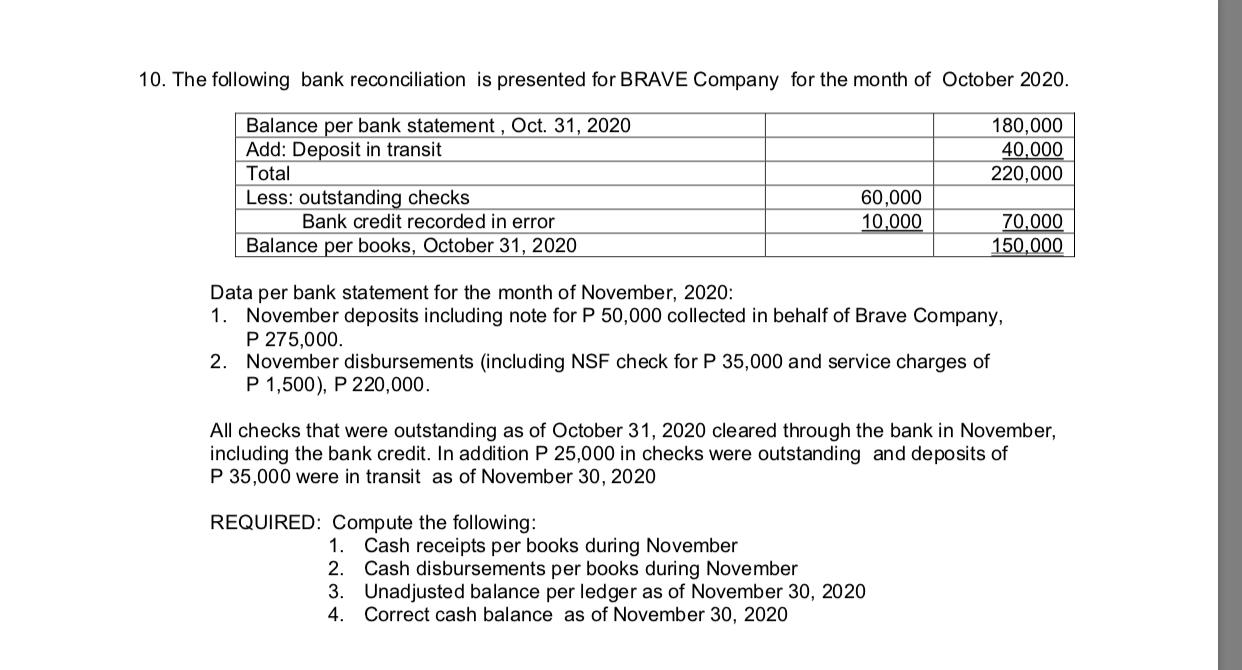
Background: The J&J Corn Growers is a family-owned, 200-acre farm that grows and sells Nebraska corn to grocery stores, wholesalers, and small roadside stands. J&J has 5 full-time employees and hires 75 to 100 seasonal workers for the harvest. For the past six summers, you have picked corn for J&J. When you graduated, you were hired full-time as the accountant/office manager. Until now, J&J kept most of its accounting records in a big file box. Bill Johnson, the owner, would like a more organized approach to the farm's accounting records. He asked you to establish a proper set of books. You decide to start by establishing appropriate journals and ledgers for these transactions. Presented below are a set of vendor invoices and a few partially completed journals and ledgers. Your job is to record these transactions in the purchase journal and update the appropriate subsidiary and general ledgers. Be sure to leave a proper audit trail. Type your updates in the related rows below and submit your excel file in elearning attached to this question. Vendor Invoices Supplier Date Supplier Invoice Supplier Name Amount Address 7-Mar AJ34 Bud's Soil Prep PO Box 34 $2,067.85 11-Mar 14568 Osto Farmers Supply 45 Main $67.50 14-Mar 893V Whalers Fertilizer Route 34 $5,000.00 21-Mar 14699 Osto Farmers Supply 45 Main $3,450.37 All purchases are debited to a purchases account (605) and credited to accounts payable (300). Complete the following journals and ledgers. The first invoice is recorded below in the Purchases Journal to get you started. Enter the remaining invoices on the purchase journal and update the appropriate subsidiary ledgers and the general ledger. Post all transactions for the month in total from the Subs. Ledger to the Genear Ledger in batch Purchases Journal Account Date Supplier Supplier Invoice Post Ref Amount Number 7-Mar Bud's Soil Prep AJ34 23 V $2,067.85 31-Mar TOTALThe trial balance of Mazita, a trader, as at 31 January 2016 failed to agree. The difference that show a net profit for the year of RM53,670. Errors and Suspense Account entered in a suspense account. The trial balance was then used to prepare draft final accounts 173 Mazita's books comprise the usual books of prime entry, including a two-column cash book creditors' personal accounts. with cash discount columns, and a single general ledger that contains all the debtors' and A subsequent audit revealed the following errors and omissions. books. (i) At the end of the accounting year, RM1,500 rent expenses were omitted from the (ii) book. Cash discount allowed to Mazlan, a debtor, of RM20 has not been entered in the cash (iii) Bank charges shown in the cash book as RM430 have been entered in the bank charges account as RM340 in error. (iv) No entries had been made in the books at the end of the accounting year in respect of a stock of stationery that costs RM100. (v) A sales invoice for RM3,000 sent to Thanga has been entered in the sales day book as RM300. (vi) The debit side of the electricity account has been over-cast by RM9. (vii) Interest received of RM250 has been recorded in the books as interest paid. (viii) The total of the sales returns day book has been under-cast by RM900. (ix) A personal computer costing RM2,000 has been debited to the office expenses account erroneously. This was purchased on 1 May 2015. Office equipment is depreciated at 20% p.a on a pro-rated basis using the reducing balance method. (x) The balance on the rent and rates account shown in the ledger as RM10,000 has been entered in the trial balance as RM1,000. Required: a. Prepare the journal entries necessary to correct the above errors and omissions. For each journal entry, give a short narrative containing the name of the type of error that has occurred. b. Show the entries in the suspense account. C. Prepare a statement showing the revised net profit for the year as at 31 January 2016. d. Briefly explain the reason for preparing a suspense account. rietor, for 30 June 2016 failed to agree and a suspense ar ended 30 June 2016 were preparedJoan Joan, a second hand bookseller, has been in business for two months. In this time she: (1) Paid in cash $5,000 as capital (2) Took the lease of a stall and paid two months' rent. The annual rental was $1,200 (3) Purchased, on credit from J Fox, books at cost of $825 (4) Spent $420 cash on the purchase of other books from W Smith (5) Paid an odd-job man $75 to paint the exterior of the stall and repair a broken lock ) Put an advertisement in the local paper at a cost of $10 (7) Sold three volumes containing The Complete Works of Shakespeare to an American for $60 cash (8) Sold six similar sets on credit to a local school for $300 (9) Paid J Fox $525 on account for the amount due to him (10) Received $200 from the school (11) Purchased cleaning materials at a cost of $ 10 and paid a char lady $30 (12) Took $ 100 from the business to pay for her own personal expenses (13) Made other cash sales during the two months of $ 1,500 (14) All books had been sold by the end of two months Required (a) Write up the relevant ledger accounts for these transactions. ( b) Balance off all of the ledger accounts. (C) Prepare a trial balance, a statement of profit or loss and a statement of financial position.Next Page Previous Page Question 6 South River's general ledger showed a cash balance of $14.565 at October 31. The company's bank statement for the month of October showed that the company had a cash balance of $17,230 as at October 31. A comparison of the bank statement and the accounting records revealed the following information: -Bank service and credit card charges for the month were $65 The cash receipts for October 31 amounted to $3,600 and had been deposited in the night drop slot at the bank on the evening of October 31. These were not reflected on the bank statement for October. -During the last week of the month, one of South Raver's customers made an electronic payment directly to South River's bank in the amount of $2,740. Because the customer had not notified South River of the payment, the company was unaware of it until it received the bank statement for October South River had written and mailed out cheques with a value of $6.200 that had not yet cleared the bank account A cheque for $2 610 from one of South River's customers that had been deposited during the last week of October was returned with the bank statement as "NSF." Note: provide all answers with no dollar signs, commas, periods or space Question 33 (1 point) River's books (general ledger)? Black #1 On October 31", before the bank reconciliation is prepared, what is the cash balance is South . Question 34 (1 point] Type true, if you disagree with this statement type false Blank #2 When preparing the bank reconciliation, the bank service and credit card charges should be an adjustment to the cash balance in South River's books (general ledger). If you agree with this statement10. The following bank reconciliation is presented for BRAVE Company for the month of October 2020. Balance per bank statement , Oct. 31, 2020 180,000 Add: Deposit in transit 40,000 Total 220,000 Less: outstanding checks 60,000 Bank credit recorded in error 10,000 70,000 Balance per books, October 31, 2020 150,000 Data per bank statement for the month of November, 2020: 1. November deposits including note for P 50,000 collected in behalf of Brave Company, P 275,000. 2. November disbursements (including NSF check for P 35,000 and service charges of P 1,500), P 220,000. All checks that were outstanding as of October 31, 2020 cleared through the bank in November, including the bank credit. In addition P 25,000 in checks were outstanding and deposits of P 35,000 were in transit as of November 30, 2020 REQUIRED: Compute the following: 1. Cash receipts per books during November 2. Cash disbursements per books during November 3. Unadjusted balance per ledger as of November 30, 2020 4. Correct cash balance as of November 30, 2020
Step by Step Solution
There are 3 Steps involved in it

Get step-by-step solutions from verified subject matter experts
 Study Help