







Question: Problem S. Microstates: A Turning Point In course notes 5, you learned the following general expression for indistinguishable particles in a grid with M spots:
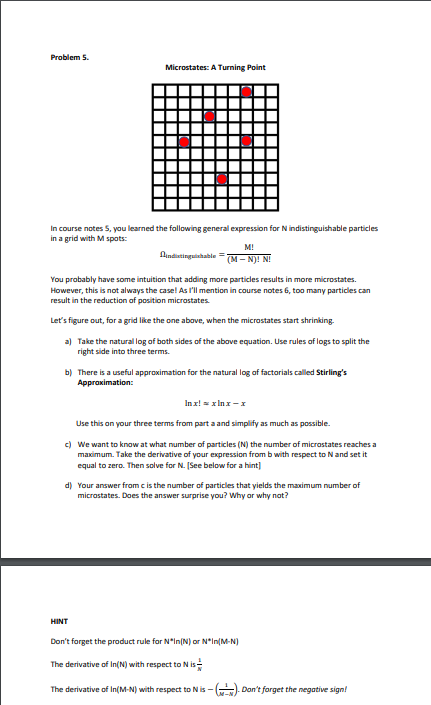
Problem S. Microstates: A Turning Point In course notes 5, you learned the following general expression for indistinguishable particles in a grid with M spots: M! indistinguishable = (M-N) N! You probably have some intuition that adding more particles results in more microstates. However, this is not always the case! As I'll mention in course notes 6, too many particles can result in the reduction of position microstates. Let's figure out for a grid like the one above, when the microstates start shrinking. a) Take the natural log of both sides of the above equation. Use rules of logs to split the right side into three terms. b) There is a useful approximation for the natural log of factorials called Stirling's Approximation: Inx! xnxx Use this on your three terms from part a and simplify as much as possible. c) We want to know at what number of particles (N) the number of microstates reaches a maximum. Take the derivative of your expression from b with respect to N and set it equal to zero. Then solve for N.See below for a hint] d) Your answer from C is the number of particles that yields the maximum number of microstates. Does the answer surprise you? Why or why not? HINT Don't forget the product rule for N'In(N) or N*InM-N) The derivative of In(N) with respect to Nis The derivative of In(M-N) with respect to Nis-...). Don't forget the negative sign! NN Problem S. Microstates: A Turning Point In course notes 5, you learned the following general expression for indistinguishable particles in a grid with M spots: M! indistinguishable = (M-N) N! You probably have some intuition that adding more particles results in more microstates. However, this is not always the case! As I'll mention in course notes 6, too many particles can result in the reduction of position microstates. Let's figure out for a grid like the one above, when the microstates start shrinking. a) Take the natural log of both sides of the above equation. Use rules of logs to split the right side into three terms. b) There is a useful approximation for the natural log of factorials called Stirling's Approximation: Inx! xnxx Use this on your three terms from part a and simplify as much as possible. c) We want to know at what number of particles (N) the number of microstates reaches a maximum. Take the derivative of your expression from b with respect to N and set it equal to zero. Then solve for N.See below for a hint] d) Your answer from C is the number of particles that yields the maximum number of microstates. Does the answer surprise you? Why or why not? HINT Don't forget the product rule for N'In(N) or N*InM-N) The derivative of In(N) with respect to Nis The derivative of In(M-N) with respect to Nis-...). Don't forget the negative sign! NN
Step by Step Solution
There are 3 Steps involved in it

Get step-by-step solutions from verified subject matter experts
 Study Help