



Question: Problem Set 3: Dirrensional Analysis (Unit Conversion) Density (d=m/V) 1. Benzene (C6H6) has a density of 0.8765g/ml. How many milliliters of benzene would correspond to
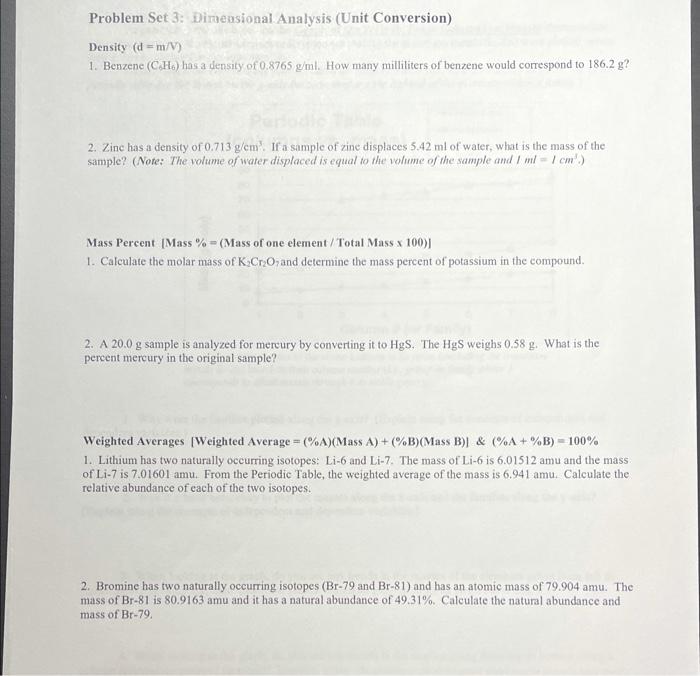
Problem Set 3: Dirrensional Analysis (Unit Conversion) Density (d=m/V) 1. Benzene (C6H6) has a density of 0.8765g/ml. How many milliliters of benzene would correspond to 186.2g ? 2. Zine has a density of 0.713g/cm3. If a sample of zine displaces 5.42ml of water, what is the mass of the sample? (Note: The volume of water displaced is equal to the volume of the sample and /ml=1cm3.) Mass Percent [Mass %= (Mass of one element/Total Mass 100) ] 1. Calculate the molar mass of K2Cr2O7 and determine the mass percent of potassium in the compound. 2. A 20.0g sample is analyzed for mercury by converting it to HgS. The HgS weighs 0.58g. What is the percent mercury in the original sample? Weighted Averages [Weighted Average =(%A)( Mass A)+(%B)( Mass B ) ] &(%A+%B)=100% 1. Lithium has two naturally oecurring isotopes: Li-6 and Li-7. The mass of Li-6 is 6.01512 amu and the mass. of Li-7 is 7.01601 amu. From the Periodic Table, the weighted average of the mass is 6.941 amu, Calculate the relative abundance of each of the two isotopes. 2. Bromine has two naturally occurring isotopes ( Br79 and Br81 ) and has an atomic mass of 79.904 amu. The mass of Br81 is 80.9163 amu and it has a natural abundance of 49.31%. Calculate the natural abundance and mass of Br-79
Step by Step Solution
There are 3 Steps involved in it

Get step-by-step solutions from verified subject matter experts