







Question: Problem Set I Consider the following game played by two firms with the following payoffs (expressed in profits): you may assume that each firm chooses
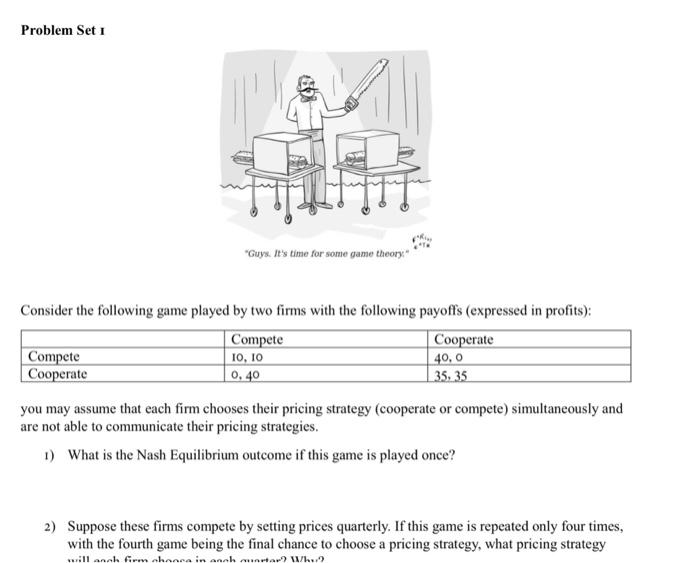
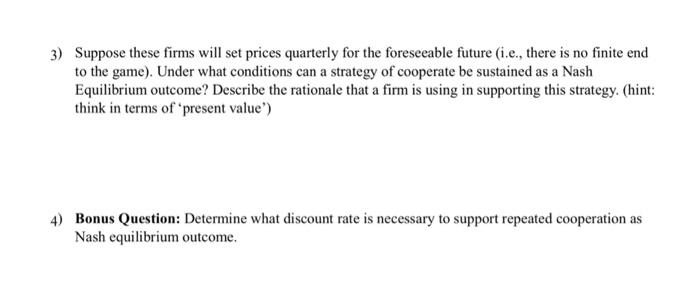
Problem Set I Consider the following game played by two firms with the following payoffs (expressed in profits): you may assume that each firm chooses their pricing strategy (cooperate or compete) simultaneously and are not able to communicate their pricing strategies. 1) What is the Nash Equilibrium outcome if this game is played once? 2) Suppose these firms compete by setting prices quarterly. If this game is repeated only four times, with the fourth game being the final chance to choose a pricing strategy, what pricing strategy 3) Suppose these firms will set prices quarterly for the foreseeable future (i.e., there is no finite end to the game). Under what conditions can a strategy of cooperate be sustained as a Nash Equilibrium outcome? Describe the rationale that a firm is using in supporting this strategy. (hint: think in terms of 'present value') 4) Bonus Question: Determine what discount rate is necessary to support repeated cooperation as Nash equilibrium outcome
Step by Step Solution
There are 3 Steps involved in it

Get step-by-step solutions from verified subject matter experts
 Study Help