







Question: PROBLEM SITUATION: Comparing Two Salary Structures 78 Graph com Schenge You have two job offers, Job 1 has an annual starting salary of $60,000
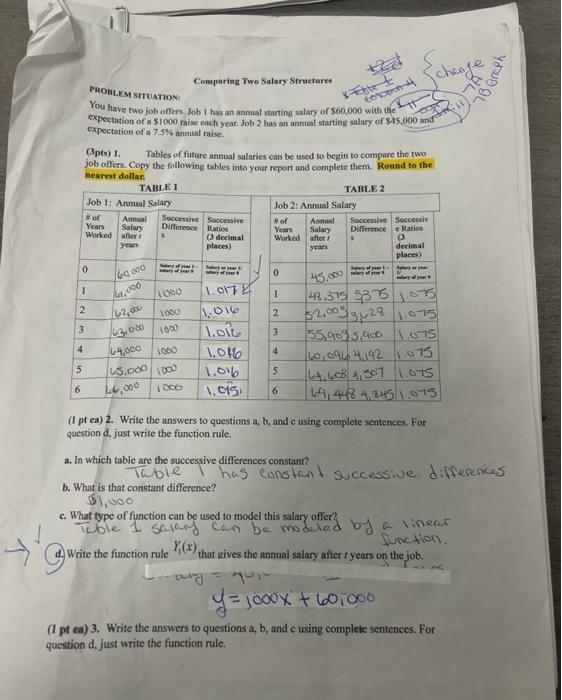
PROBLEM SITUATION: Comparing Two Salary Structures 78 Graph com Schenge You have two job offers, Job 1 has an annual starting salary of $60,000 with the expectation of a $1000 raise each year. Job 2 has an annual starting salary of $45,000 and expectation of a 7.5% annual raise. (3pts) 1. Tables of future annual salaries can be used to begin to compare the two job offers. Copy the following tables into your report and complete them. Round to the nearest dollar. TABLE 1 Job 1: Annual Salary TABLE 2 Job 2: Annual Salary Annual Successive Salary Difference Worked after years Successive- Ratios (3 decimal places) of Years Annual Salary Successive Successiv Difference e Ratios Worked after years (3 decimal places) # of Years 9L, 0 I 60,000 1,000 0 45,000 1000 1.017 1 2 62,000 1000 1.016 2 3 3,000 1000 1.01 48.375 936075 52.0033628 1.075 3 4 4,000 1000 55,9093,900 1.075 1.016 4 5 US,000 1000 60,096 4.192 1075 1.016 5 6 4,000 1000 64,084,307 1.075 1.015 6 4,448 4,345.075 (I pt ea) 2. Write the answers to questions a, b, and c using complete sentences. For question d, just write the function rule. a. In which table are the successive differences constant? Table b. What is that constant difference? $1,000 has constant successive differences e. What type of function can be used to model this salary offer? Table 1 salary can be modeled by a linear function. that gives the annual salary after r years on the job. Write the function rule Y(x), any = = 1000x +60,000 (1 pt ea) 3. Write the answers to questions a, b, and c using complete sentences. For question d, just write the function rule.
Step by Step Solution
There are 3 Steps involved in it

Get step-by-step solutions from verified subject matter experts
 Study Help