Question: PROBLEM SOLVING APPLICATION CASE (PSAC) Leadership Style and Substance at Dignity Health language that people will understand. Three, motivate and create the desire in Individuals
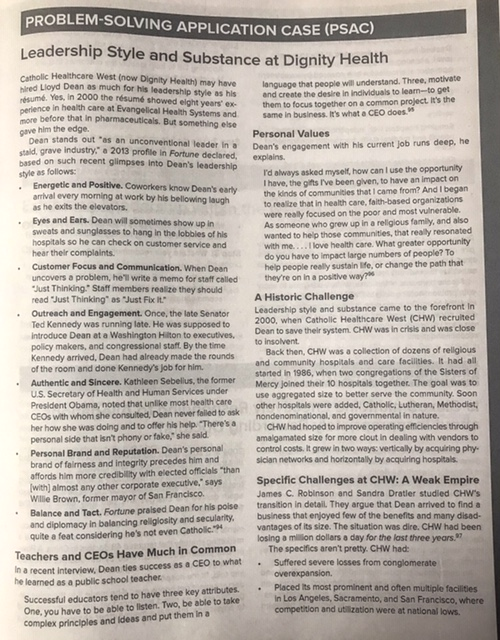
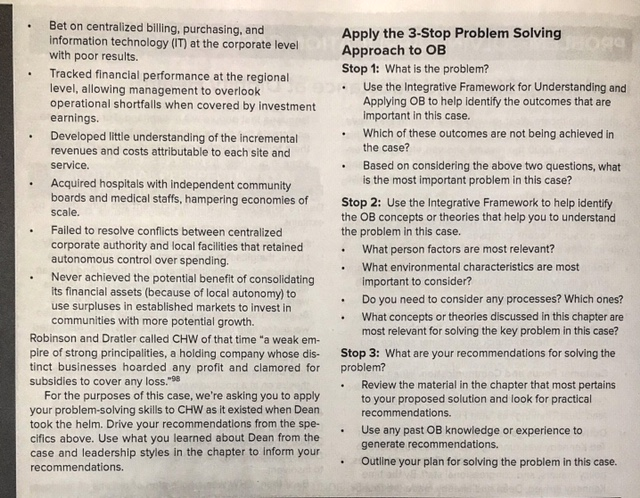
PROBLEM SOLVING APPLICATION CASE (PSAC) Leadership Style and Substance at Dignity Health language that people will understand. Three, motivate and create the desire in Individuals to leam-to get them to focus together on a common project. It's the same in business. It's what a CEO does. them to focus together Personal Values Dean's engagement with his current job runs deep, he explains. I'd always asked myself, how can I use the opportunity I have, the gifts I've been given to have an impact on the kinds of communities that I came from? And I began to realize that in health care, faith-based organizations were really focused on the poor and most vulnerable. As someone who grew up in a religious family, and also wanted to help those communities that really resonated with me.... I love health care. What greater opportunity do you have to Impact large numbers of people? TO help people really sustain life, or change the path that they're on in a positive way? Catholic Healthcare West (now Dignity Health may have Lloyd Dean as much for his leadership style as his Yes. In 2000 the resume showed eight years' ex- ence in health care at Evangelical Health Systems and one before that in pharmaceuticals. But something else give him the edge. Dean stands out as an unconventional leader in grave industry." a 2013 profile in Fortune declared sed on such recent glimpses Into Dean's leadership style as follows: Energetic and Positive. Coworkers know Dean's early arrival every morning at work by his bellowing laugh as he exits the elevators. Eyes and Ears. Dean will sometimes show up in sweats and sunglasses to hang in the lobbles of his hospitals so he can check on customer service and hear their complaints. Customer Focus and Communication. When Dean uncovers a problem, he'll write a memo for staff called Just Thinking." Staff members realize they should read Just Thinking as "Just Fix it." Outreach and Engagement. Once, the late Senator Ted Kennedy was running late. He was supposed to Introduce Dean at a Washington Hilton to executives, policy makers, and congressional staff. By the time Kennedy arrived, Dean had already made the rounds of the room and done Kennedy's job for him. Authentic and Sincere. Kathleen Sebellus, the former U.S. Secretary of Health and Human Services under President Obama, noted that unlike most health care CEOs with whom she consulted, Dean never failed to ask her how she was doing and to offer his help. "There's a personal side that isn't phony or fake," she said. Personal Brand and Reputation. Dean's personal brand of fairness and integrity precedes him and affords him more credibility with elected officials than with almost any other corporate executive," says Willie Brown, former mayor of San Francisco Balance and Tact. Fortune praised Dean for his poise and diplomacy in balancing religiosity and secularity quite a feat considering he's not even Catholic. A Historic Challenge Leadership style and substance came to the forefront In 2000, when Catholic Healthcare West (CHW) recruited Dean to save their system. CHW was in crisis and was close to insolvent Back then, CHW was a collection of dozens of religious and community hospitals and care facilities. It had all started in 1986, when two congregations of the Sisters of Mercy joined their 10 hospitals together. The goal was to use aggregated size to better serve the community. Soon other hospitals were added, Catholic, Lutheran, Methodist, nondenominational, and governmental in nature. CHW had hoped to improve operating efficiencies through amalgamated size for more clout in dealing with vendors to control costs. It grow in two ways: vertically by acquiring phy. sician networks and horizontally by acquiring hospitals Specific Challenges at CHW: A Weak Empire James C. Robinson and Sandra Dratier studied CHW's transition in detail. They argue that Dean arrived to find a business that enjoyed few of the benefits and many did vantages of its size. The situation was dire. CHW had been losing a milion dollars a day for the last three years. The specifics aren't pretty. CHW had: Suffered severe losses from conglomerate overexpansion Placed its most prominent and often multiple facilities In Los Angeles, Sacramento, and San Francisco, where competition and utilization were at national lows. Teachers and CEOs Have Much in Common In a recent interview, Dean ties success as a CEO to what he learned as a public school teacher Successful educators tend to have three key attributes. One, you have to be able to listen. Two, be able to take complex principles and ideas and put them in a Bet on centralized billing, purchasing, and information technology (IT) at the corporate level with poor results. Tracked financial performance at the regional level, allowing management to overlook operational shortfalls when covered by investment earnings. Developed little understanding of the incremental revenues and costs attributable to each site and service. Acquired hospitals with independent community boards and medical staffs, hampering economies of scale. Failed to resolve conflicts between centralized corporate authority and local facilities that retained autonomous control over spending. Never achieved the potential benefit of consolidating its financial assets (because of local autonomy) to use surpluses in established markets to invest in communities with more potential growth. Robinson and Dratler called CHW of that time "a weak em- pire of strong principalities, a holding company whose dis- tinct businesses hoarded any profit and clamored for subsidies to cover any loss.98 For the purposes of this case, we're asking you to apply your problem-solving skills to CHW as it existed when Dean took the helm. Drive your recommendations from the spe- cifics above. Use what you learned about Dean from the case and leadership styles in the chapter to inform your recommendations. Apply the 3-Stop Problem Solving Approach to OB Stop 1: What is the problem? Use the Integrative Framework for Understanding and Applying OB to help identify the outcomes that are important in this case. Which of these outcomes are not being achieved in the case? Based on considering the above two questions, what is the most important problem in this case? Stop 2: Use the Integrative Framework to help identify the OB concepts or theories that help you to understand the problem in this case. What person factors are most relevant? What environmental characteristics are most Important to consider? Do you need to consider any processes? Which ones? What concepts or theories discussed in this chapter are most relevant for solving the key problem in this case? Stop 3: What are your recommendations for solving the problem? Review the material in the chapter that most pertains to your proposed solution and look for practical recommendations. Use any past OB knowledge or experience to generate recommendations. Outline your plan for solving the problem in this case









 Study Help