







Question: Problem Solving Project Two A change machine is broken. If you put in a penny, it spits out a coin at random: either a penny,
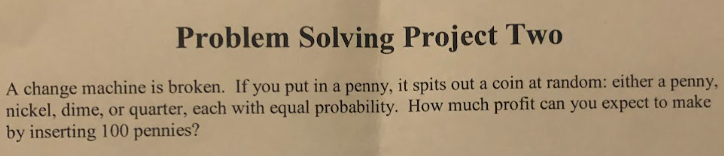
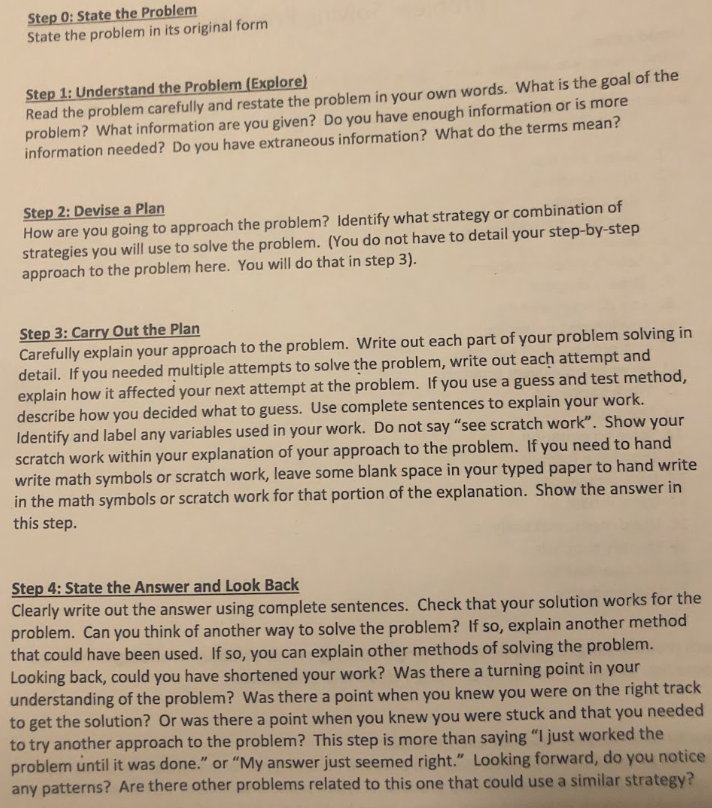
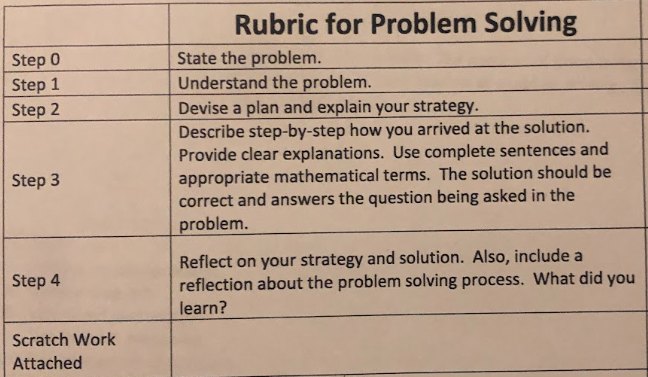
Problem Solving Project Two A change machine is broken. If you put in a penny, it spits out a coin at random: either a penny, nickel, dime, or quarter, each with equal probability. How much profit can you expect to make by inserting 100 pennies?Step 0: State the Problem State the problem in its original form Step 1: Understand the Problem (Explore) Read the problem carefully and restate the problem in your own words. What is the goal of the problem? What information are you given? Do you have enough information or is more information needed? Do you have extraneous information? What do the terms mean? Step 2: Devise a Plan How are you going to approach the problem? Identify what strategy or combination of strategies you will use to solve the problem. (You do not have to detail your step-by-step approach to the problem here. You will do that in step 3). Step 3: Carry Out the Plan Carefully explain your approach to the problem. Write out each part of your problem solving in detail. If you needed multiple attempts to solve the problem, write out each attempt and explain how it affected your next attempt at the problem. If you use a guess and test method, describe how you decided what to guess. Use complete sentences to explain your work. Identify and label any variables used in your work. Do not say "see scratch work". Show your scratch work within your explanation of your approach to the problem. If you need to hand write math symbols or scratch work, leave some blank space in your typed paper to hand write in the math symbols or scratch work for that portion of the explanation. Show the answer in this step. Step 4: State the Answer and Look Back Clearly write out the answer using complete sentences. Check that your solution works for the problem. Can you think of another way to solve the problem? If so, explain another method that could have been used. If so, you can explain other methods of solving the problem. Looking back, could you have shortened your work? Was there a turning point in your understanding of the problem? Was there a point when you knew you were on the right track to get the solution? Or was there a point when you knew you were stuck and that you needed to try another approach to the problem? This step is more than saying "I just worked the problem until it was done." or "My answer just seemed right." Looking forward, do you notice any patterns? Are there other problems related to this one that could use a similar strategy?Rubric for Problem Solving Step 0 State the problem. Step 1 Understand the problem. Step 2 Devise a plan and explain your strategy. Describe step-by-step how you arrived at the solution. Provide clear explanations. Use complete sentences and Step 3 appropriate mathematical terms. The solution should be correct and answers the question being asked in the problem. Reflect on your strategy and solution. Also, include a Step 4 reflection about the problem solving process. What did you learn? Scratch Work Attached
Step by Step Solution
There are 3 Steps involved in it

Get step-by-step solutions from verified subject matter experts
 Study Help