







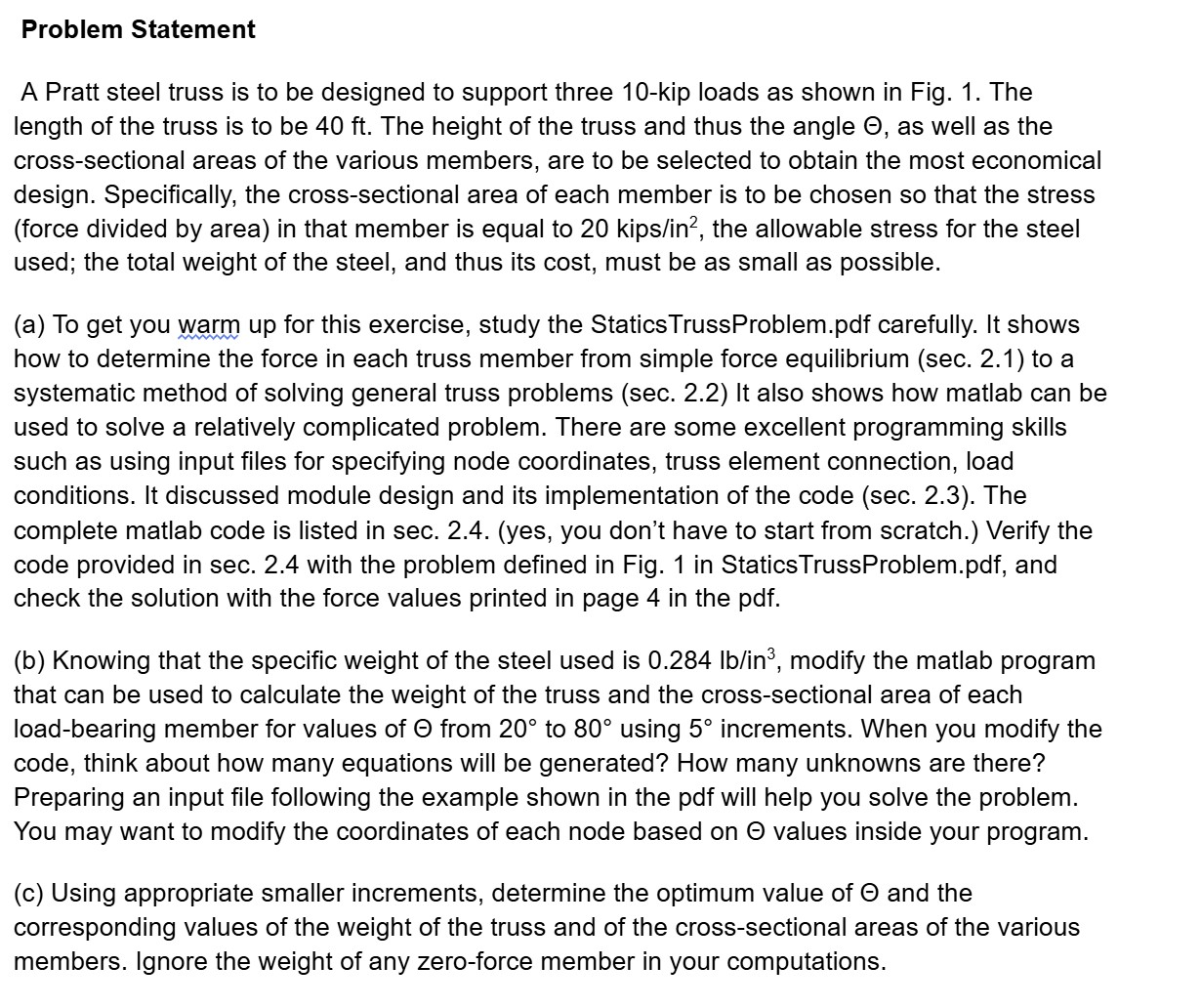
Question: Problem Statement A Pratt steel truss is to be designed to support three 1 0 - kip loads as shown in Fig. 1 . The
Problem Statement
A Pratt steel truss is to be designed to support three kip loads as shown in Fig. The length of the truss is to be ft The height of the truss and thus the angle Theta as well as the crosssectional areas of the various members, are to be selected to obtain the most economical design. Specifically, the crosssectional area of each member is to be chosen so that the stress force divided by area in that member is equal to mathrmkipsmathrmin the allowable stress for the steel used; the total weight of the steel, and thus its cost, must be as small as possible.
a To get you warm up for this exercise, study the StaticsTrussProblem.pdf carefully. It shows how to determine the force in each truss member from simple force equilibrium sec to a systematic method of solving general truss problems sec It also shows how matlab can be used to solve a relatively complicated problem. There are some excellent programming skills such as using input files for specifying node coordinates, truss element connection, load conditions. It discussed module design and its implementation of the code sec The complete matlab code is listed in secyes you don't have to start from scratch. Verify the code provided in sec with the problem defined in Fig. in StaticsTrussProblem.pdf and check the solution with the force values printed in page in the pdf
b Knowing that the specific weight of the steel used is mathrmlbmathrmin modify the matlab program that can be used to calculate the weight of the truss and the crosssectional area of each loadbearing member for values of Theta from circ to circ using circ increments. When you modify the code, think about how many equations will be generated? How many unknowns are there? Preparing an input file following the example shown in the pdf will help you solve the problem. You may want to modify the coordinates of each node based on Theta values inside your program.
c Using appropriate smaller increments, determine the optimum value of Theta and the corresponding values of the weight of the truss and of the crosssectional areas of the various members. Ignore the weight of any zeroforce member in your computations.
The complete Matlab program for computing the forces in trusses is shown
below.
Step by Step Solution
There are 3 Steps involved in it
1 Expert Approved Answer
Step: 1 Unlock

Question Has Been Solved by an Expert!
Get step-by-step solutions from verified subject matter experts
Step: 2 Unlock
Step: 3 Unlock
 Study Help