







Question: Problem Statement: Rolling Disk with Dissipation A homogeneous circular disk of mass M, radius R, and moment of inertia I = MR rolls without
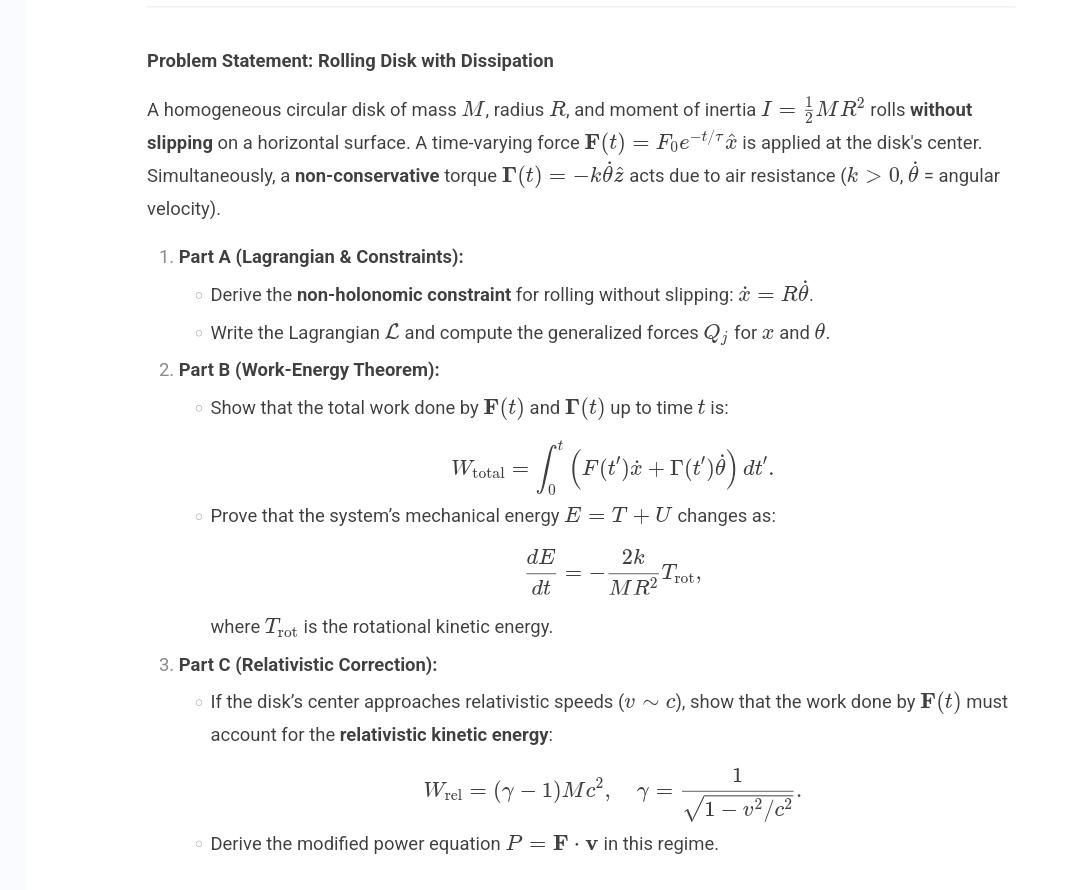
Problem Statement: Rolling Disk with Dissipation A homogeneous circular disk of mass M, radius R, and moment of inertia I = MR rolls without slipping on a horizontal surface. A time-varying force F(t) = Foet/ is applied at the disk's center. Simultaneously, a non-conservative torque I(t) = -k acts due to air resistance (k > 0, 0 = angular velocity). 1. Part A (Lagrangian & Constraints): o Derive the non-holonomic constraint for rolling without slipping: * = R. Write the Lagrangian and compute the generalized forces Q; for x and 0. 2. Part B (Work-Energy Theorem): Show that the total work done by F(t) and I(t) up to time t is: dt'. Wtotal = = & T S (F(t) 2 + (t')) at. Prove that the system's mechanical energy E = T + U changes as: dE 2k dt MR Trot where Trot is the rotational kinetic energy. 3. Part C (Relativistic Correction): If the disk's center approaches relativistic speeds (v account for the relativistic kinetic energy: c), show that the work done by F(t) must Wrel (y-1)Mc, y= = Derive the modified power equation PF v in this regime. 1
Step by Step Solution
There are 3 Steps involved in it

Get step-by-step solutions from verified subject matter experts
 Study Help