







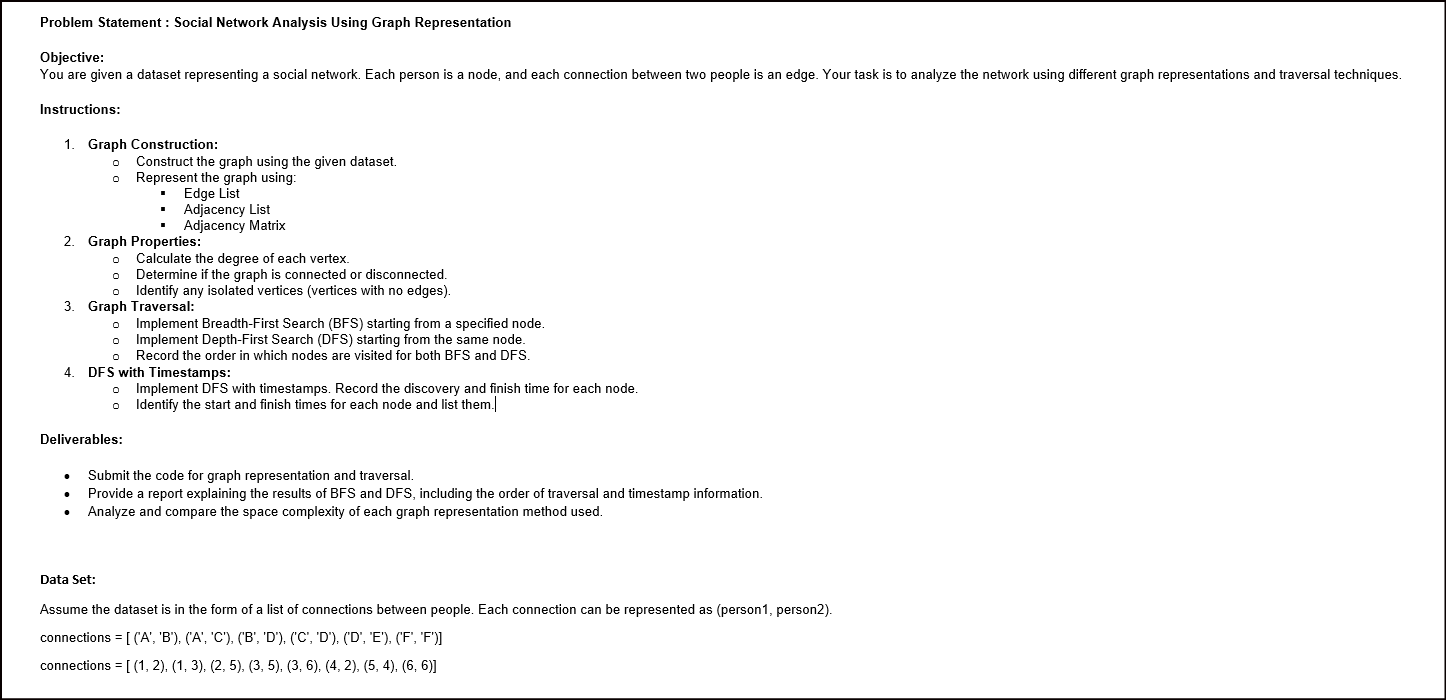
Question: Problem Statement : Social Network Analysis Using Graph Representation Problem Statement : Social Network Analysis Using Graph Representation Objective: Instructions: Graph Construction: Construct the graph
Problem Statement : Social Network Analysis Using Graph Representation Problem Statement : Social Network Analysis Using Graph Representation
Objective:
Instructions:
Graph Construction:
Construct the graph using the given dataset.
Represent the graph using:
Edge List
Adjacency List
Adjacency Matrix
Graph Properties:
Calculate the degree of each vertex.
Determine if the graph is connected or disconnected.
Identify any isolated vertices vertices with no edges
Graph Traversal:
Implement BreadthFirst Search BFS starting from a specified node.
Implement DepthFirst Search DFS starting from the same node.
Record the order in which nodes are visited for both BFS and DFS
DFS with Timestamps:
Implement DFS with timestamps. Record the discovery and finish time for each node.
Identify the start and finish times for each node and list them.
Deliverables:
Submit the code for graph representation and traversal.
Provide a report explaining the results of BFS and DFS including the order of traversal and timestamp information.
Analyze and compare the space complexity of each graph representation method used.
Data Set:
Assume the dataset is in the form of a list of connections between people. Each connection can be represented as person person
Objective:
You are given a dataset representing a social network. Each person is a node, and each connection between two people is an edge. Your task is to analyze the network using different graph representations and traversal techniques.
Instructions:
Graph Construction:
o Construct the graph using the given dataset.
o Represent the graph using:
Edge List
Adjacency List
Adjacency Matrix
Graph Properties:
o Calculate the degree of each vertex.
o Determine if the graph is connected or disconnected.
o Identify any isolated vertices vertices with no edges
Graph Traversal:
o Implement BreadthFirst Search BFS starting from a specified node.
o Implement DepthFirst Search DFS starting from the same node.
o Record the order in which nodes are visited for both BFS and DFS
DFS with Timestamps:
o Implement DFS with timestamps. Record the discovery and finish time for each node.
o Identify the start and finish times for each node and list them.
Deliverables:
Submit the code for graph representation and traversal.
Provide a report explaining the results of BFS and DFS including the order of traversal and timestamp information.
Analyze and compare the space complexity of each graph representation method used.
Data Set:
Assume the dataset is in the form of a list of connections between people. Each connection can be represented as person person
connections ABACBDCDDEFF
connections
Step by Step Solution
There are 3 Steps involved in it
1 Expert Approved Answer
Step: 1 Unlock

Question Has Been Solved by an Expert!
Get step-by-step solutions from verified subject matter experts
Step: 2 Unlock
Step: 3 Unlock
 Study Help