



Question: Problem The elementary, irreversible, organic liquid-phase reaction A+BC is carried out adiabatically in a flow reactor. An equal molar feed in A and B enters
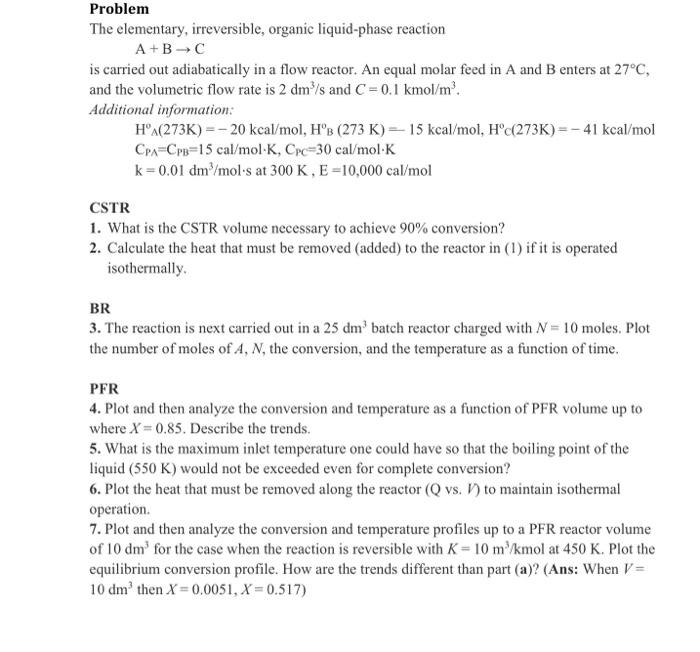
Problem The elementary, irreversible, organic liquid-phase reaction A+BC is carried out adiabatically in a flow reactor. An equal molar feed in A and B enters at 27C, and the volumetric flow rate is 2dm3/s and C=0.1kmol/m3. Additional information: HA(273K)=20kcal/mol,HB(273K)=15kcal/mol,HC(273K)=41kcal/mol CPA=CPB=15cal/molK,CPC=30cal/molK k=0.01dm3/mols at 300K,E=10,000cal/mol CSTR 1. What is the CSTR volume necessary to achieve 90% conversion? 2. Calculate the heat that must be removed (added) to the reactor in (1) if it is operated isothermally. BR 3. The reaction is next carried out in a 25dm3 batch reactor charged with N=10 moles. Plot the number of moles of A,N, the conversion, and the temperature as a function of time. PFR 4. Plot and then analyze the conversion and temperature as a function of PFR volume up to where X=0.85. Describe the trends. 5. What is the maximum inlet temperature one could have so that the boiling point of the liquid ( 550K ) would not be exceeded even for complete conversion? 6. Plot the heat that must be removed along the reactor ( Q vs. V ) to maintain isothermal operation. 7. Plot and then analyze the conversion and temperature profiles up to a PFR reactor volume of 10dm3 for the case when the reaction is reversible with K=10m3/kmol at 450K. Plot the equilibrium conversion profile. How are the trends different than part (a)? (Ans: When V= 10dm3 then X=0.0051,X=0.517 )
Step by Step Solution
There are 3 Steps involved in it

Get step-by-step solutions from verified subject matter experts