







Question: The time-dependent displacement r(t), and velocity i(t), of a particle's motion is described by the equation x + 2i = 3ri. (a) Find any
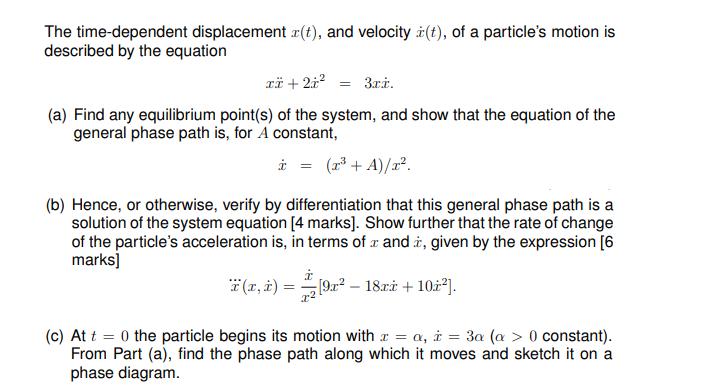
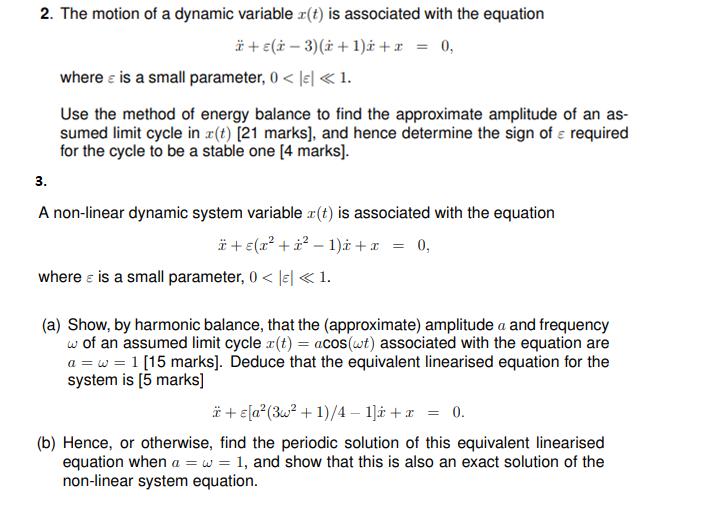
The time-dependent displacement r(t), and velocity i(t), of a particle's motion is described by the equation x + 2i = 3ri. (a) Find any equilibrium point(s) of the system, and show that the equation of the general phase path is, for A constant, = (x + A)/x. (b) Hence, or otherwise, verify by differentiation that this general phase path is a solution of the system equation [4 marks]. Show further that the rate of change of the particle's acceleration is, in terms of a and i, given by the expression [6 marks] i 7(x, i)=[9x 18xi +10i]. = (c) At t=0 the particle begins its motion with z = a, i 3a (a> 0 constant). From Part (a), find the phase path along which it moves and sketch it on a phase diagram. 2. The motion of a dynamic variable r(t) is associated with the equation +(-3) (x + 1) + x = 0, where is a small parameter, 0 < le| < 1. Use the method of energy balance to find the approximate amplitude of an as- sumed limit cycle in z(t) [21 marks], and hence determine the sign of required for the cycle to be a stable one [4 marks]. 3. A non-linear dynamic system variable r(t) is associated with the equation *+ (x+-1) + x where is a small parameter, 0 < | < < 1. = 0, (a) Show, by harmonic balance, that the (approximate) amplitude a and frequency w of an assumed limit cycle (t) = acos(wt) associated with the equation are a = w = 1 [15 marks]. Deduce that the equivalent linearised equation for the system is [5 marks] *+ [a (3w+1)/4 - 1] + x = 0. (b) Hence, or otherwise, find the periodic solution of this equivalent linearised equation when a = w = 1, and show that this is also an exact solution of the non-linear system equation.
Step by Step Solution
3.41 Rating (157 Votes )
There are 3 Steps involved in it
a An equilibrium point is defined as a point where the veloci... View full answer

Get step-by-step solutions from verified subject matter experts
 Study Help