







Question: Question 1 (1 point] An object performing simple harmonic motion has an equation for the displacement from equilibrium xlt) = (0.48 m} cos (153t +
![Question 1 (1 point] An object performing simple harmonic motion has](https://dsd5zvtm8ll6.cloudfront.net/si.experts.images/questions/2024/09/66f6fcfe691f5_65466f6fcfe1f470.jpg)
![(1 point] An object performing simple harmonic motion has an equation for](https://dsd5zvtm8ll6.cloudfront.net/si.experts.images/questions/2024/09/66f6fd004c03c_65666f6fd001b7a1.jpg)
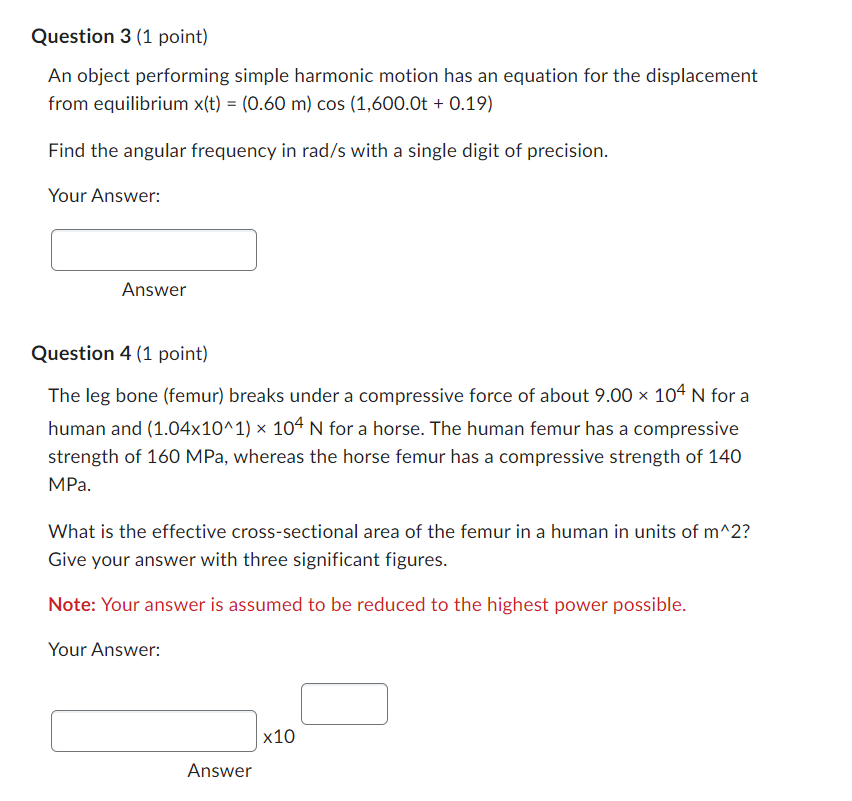
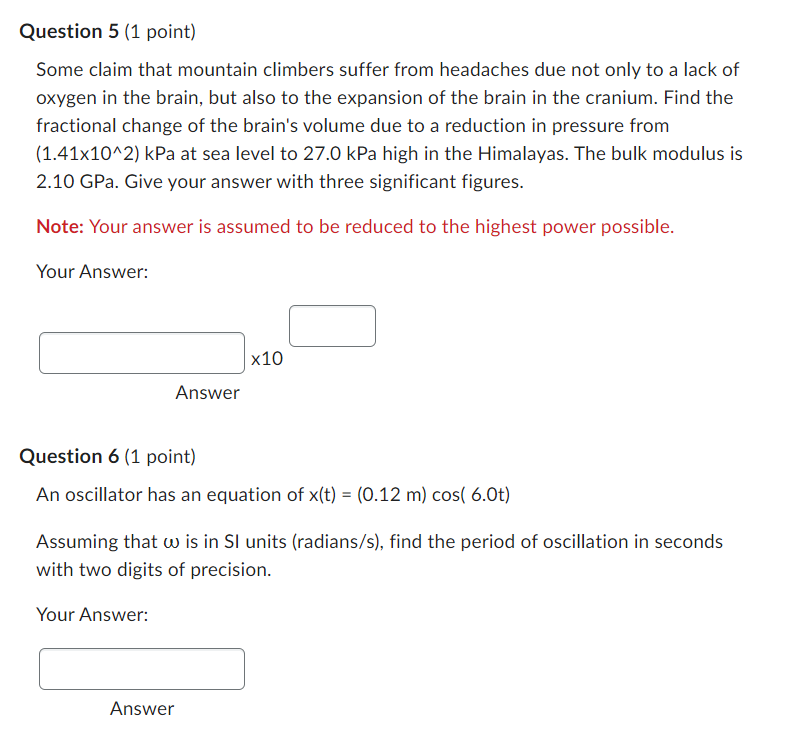
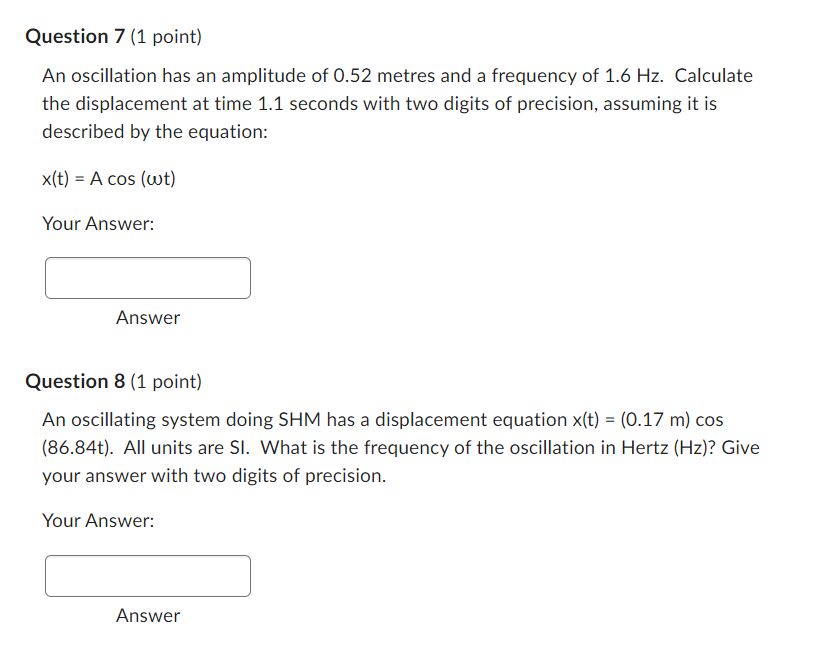
Question 1 (1 point] An object performing simple harmonic motion has an equation for the displacement from equilibrium xlt) = (0.48 m} cos (153t + 0.22} What is the amplitude of Vibration? Calculate your answer in metres with two digits of precision. Your Answer: Answer Question 2 (1 point] An object performing simple harmonic motion has an equation for the displacement from equilibrium xlt) = (0.28 cm} cos (80.9t + 0.28). Calculate the displacement at t = 3.0 5, giving your answer in cm with two digits of precision. Your Answer: Answer Question 3 {1 point) An object performing simple harmonic motion has an equation for the displacement from equilibrium xlti = (0.60 m) cos (1,600.0t + 0.19) Find the angular frequencv in rad/s with a single digit of precision. Your Answer: Answer Question 4 {1 point) The leg bone (femur) breaks under a compressive force of about 9.00 x 10'4 N for a human and (1.04x10A1i x 104 N fora horse. The human femur has a compressive strength of 160 MPa. whereas the horse femur has a compressive strength of 140 MPa. What is the effective cross-sectional area of the femur in a human in units of mn2? Give your answer with three significant figures. Note: Your answer is assumed to be reduced to the highest power possible. Your Answer: Answer Question 5 {1 point) Some claim that mountain climbers suffer from headaches due not only to a lack of oxygen in the brain, but also to the expansion of the brain in the cranium. Find the fractional change of the brain's volume due to a reduction in pressure from {1.41x10h2) kPa at sea level to 27.0 kPa high in the Himalayas. The bulk modulus is 2.10 GPa. Give your answer with three significant figures. Note: Your answer is assumed to be reduced to the highest power possible. Your Answer: Answer Question 6 {1 point) An oscillator has an equation of Kit) = (0.12 m} cosi 6.0tl Assuming that cu is in SI units iradiansfs), find the period of oscillation in seconds with two digits of precision. Your Answer: Answer Question 7 (1 point) An oscillation has an amplitude of 0.52 metres and a frequency of 1.6 Hz. Calculate the displacement at time 1.1 seconds with two digits of precision, assuming it is described by the equation: x(t) = A cos (wt) Your Answer: Answer Question 8 (1 point) An oscillating system doing SHM has a displacement equation x(t) = (0.17 m) cos (86.84t). All units are SI. What is the frequency of the oscillation in Hertz (Hz)? Give your answer with two digits of precision. Your Answer: AnswerQuestion 9 {1 point) A mass of 141 g is hanging underneath a spring which has a spring constant of 41.8 Him. The spring is displaced from the equilibrium position by 3.4 cm and released. What is the period of vibration? Give vour answer in seconds with two digits of precision. Your Answer: Answer Question 10 {1 point) A marble column with a crosssectional area of{2.15lCiI'LiUM1U\"1icm2 supports a load of {7.50x10A4) N. The marble has a Young's modulus of 60 GPa and a compressive strength of 200 MPa. What is the stress in the column to three significant figures? Note: Your answer is assumed to be reduced to the highest power possible. Your
Step by Step Solution
There are 3 Steps involved in it

Get step-by-step solutions from verified subject matter experts
 Study Help