







Question: Problem Three. (25 Points) We will consider a dilute gas of CO molecules at thermal equilibrium. Use the rigid rotor model to describe rotations and
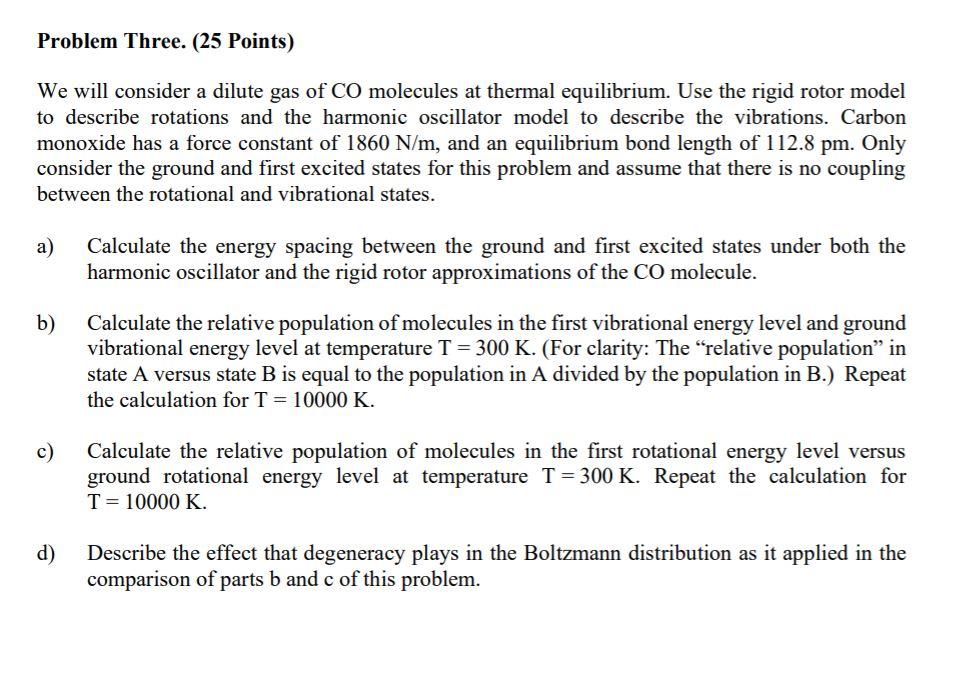
Problem Three. (25 Points) We will consider a dilute gas of CO molecules at thermal equilibrium. Use the rigid rotor model to describe rotations and the harmonic oscillator model to describe the vibrations. Carbon monoxide has a force constant of 1860 N/m, and an equilibrium bond length of 112.8 pm. Only consider the ground and first excited states for this problem and assume that there is no coupling between the rotational and vibrational states. a) Calculate the energy spacing between the ground and first excited states under both the harmonic oscillator and the rigid rotor approximations of the CO molecule. b) Calculate the relative population of molecules in the first vibrational energy level and ground vibrational energy level at temperature T = 300 K. (For clarity: The "relative population" in state A versus state B is equal to the population in A divided by the population in B.) Repeat the calculation for T = 10000 K. c) Calculate the relative population of molecules in the first rotational energy level versus ground rotational energy level at temperature T = 300 K. Repeat the calculation for T= 10000 K. d) Describe the effect that degeneracy plays in the Boltzmann distribution as it applied in the comparison of parts b and c of this problem. Problem Three. (25 Points) We will consider a dilute gas of CO molecules at thermal equilibrium. Use the rigid rotor model to describe rotations and the harmonic oscillator model to describe the vibrations. Carbon monoxide has a force constant of 1860 N/m, and an equilibrium bond length of 112.8 pm. Only consider the ground and first excited states for this problem and assume that there is no coupling between the rotational and vibrational states. a) Calculate the energy spacing between the ground and first excited states under both the harmonic oscillator and the rigid rotor approximations of the CO molecule. b) Calculate the relative population of molecules in the first vibrational energy level and ground vibrational energy level at temperature T = 300 K. (For clarity: The "relative population" in state A versus state B is equal to the population in A divided by the population in B.) Repeat the calculation for T = 10000 K. c) Calculate the relative population of molecules in the first rotational energy level versus ground rotational energy level at temperature T = 300 K. Repeat the calculation for T= 10000 K. d) Describe the effect that degeneracy plays in the Boltzmann distribution as it applied in the comparison of parts b and c of this
Step by Step Solution
There are 3 Steps involved in it

Get step-by-step solutions from verified subject matter experts
 Study Help