







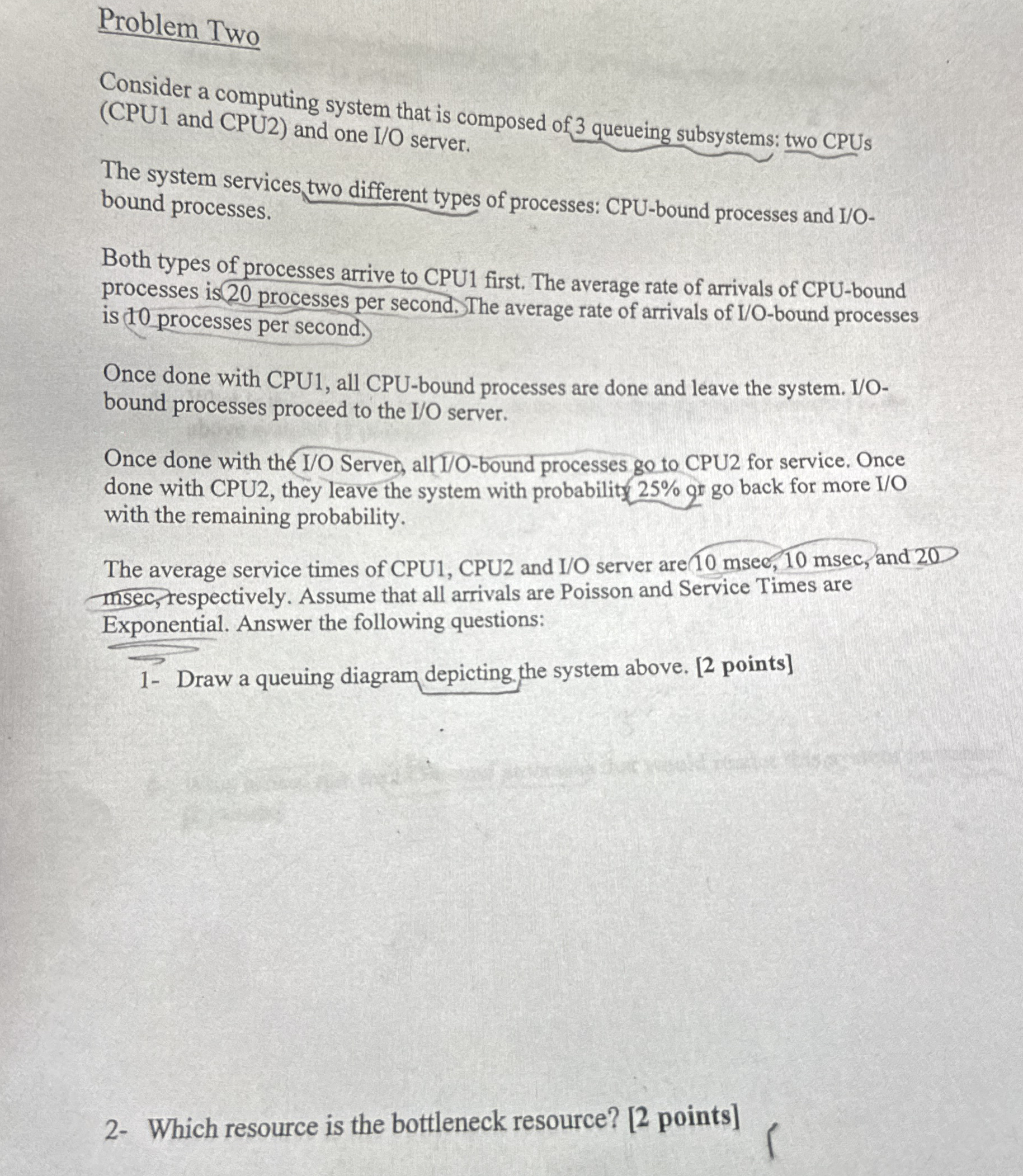
Question: Problem Two Consider a computing system that is composed of 3 queueing subsystems: two CPUs ( CPU 1 and CPU 2 ) and one I
Problem Two
Consider a computing system that is composed of queueing subsystems: two CPUs CPU and CPU and one IO server.
The system services two different types of processes: CPUbound processes and IObound processes.
Both types of processes arrive to CPU first. The average rate of arrivals of CPUbound processes is processes per second. The average rate of arrivals of bound processes is processes per second.
Once done with CPU all CPUbound processes are done and leave the system. IObound processes proceed to the IO server.
Once done with the IO Server, allTObound processes go to CPU for service. Once done with CPU they leave the system with probabiliti q g go back for more IO with the remaining probability.
The average service times of CPU CPU and IO server are msec,msec, and msec, respectively. Assume that all arrivals are Poisson and Service Times are Exponential. Answer the following questions:
Draw a queuing diagram depicting, the system above. points
Which resource is the bottleneck resource? points
Step by Step Solution
There are 3 Steps involved in it
1 Expert Approved Answer
Step: 1 Unlock

Question Has Been Solved by an Expert!
Get step-by-step solutions from verified subject matter experts
Step: 2 Unlock
Step: 3 Unlock
 Study Help