







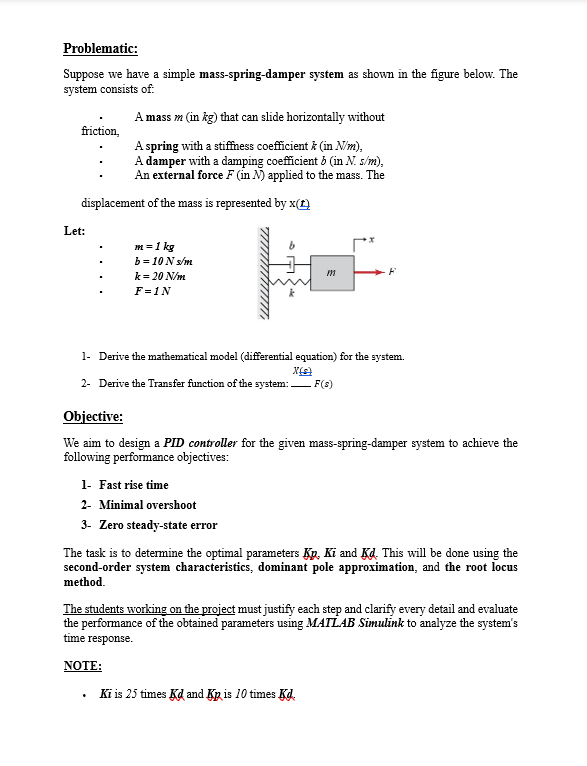
Question: Problematic: Suppose we have a simple mass - spring - damper system as shown in the figure below. The system consists of: - A mass
Problematic:
Suppose we have a simple massspringdamper system as shown in the figure below. The system consists of:
A mass m in kg that can slide horizontally without friction,
A spring with a stiffness coefficient k in mathrmNmathrmm
A damper with a damping coefficient b in N mathrm~smathrmm
An external force Foperatornamein N applied to the mass. The
displacement of the mass is represented by xunderlinet
Let:
quad mmathrm~kg
bmathrm~Nmathrm~smathrmm
kmathrm~Nmathrmm
F N
Derive the mathematical model differential equation for the system.
Xs
Derive the Transfer function of the system: Fs
Objective:
We aim to design a PID controller for the given massspringdamper system to achieve the following performance objectives:
Fast rise time
Minimal overshoot
Zero steadystate error
The task is to determine the optimal parameters mathrmKpmathrmKi and Kd This will be done using the secondorder system characteristics, dominant pole approximation, and the root locus method.
The students working on the project must justify each step and clarify every detail and evaluate the performance of the obtained parameters using MATLAB Simulink to analyze the system's time response.
NOTE:
K i is times K d and K p is times K d
Step by Step Solution
There are 3 Steps involved in it
1 Expert Approved Answer
Step: 1 Unlock

Question Has Been Solved by an Expert!
Get step-by-step solutions from verified subject matter experts
Step: 2 Unlock
Step: 3 Unlock
 Study Help