







Question: Problemi Write a program that generates the Sierpinski tetrahedron. The level 0 set is a tetrahedron. The level n+1 set is formed by constructing the
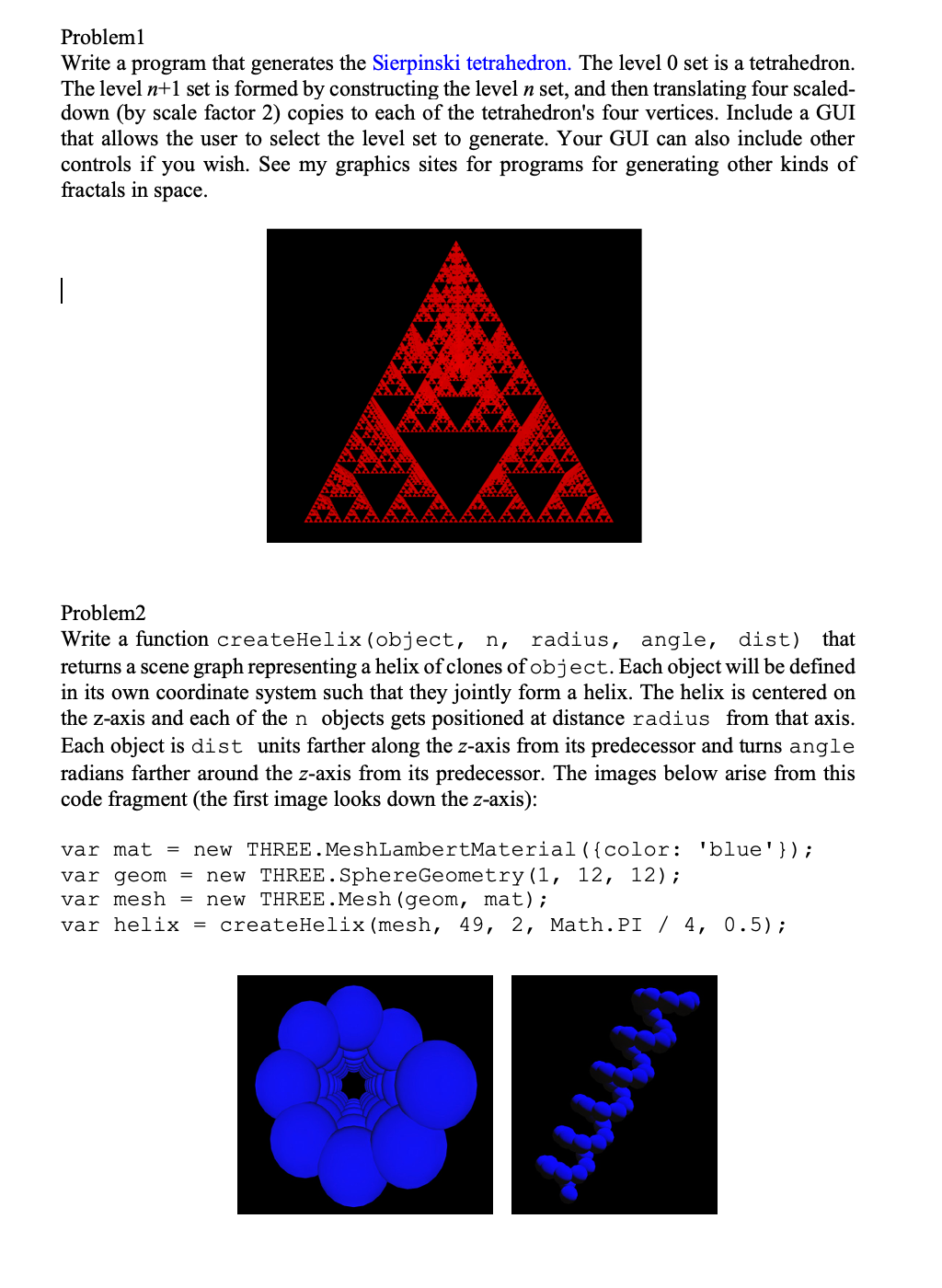
Problemi Write a program that generates the Sierpinski tetrahedron. The level 0 set is a tetrahedron. The level n+1 set is formed by constructing the level n set, and then translating four scaled- down (by scale factor 2) copies to each of the tetrahedron's four vertices. Include a GUI that allows the user to select the level set to generate. Your GUI can also include other controls if you wish. See my graphics sites for programs for generating other kinds of fractals in space. | Problem2 Write a function createHelix (object, n, radius, angle, dist) that returns a scene graph representing a helix of clones of object. Each object will be defined in its own coordinate system such that they jointly form a helix. The helix is centered on the z-axis and each of the n objects gets positioned at distance radius from that axis. Each object is dist units farther along the z-axis from its predecessor and turns angle radians farther around the z-axis from its predecessor. The images below arise from this code fragment (the first image looks down the z-axis): = var mat new THREE.MeshLambertMaterial ({color: 'blue'}); var geom= new THREE.SphereGeometry(1, 12, 12); var mesh = new THREE.Mesh (geom, mat); var helix = createHelix (mesh, 49, 2, Math.PI / 4, 0.5); Problemi Write a program that generates the Sierpinski tetrahedron. The level 0 set is a tetrahedron. The level n+1 set is formed by constructing the level n set, and then translating four scaled- down (by scale factor 2) copies to each of the tetrahedron's four vertices. Include a GUI that allows the user to select the level set to generate. Your GUI can also include other controls if you wish. See my graphics sites for programs for generating other kinds of fractals in space. | Problem2 Write a function createHelix (object, n, radius, angle, dist) that returns a scene graph representing a helix of clones of object. Each object will be defined in its own coordinate system such that they jointly form a helix. The helix is centered on the z-axis and each of the n objects gets positioned at distance radius from that axis. Each object is dist units farther along the z-axis from its predecessor and turns angle radians farther around the z-axis from its predecessor. The images below arise from this code fragment (the first image looks down the z-axis): = var mat new THREE.MeshLambertMaterial ({color: 'blue'}); var geom= new THREE.SphereGeometry(1, 12, 12); var mesh = new THREE.Mesh (geom, mat); var helix = createHelix (mesh, 49, 2, Math.PI / 4, 0.5)
Step by Step Solution
There are 3 Steps involved in it

Get step-by-step solutions from verified subject matter experts
 Study Help