







Question: Problems with the IRR method Acme Oscillators is considering an investment project that has the following rather unusual cash flow pattern. Year Cash Flow 0
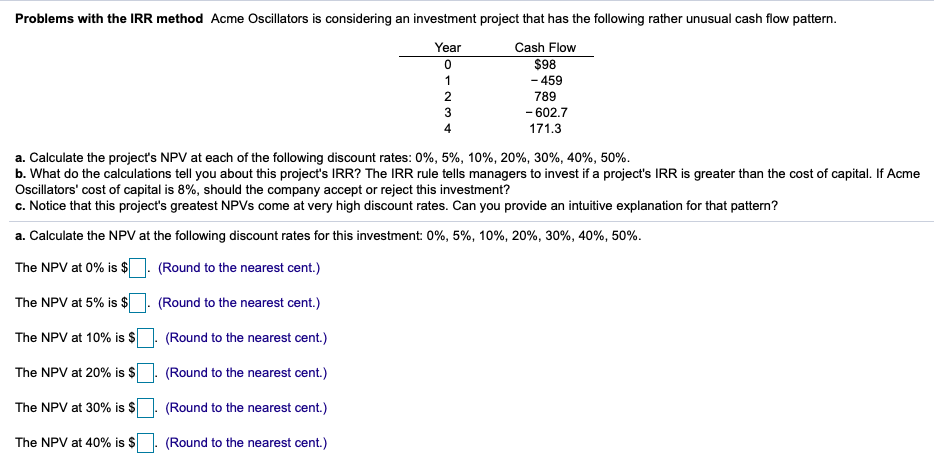
Problems with the IRR method Acme Oscillators is considering an investment project that has the following rather unusual cash flow pattern. Year Cash Flow 0 $98 1 - 459 2 789 3 -602.7 4 171.3 a. Calculate the project's NPV at each of the following discount rates: 0%, 5%, 10%, 20%, 30%, 40%, 50%. b. What do the calculations tell you about this project's IRR? The IRR rule tells managers to invest if a project's IRR is greater than the cost of capital. If Acme Oscillators' cost of capital is 8%, should the company accept or reject this investment? c. Notice that this project's greatest NPVs come at very high discount rates. Can you provide an intuitive explanation for that pattern? a. Calculate the NPV at the following discount rates for this investment: 0%, 5%, 10%, 20%, 30%, 40%, 50%. The NPV at 0% is $. (Round to the nearest cent.) The NPV at 5% is $ (Round to the nearest cent.) The NPV at 10% is $ (Round to the nearest cent.) The NPV at 20% is $ (Round to the nearest cent.) The NPV at 30% is $ (Round to the nearest cent.) The NPV at 40% is $ (Round to the nearest cent.)
Step by Step Solution
There are 3 Steps involved in it

Get step-by-step solutions from verified subject matter experts
 Study Help