





Question: Problern 7. We dene the function (,0: N } N as the number of distinct oalgebras dened on the set s: {1,2,3,...,n}. a. Let rn}
Problern 7. We dene the function (,0: N } N as
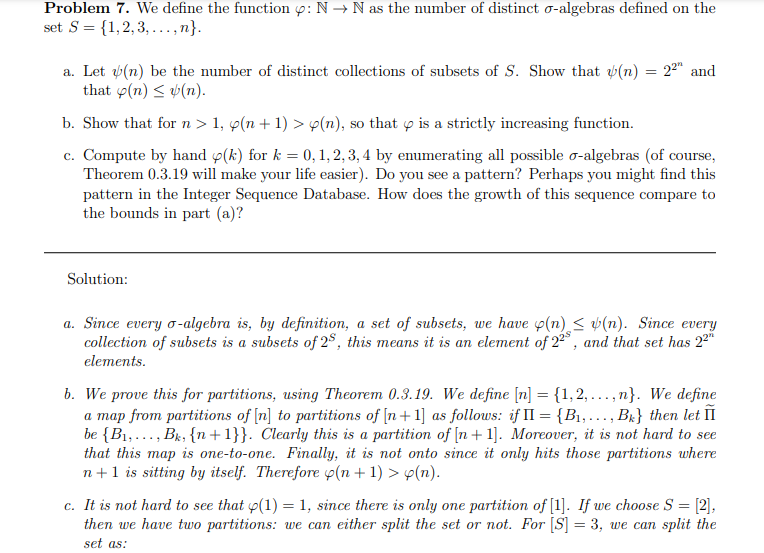
Problern 7. We dene the function (,0: N } N as the number of distinct oalgebras dened on the set s: {1,2,3,...,n}. a. Let rn} be the number of distinct collections of subsets of S. Show that rn} = 2Eu and that an) s an}. b. Show that for n :3- 1, rp[n +1} :3! (,o[n}, so that go is a strictly increasing function. c. Compute by hand 50%} for h = I], 1, 2, 3, 4 by enumerating all possible oalgebras [of oourse, Theorem {1.3.19 will make your life easier). Do you see a pattern? Perhaps you might nd this pattern in the Integer Sequence Database. Horar does the growth of this sequence compare to the bounds in part {a}? Solution: a. Since every oalyehra is, by denition, a set of snhsets, are have :p[n}s rMn} Since every collection of sahsets is a subsets of 23, this means it is an element of 22 , and that set has 22" elements. h. We pro-ye this for partitions, risingI Theorem H.312. We define [n] = {1, 2, . . . , n} We define a may from partitions of [n] to partitions of [n+ 1] asfolloars: ifl'l = {31, . . . ,Bk} then let 11 he {31, . . . , Br\" {11+ 1}} Clearly this is a partition of [n + 1]. Moreover, it is not hard to see that this rnap is onetoone. Finally, it is not onto since it only hits those partitions where 11 +1 is sitting by itself. Therefore rp(n + 1} Te go[n}. c. It is not hard to see that 5.91:1} = 1, since there is only one partition of [1] If we choose 3 = [2], then are have two partitions: we can either split the set or not. For [3] = 3, roe can split the set as

Step by Step Solution

There are 3 Steps involved in it

1 Expert Approved Answer
Step: 1 Unlock blur-text-image

Question Has Been Solved by an Expert!

Get step-by-step solutions from verified subject matter experts

Step: 2 Unlock
Step: 3 Unlock

Students Have Also Explored These Related Mathematics Questions!