







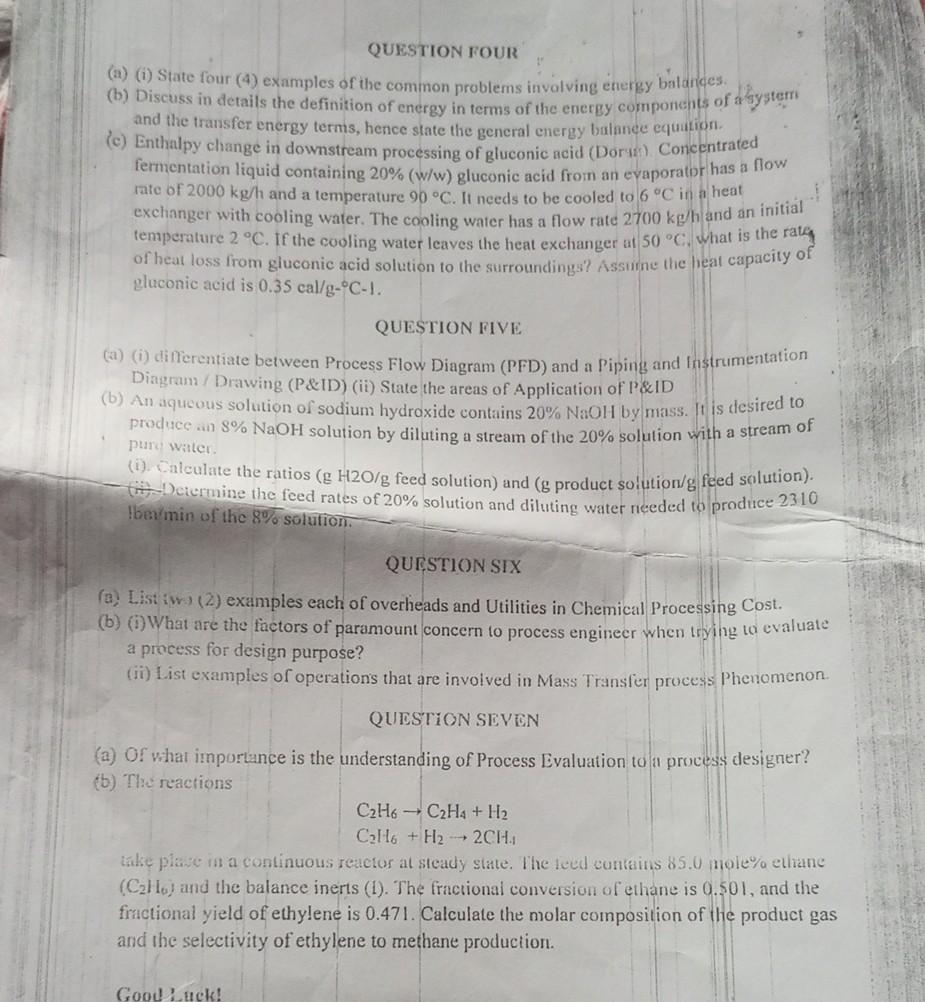
Question: process design QUESTION FOUR (a) (i) State four (4) examples of the common problems invalving energy balances. (b) Discuss in details the definition of energy
process design
QUESTION FOUR (a) (i) State four (4) examples of the common problems invalving energy balances. (b) Discuss in details the definition of energy in terms of the energy components of a system and the transfer energy terms, hence state the general energy balance equation. (c) Enthalpy change in downstream processing of gluconic acid (Dorim). Concentrated fermentation liquid containing 20%(w/w) gluconic acid from an eyaporator has a flow rate of 2000kg/h and a temperature 90C. It needs to be cooled to 6C in a heat exchanger with cooling water. The cooling water has a flow rate 2700kg/h and an initial temperature 2C. If the cooling water leaves the heat exchanger at 50C, what is the rate of heat loss from gluconic acid solution to the surroundings? Assume the heat capacity of gluconic acid is 0.35cal/gC1. QUESTION FIVE (a) (i) differentiate between Process Flow Diagram (PFD) and a Piping and fnstrumentation Diagram / Drawing (P\&ID) (ii) State the areas of Application of P\&ID (b) An aqueous solution of sodium hydroxide contains 20%NaOH by mass. It is desired to produce in 8%NaOH solution by diluting a stream of the 20% solution with a stream of purc witer. (i). Calculate the ratios ( gH2O/g feed solution) and ( g product solution/g feed solution). (ii)- Detcrmine the feed rates of 20% solution and diluting water needed to produce 2310 thermin of the 8% solution. QUESTIONSIX (a) List iw) (2) examples each of overheads and Utilities in Chemical Processing Cost. (b) (i) What are the factors of paramount concern to process engineer when trying to evaluate a process for design purpose? (ii) List examples of operations that are involved in Mass Transfer process Phenomenon. QUESTION SEVEN (a) Of what importance is the understanding of Process Evaluation to a process designer? (b) The reactions C2H6C2H4+H2C2H6+H22CH4 take plase in a continuous reacter at steady state. The leed cuntains 85.0 mole\% ethane (C2H6) and the balance inerts (i). The fractional conversion of ethane is 0.501 , and the fructional yield of ethy!ene is 0.471 . Calculate the molar composition of the product gas and the selectivity of ethylene to methane production
Step by Step Solution
There are 3 Steps involved in it

Get step-by-step solutions from verified subject matter experts
 Study Help