







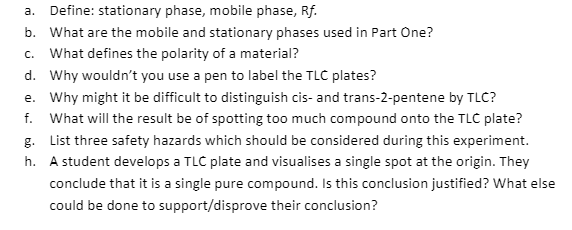
Question: a . Define: stationary phase, mobile phase, R f . b . What are the mobile and stationary phases used in Part One? c .
a Define: stationary phase, mobile phase,
b What are the mobile and stationary phases used in Part One?
c What defines the polarity of a material?
d Why wouldn't you use a pen to label the TLC plates?
e Why might it be difficult to distinguish cis and transpentene by TLC
f What will the result be of spotting too much compound onto the TLC plate?
g List three safety hazards which should be considered during this experiment.
h A student develops a TLC plate and visualises a single spot at the origin. They
conclude that it is a single pure compound. Is this conclusion justified? What else
could be done to supportdisprove their conclusion?
Step by Step Solution
There are 3 Steps involved in it
1 Expert Approved Answer
Step: 1 Unlock

Question Has Been Solved by an Expert!
Get step-by-step solutions from verified subject matter experts
Step: 2 Unlock
Step: 3 Unlock
 Study Help