







Question: Professional Communication Analysis (30%) (Please view images for support) Your analysis must be 1800-2000 words analysis on your learning around professional writing based on the
Professional Communication Analysis (30%) (Please view images for support)
Your analysis must be 1800-2000 words analysis on your learning around professional writing based on the learning outcomes (whether your outcomes were achieved, evidence that you completed your outcomes, etc.) The analysis should demonstrate how you plan to to apply or are applying what you learned in the subject to yourself as a writer.
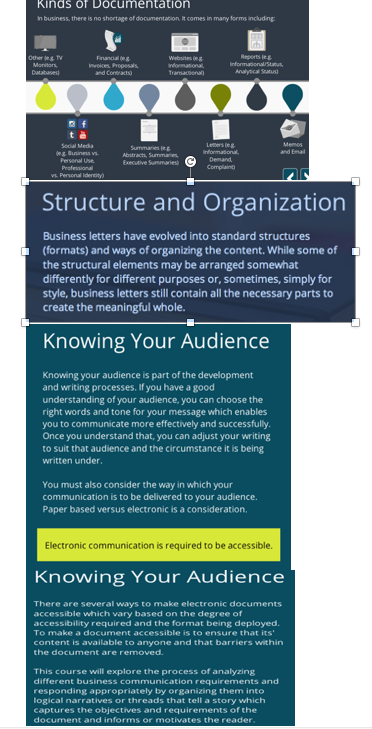
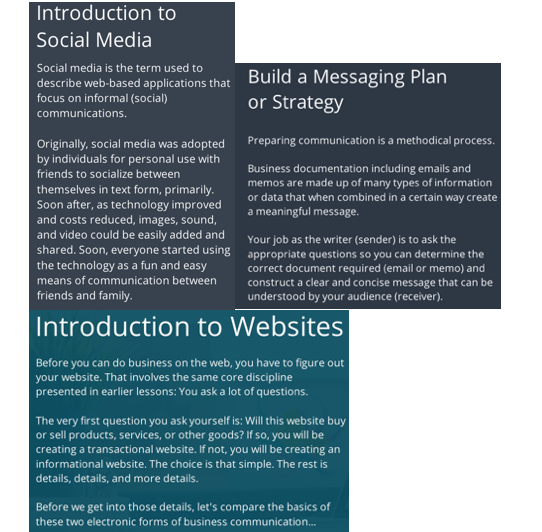
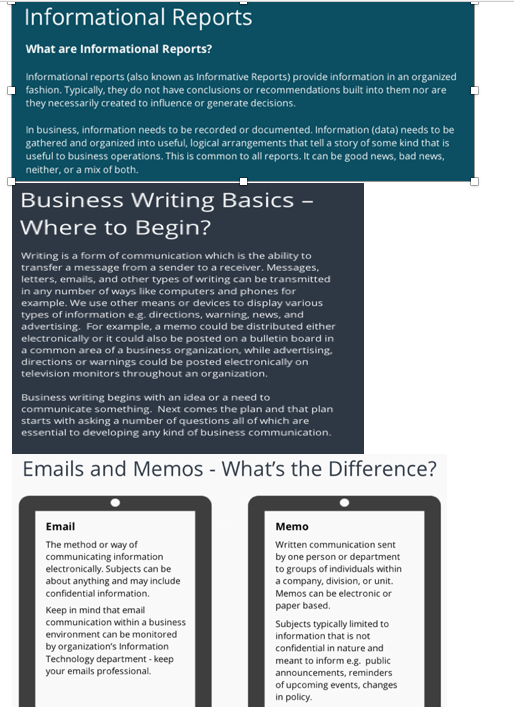
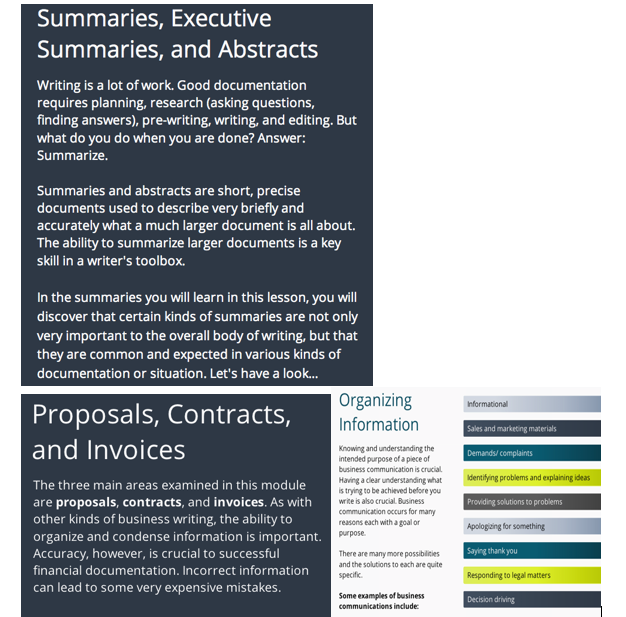
the images are not supposed to be together. they are all seperate. it is all about the writing structures. thank you.
Kinds of Documentation in business, there is no shortage of documentation. It comes in many forms including Othereg TV Monitor Databases invoices, Proposals and Contact Information Transactional Reports Informational Status Analytical Status Social Media Ing Business Personal use. Professional vs. Personal identity Summaries Abstracts, Sures Executive Summaries Letterste Informational Demand Complaint and Email Structure and Organization Business letters have evolved into standard structures (formats) and ways of organizing the content. While some of the structural elements may be arranged somewhat differently for different purposes or, sometimes, simply for style, business letters still contain all the necessary parts to create the meaningful whole. Knowing Your Audience Knowing your audience is part of the development and writing processes. If you have a good understanding of your audience, you can choose the right words and tone for your message which enables you to communicate more effectively and successfully. Once you understand that, you can adjust your writing to suit that audience and the circumstance it is being written under You must also consider the way in which your communication is to be delivered to your audience. Paper based versus electronic is a consideration. Electronic communication is required to be accessible. Knowing Your Audience There are several ways to make electronic documents accessible which vary based on the degree of accessibility required and the format being deployed. To make a document accessible is to ensure that its' content is available to anyone and that barriers within the document are removed. This course will explore the process of analyzing different business communication requirements and responding appropriately by organizing them into logical narratives or threads that tell a story which captures the objectives and requirements of the document and informs or motivates the reader. Introduction to Social Media Social media is the term used to describe web-based applications that Build a Messaging Plan focus on informal (social) or Strategy communications. Originally, social media was adopted Preparing communication is a methodical process. by individuals for personal use with friends to socialize between Business documentation including emails and themselves in text form, primarily. memos are made up of many types of information Soon after, as technology improved or data that when combined in a certain way create a meaningful message and costs reduced, images, sound, and video could be easily added and Your job as the writer (sender) is to ask the shared. Soon, everyone started using appropriate questions so you can determine the the technology as a fun and easy correct document required (email or memo) and means of communication between construct a clear and concise message that can be friends and family understood by your audience (receiver). Introduction to Websites Before you can do business on the web, you have to figure out your website. That involves the same core discipline presented in earlier lessons: You ask a lot of questions. The very first question you ask yourself is: Will this website buy or sell products, services, or other goods? If so, you will be creating a transactional website. If not, you will be creating an informational website. The choice is that simple. The rest is details, details, and more details. Before we get into those details, let's compare the basics of these two electronic forms of business communication... Informational Reports What are Informational Reports? Informational reports (also known as Informative Reports) provide information in an organized fashion. Typically, they do not have conclusions or recommendations built into them nor are they necessarily created to influence or generate decisions. In business, information needs to be recorded or documented. Information (data) needs to be gathered and organized into useful, logical arrangements that tell a story of some kind that is useful to business operations. This is common to all reports. It can be good news, bad news, neither, or a mix of both. Business Writing Basics Where to Begin? Writing is a form of communication which is the ability to transfer a message from a sender to a receiver. Messages, letters, emails, and other types of writing can be transmitted in any number of ways like computers and phones for example. We use other means or devices to display various types of information e.g. directions, warning, news, and advertising. For example, a memo could be distributed either electronically or it could also be posted on a bulletin board in a common area of a business organization, while advertising. directions or warnings could be posted electronically on television monitors throughout an organization. Business writing begins with an idea or a need to communicate something. Next comes the plan and that plan starts with asking a number of questions all of which are essential to developing any kind of business communication. Emails and Memos - What's the Difference? Email The method or way of communicating information electronically. Subjects can be about anything and may include confidential information Keep in mind that email communication within a business environment can be monitored by organization's Information Technology department - keep your emails professional. Memo Written communication sent by one person or department to groups of individuals within a company, division, or unit. Memos can be electronic or paper based Subjects typically limited to information that is not confidential in nature and meant to inform e.g. public announcements, reminders of upcoming events, changes in policy Summaries, Executive Summaries, and Abstracts Writing is a lot of work. Good documentation requires planning, research (asking questions, finding answers), pre-writing, writing, and editing. But what do you do when you are done? Answer: Summarize. Summaries and abstracts are short, precise documents used to describe very briefly and accurately what a much larger document is all about. The ability to summarize larger documents is a key skill in a writer's toolbox. Informational In the summaries you will learn in this lesson, you will discover that certain kinds of summaries are not only very important to the overall body of writing, but that they are common and expected in various kinds of documentation or situation. Let's have a look... Organizing Proposals, Contracts, Information and Invoices Knowing and understanding the intended purpose of a piece of business communication is crucial The three main areas examined in this module Having a clear understanding what is trying to be achieved before you are proposals, contracts, and invoices. As with write is also crucial Business communication occurs for many other kinds of business writing, the ability to reasons each with a goal or organize and condense information is important. purpose. Accuracy, however, is crucial to successful There are many more possibilities and the solutions to each are quite financial documentation. Incorrect information can lead to some very expensive mistakes. Some examples of business Sales and marketing materials Demands/ complaints Identifying problems and explaining ideas Providing solutions to problems Apologizing for something saying thank you Responding to legal matters Decision driving specific communications include
Step by Step Solution
There are 3 Steps involved in it
1 Expert Approved Answer
Step: 1 Unlock

Question Has Been Solved by an Expert!
Get step-by-step solutions from verified subject matter experts
Step: 2 Unlock
Step: 3 Unlock
 Study Help