







Question: Profil... 11. Find the zeros for the polynomial function and give the multiplicity for e the x-axis and turns around at each zero. 1(xx)=x3 +8x2-16x-128
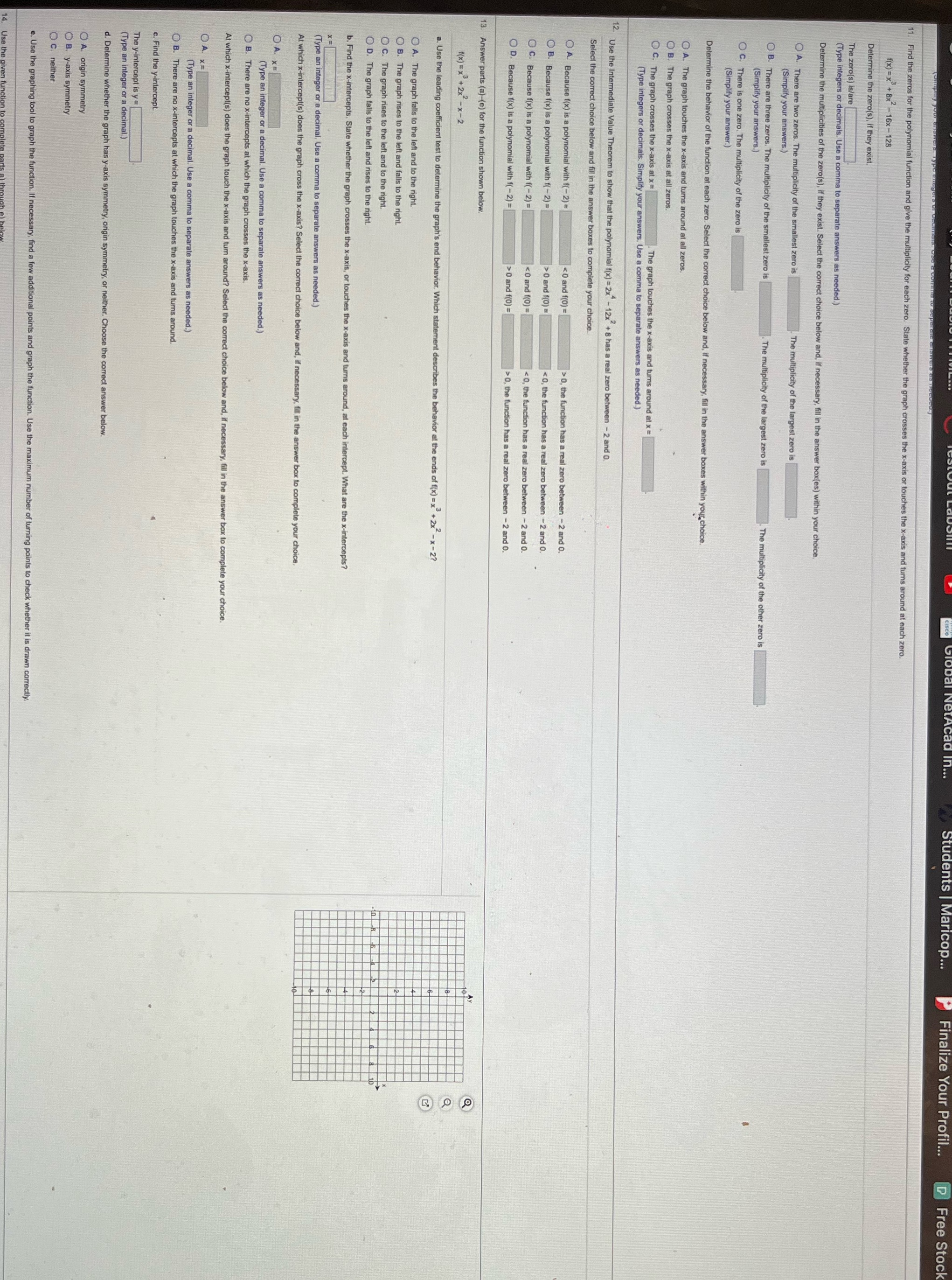
Profil... 11. Find the zeros for the polynomial function and give the multiplicity for e the x-axis and turns around at each zero. 1(xx)=x3 +8x2-16x-128 Determine the zero(s), if they exist. The zero(s) is/are (Type integers or decimals. Use a comma to separate answers as needed.) Determine the multiplicities of the zero(s), if they exist. Select the correct choice below and, if necessary, fill in the answer box(es) within your choice. A. There are two zeros. The multiplicity of the smallest The multiplicity of the largest zero is (Simplify your answers.) O B. There are three zeros. The multiplicity of the smallest zero is . The multiplicity of the largest zero is The multiplicity of the other zero is ( Simplify your answers.) O C. There is one zero. The multiplicity of the zero is (Simplify your answer.) Determine the behavior of the function at each zero. Select the correct choice below and, if necessary, fill in the answer boxes within your, choice. O A. The graph touches the x-axis and turns around at all zeros. OB. The graph crosses the x-axis at all zeros, C. The graph crosses the x-axis at x = . The graph touches the x-axis and turns around at x = (Type integers or decimals. Simplify your answers. Use a comma to separate answers as needed.) 12 . U Use the Intermediate Value Theorem to show that the polynomial ((x) = 2x - 12x + 8 has a real zero between - 2 and 0. Select the correct choice below and fill in the answer boxes to complete your choice. O A. Because ((x) is a polynomial with (( -2)= 0 and f(0) = 0 and f(0) = > 0, the function has a real zero between - 2 and 0. 13. Answer parts (a) (e) for the function shown below 1(x) = x3+ 2x2-x-2 . Use the leading coefficient test to determine the graph's end behavior. Which stater tribes the behavior at the ends of f(x) = x3 + 2x? -x-2? O A. The graph falls to the left and to the right. B. The graph rises to the left and falls to the right. C. The graph rises left and to the right. OD, The graph falls to the left and rises to the right. b. Find the x-intercepts. State whether the graph crosses the x-axis, or touches the x-axis and turns around, at each intercept. What are the x-intercepts? (Type an integer or a decimal, Use a comma to separate answers as needed.) At which x-intercept(s) does the graph cross the X-axis? Select the correct choice below and, if necessary, fill in the answer box to complete your choice. O A X= (Type an integer or a decimal. Use a comma to separate answers as needed.) O B. There are no x-intercepts at which the graph crosses the x-axis. At which x-intercept(s) does the graph touch the x-axis and turn around? Select the correct choice below and, if necessary, fill in the answer box to complete your choice. O A X= (Type an integer or a decimal. Use a comma to separate answers as needed.) O B. There are no x-intercepts at which the graph touches the x-axis and turns around. c. Find the y-intercept. The y-intercept is y= (Type an integer or a decimal.) d. Determine whether the graph has y-axis symmetry, origin symmetry, or neither. Choose the correct answer below. O A. origin symmetry OB. y-axis symmetry O C. neither e. Use the graphing tool to graph the function. If necessary, find a few additional points and graph the function. Use the maximum number of turning points to check whether it is drawn correctly
Step by Step Solution
There are 3 Steps involved in it

Get step-by-step solutions from verified subject matter experts
 Study Help