







Question: Programmed versus Nonprogrammed Decisions Certainty, Risk, Uncertainty, and Ambiguity The Probability of Decision Failure When you make a decision, you are choosing one of a
Programmed versus Nonprogrammed Decisions
Certainty, Risk, Uncertainty, and Ambiguity
The Probability of Decision Failure
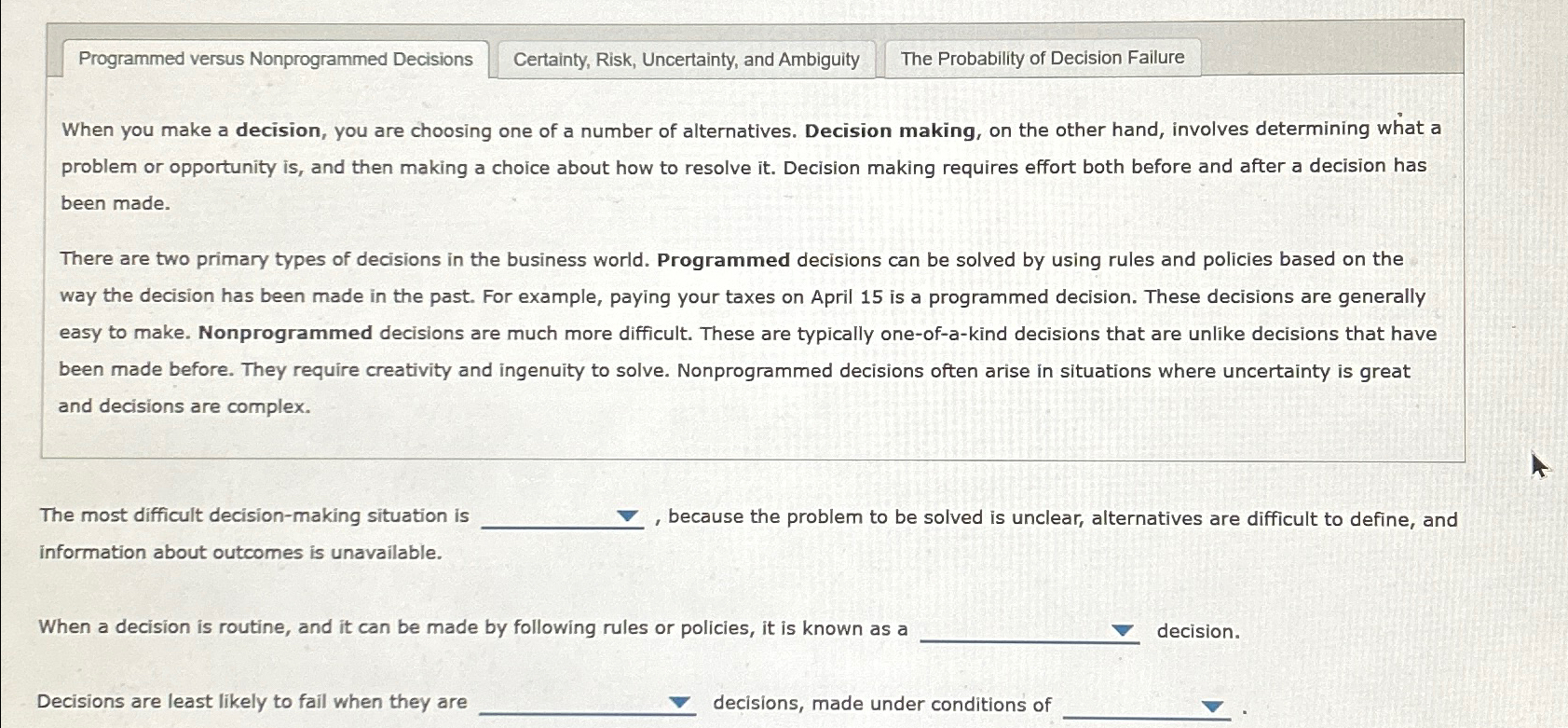
When you make a decision, you are choosing one of a number of alternatives. Decision making, on the other hand, involves determining what a problem or opportunity is and then making a choice about how to resolve it Decision making requires effort both before and after a decision has been made.
There are two primary types of decisions in the business world. Programmed decisions can be solved by using rules and policies based on the way the decision has been made in the past. For example, paying your taxes on April is a programmed decision. These decisions are generally easy to make. Nonprogrammed decisions are much more difficult. These are typically oneofakind decisions that are unlike decisions that have been made before. They require creativity and ingenuity to solve. Nonprogrammed decisions often arise in situations where uncertainty is great and decisions are complex.
The most difficult decisionmaking situation is because the problem to be solved is unclear, alternatives are difficult to define, and information about outcomes is unavailable.
When a decision is routine, and it can be made by following rules or policies, it is known as a decision.
Decisions are least likely to fail when they are decisions, made under conditions of
Step by Step Solution
There are 3 Steps involved in it
1 Expert Approved Answer
Step: 1 Unlock

Question Has Been Solved by an Expert!
Get step-by-step solutions from verified subject matter experts
Step: 2 Unlock
Step: 3 Unlock
 Study Help