







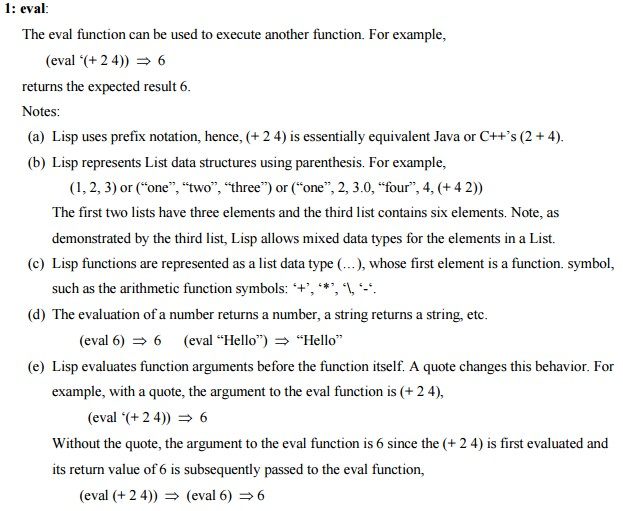
Question: Programming languages... Consider the three Lisp functions: Now... 1: eval: The eval function can be used to execute another function. For example, (eval (+ 2
Programming languages...
Consider the three Lisp functions:
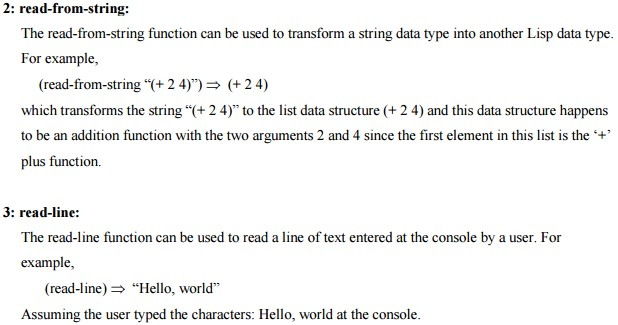

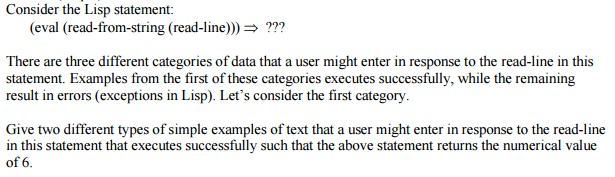
Now...
1: eval: The eval function can be used to execute another function. For example, (eval "(+ 2 4)) 6 returns the expected result 6. Notes (a) Lisp uses prefix notation, hence, (+ 2 4) is essentially equivalent Java or C++'s (2+4). (b) Lisp represents List data structures using parenthesis. For example, (1, 2, 3) or "one, two", "three") or ("one", 2, 3.0, "four", 4, (+4 2)) The first two lists have three elements and the third list cossix elements. Note, as demonstrated by the third list, Lisp allows mixed data types for the elements in a List. (c) Lisp functions are represented as a list data type(...), whose first element is a function, symbol, such as the arithmetic function symbols *, L, -. d) The evaluation of a number returns a number, a string returns a string, etc. (eval 6) 6 (eval" Hello")-"Hello" (e) Lisp evaluates function arguments before the function itself. A quote changes this behavior. For example, with a quote, the argument to the eval function is (+ 24), (eval "(+ 2 4)) 6 Without the quote, the argument to the eval function is 6 since the (+ 2 4) is first evaluated and its return value of 6 is subsequently passed to the eval function, (eval (+ 2 4)) (eval 6) 6
Step by Step Solution
There are 3 Steps involved in it

Get step-by-step solutions from verified subject matter experts
 Study Help