







Question: Project 2 : FUG Method and HYSYS Simulation 1 . Problem Statement Please design a de - ethanizer to perform the separation illustrated in Figure
Project : FUG Method and HYSYS Simulation
Problem Statement
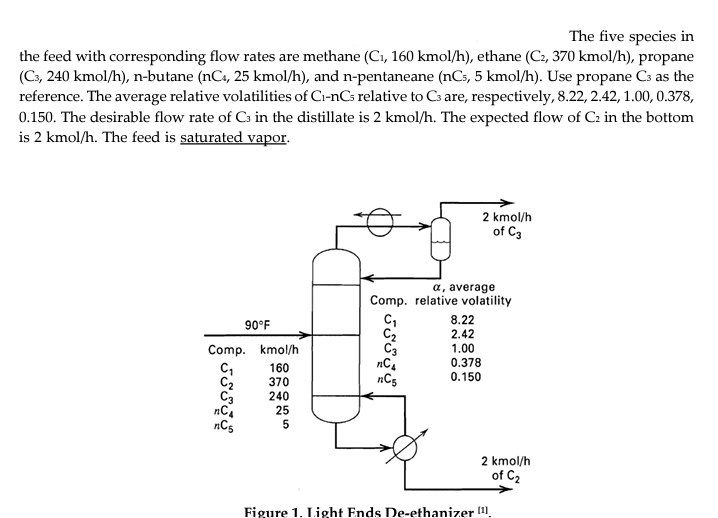
Please design a deethanizer to perform the separation illustrated in Figure The five species in the feed with corresponding flow rates are methane C kmolh ethane C kmolh propane C kmolh nbutane nC kmolh and npentaneane nC kmolh Use propane C as the reference. The average relative volatilities of CnC relative to C are, respectively, The desirable flow rate of C in the distillate is kmolh The expected flow of C in the bottom is kmolh The feed is saturated vapor. Complete the design of this column where design variables include the total number of actual stages, the compositions of distillate and bottoms, the optimum feed plate location, and the reflux ratio.
Figure Light Ends Deethanizer
Tasks to be Completed and Presented in the Report
Task With the given information in problem statement, a identify the light key LK heavy key HK light non key LNK and heavy non key HNK; b compute the fraction recoveries FRs for the LK and HK
Items to be included in your report: Specify all the LK HK LNK and HNK; Show the calculation procedures and results for FRs of LK and HK in both distillate and bottom.
Task Use the Fenske equation to determine: a the minimum number equilibrium stages Nmin; b the fractional recoveries for all nonkeys in the distillate and bottom.
Items to be included in your report: Calculation procedures and results for Nmin; Calculation procedures and results for FRs of all nonkeys in both distillate and bottom.
Task Using the obtained FRs for species in distillate and bottom from Tasks show: a flow rates of each component in the distillate Dxidist and bottom Bxibot; b minimum reflux ratio LDmin from the Underwood equation.
Items to be included in your report: Calculation procedures and results for each Dxidist and Bxibot; Calculation procedures and results for solving the st and nd Underwood equation to obtain Vmin, Lmin, D and LDmin
Task Based on the results from Task assume that the actual reflux ratio is LD LD min. Determine: a the number N of stages required under the given actual reflux ratio; the optimum feed plate location NF
Items to be included in your report: Calculation procedures and results for obtaining N hint: follow the lecture example: obtain abscissa find Liddle correlation, determine the ordinate value, and then calculate N; Calculation procedures and results for the optimum feed location NF
Step by Step Solution
There are 3 Steps involved in it
1 Expert Approved Answer
Step: 1 Unlock

Question Has Been Solved by an Expert!
Get step-by-step solutions from verified subject matter experts
Step: 2 Unlock
Step: 3 Unlock
 Study Help