







Question: PROJECT B: LINEAR ANALYSIS An important objective of a flexible pavement design is to protect the subgrade ( minimizing vertical compressive strains ) and reduce
PROJECT B: LINEAR ANALYSIS
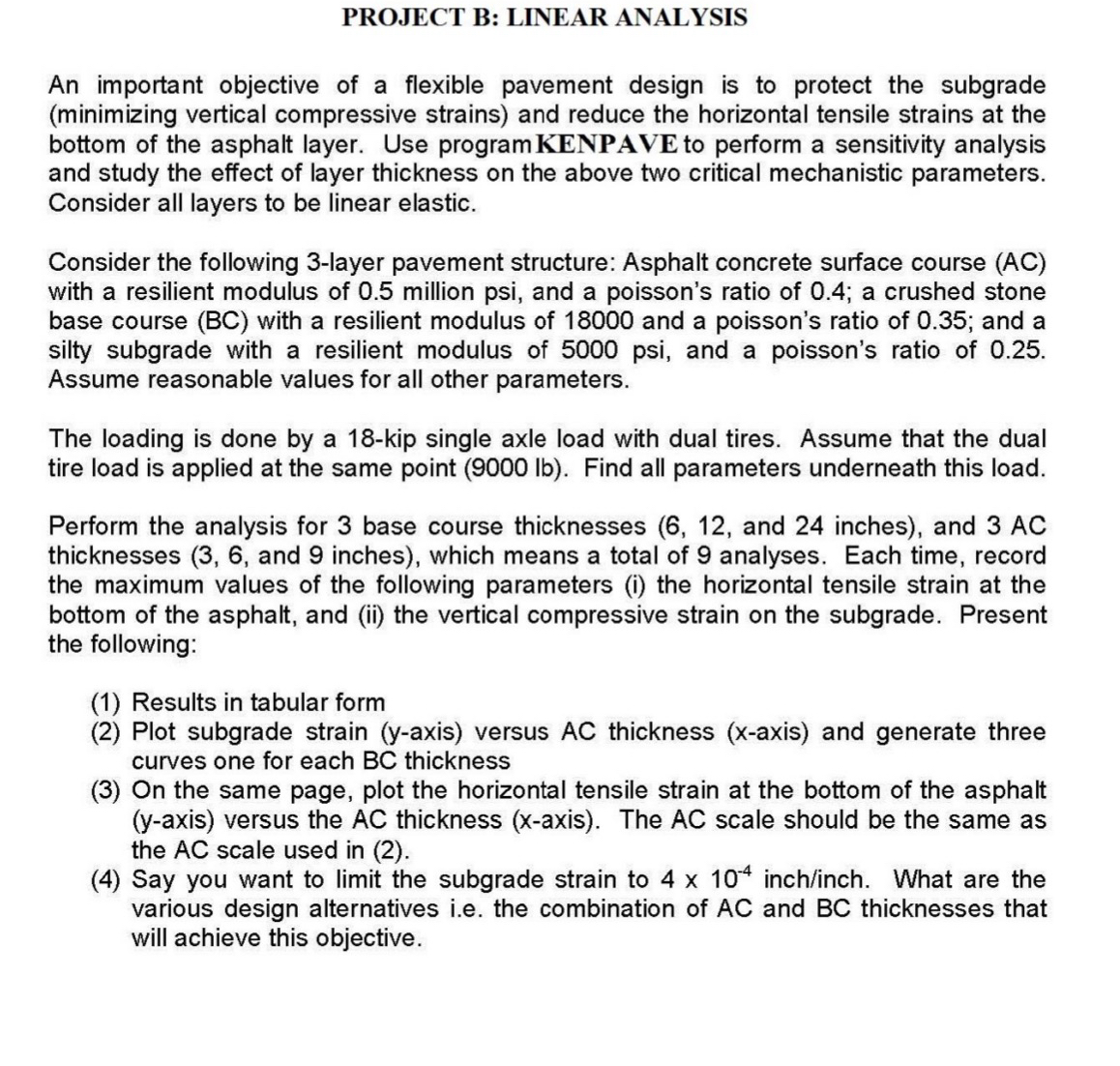
An important objective of a flexible pavement design is to protect the subgrade minimizing vertical compressive strains and reduce the horizontal tensile strains at the bottom of the asphalt layer. Use program KENPAVE to perform a sensitivity analysis and study the effect of layer thickness on the above two critical mechanistic parameters. Consider all layers to be linear elastic.
Consider the following layer pavement structure: Asphalt concrete surface course AC with a resilient modulus of million psi, and a poisson's ratio of ; a crushed stone base course BC with a resilient modulus of and a poisson's ratio of ; and a silty subgrade with a resilient modulus of and a poisson's ratio of Assume reasonable values for all other parameters.
The loading is done by a kip single axle load with dual tires. Assume that the dual tire load is applied at the same point Find all parameters underneath this load.
Perform the analysis for base course thicknesses and inches and AC thicknesses and inches which means a total of analyses. Each time, record the maximum values of the following parameters i the horizontal tensile strain at the bottom of the asphalt, and ii the vertical compressive strain on the subgrade. Present the following:
Results in tabular form
Plot subgrade strain yaxis versus thickness xaxis and generate three curves one for each thickness
On the same page, plot the horizontal tensile strain at the bottom of the asphalt yaxis versus the thickness axis The scale should be the same as the AC scale used in
Say you want to limit the subgrade strain to inchinch What are the various design alternatives ie the combination of and thicknesses that will achieve this objective.
Step by Step Solution
There are 3 Steps involved in it
1 Expert Approved Answer
Step: 1 Unlock

Question Has Been Solved by an Expert!
Get step-by-step solutions from verified subject matter experts
Step: 2 Unlock
Step: 3 Unlock
 Study Help