







Question: Project Description This course project will allow you to get practice developing a complete Java application. You will work to develop a prototype for a
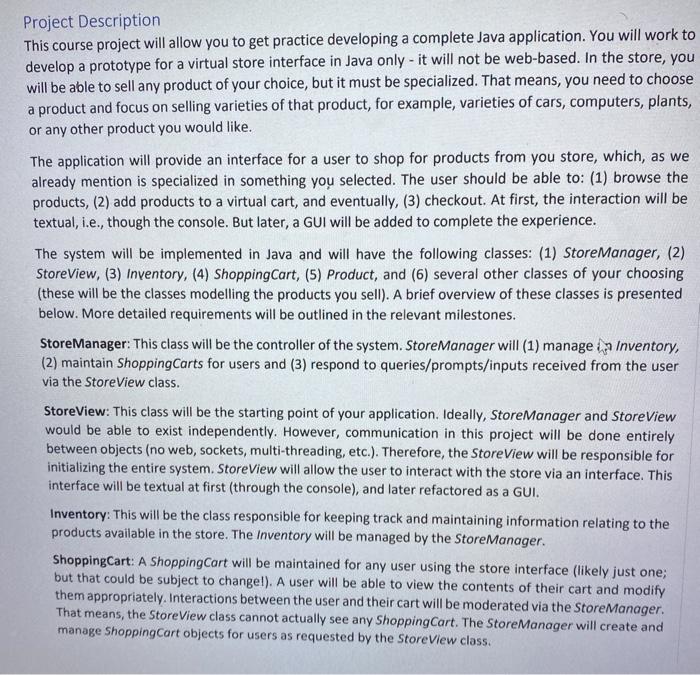
Project Description This course project will allow you to get practice developing a complete Java application. You will work to develop a prototype for a virtual store interface in Java only - it will not be web-based. In the store, you will be able to sell any product of your choice, but it must be specialized. That means, you need to choose a product and focus on selling varieties of that product, for example, varieties of cars, computers, plants, or any other product you would like. The application will provide an interface for a user to shop for products from you store, which, as we already mention is specialized in something you selected. The user should be able to: (1) browse the products, (2) add products to a virtual cart, and eventually, (3) checkout. At first, the interaction will be textual, i.e., though the console. But later, a GUI will be added to complete the experience. The system will be implemented in Java and will have the following classes: (1) Store Manager, (2) StoreView, (3) Inventory, (4) Shopping Cart, (5) Product, and (6) several other classes of your choosing (these will be the classes modelling the products you sell). A brief overview of these classes is presented below. More detailed requirements will be outlined in the relevant milestones. StoreManager: This class will be the controller of the system. StoreManager will (1) manage a inventory, (2) maintain Shopping Carts for users and (3) respond to queries/prompts/inputs received from the user via the StoreView class. StoreView: This class will be the starting point of your application. Ideally, Store Manager and StoreView would be able to exist independently. However, communication in this project will be done entirely between objects (no web, sockets, multi-threading, etc.). Therefore, the StoreView will be responsible for initializing the entire system. StoreView will allow the user to interact with the store via an interface. This interface will be textual at first (through the console), and later refactored as a GUI. Inventory: This will be the class responsible for keeping track and maintaining information relating to the products available in the store. The Inventory will be managed by the Store Manager. Shopping Cart: A Shopping Cart will be maintained for any user using the store interface (likely just one; but that could be subject to changel). A user will be able to view the contents of their cart and modify them appropriately. Interactions between the user and their cart will be moderated via the Store Manager. That means, the StoreView class cannot actually see any Shopping Cart. The Store Manager will create and manage Shopping Cart objects for users as requested by the StoreView class. Project Description This course project will allow you to get practice developing a complete Java application. You will work to develop a prototype for a virtual store interface in Java only - it will not be web-based. In the store, you will be able to sell any product of your choice, but it must be specialized. That means, you need to choose a product and focus on selling varieties of that product, for example, varieties of cars, computers, plants, or any other product you would like. The application will provide an interface for a user to shop for products from you store, which, as we already mention is specialized in something you selected. The user should be able to: (1) browse the products, (2) add products to a virtual cart, and eventually, (3) checkout. At first, the interaction will be textual, i.e., though the console. But later, a GUI will be added to complete the experience. The system will be implemented in Java and will have the following classes: (1) Store Manager, (2) StoreView, (3) Inventory, (4) Shopping Cart, (5) Product, and (6) several other classes of your choosing (these will be the classes modelling the products you sell). A brief overview of these classes is presented below. More detailed requirements will be outlined in the relevant milestones. StoreManager: This class will be the controller of the system. StoreManager will (1) manage a inventory, (2) maintain Shopping Carts for users and (3) respond to queries/prompts/inputs received from the user via the StoreView class. StoreView: This class will be the starting point of your application. Ideally, Store Manager and StoreView would be able to exist independently. However, communication in this project will be done entirely between objects (no web, sockets, multi-threading, etc.). Therefore, the StoreView will be responsible for initializing the entire system. StoreView will allow the user to interact with the store via an interface. This interface will be textual at first (through the console), and later refactored as a GUI. Inventory: This will be the class responsible for keeping track and maintaining information relating to the products available in the store. The Inventory will be managed by the Store Manager. Shopping Cart: A Shopping Cart will be maintained for any user using the store interface (likely just one; but that could be subject to changel). A user will be able to view the contents of their cart and modify them appropriately. Interactions between the user and their cart will be moderated via the Store Manager. That means, the StoreView class cannot actually see any Shopping Cart. The Store Manager will create and manage Shopping Cart objects for users as requested by the StoreView class
Step by Step Solution
There are 3 Steps involved in it

Get step-by-step solutions from verified subject matter experts
 Study Help