







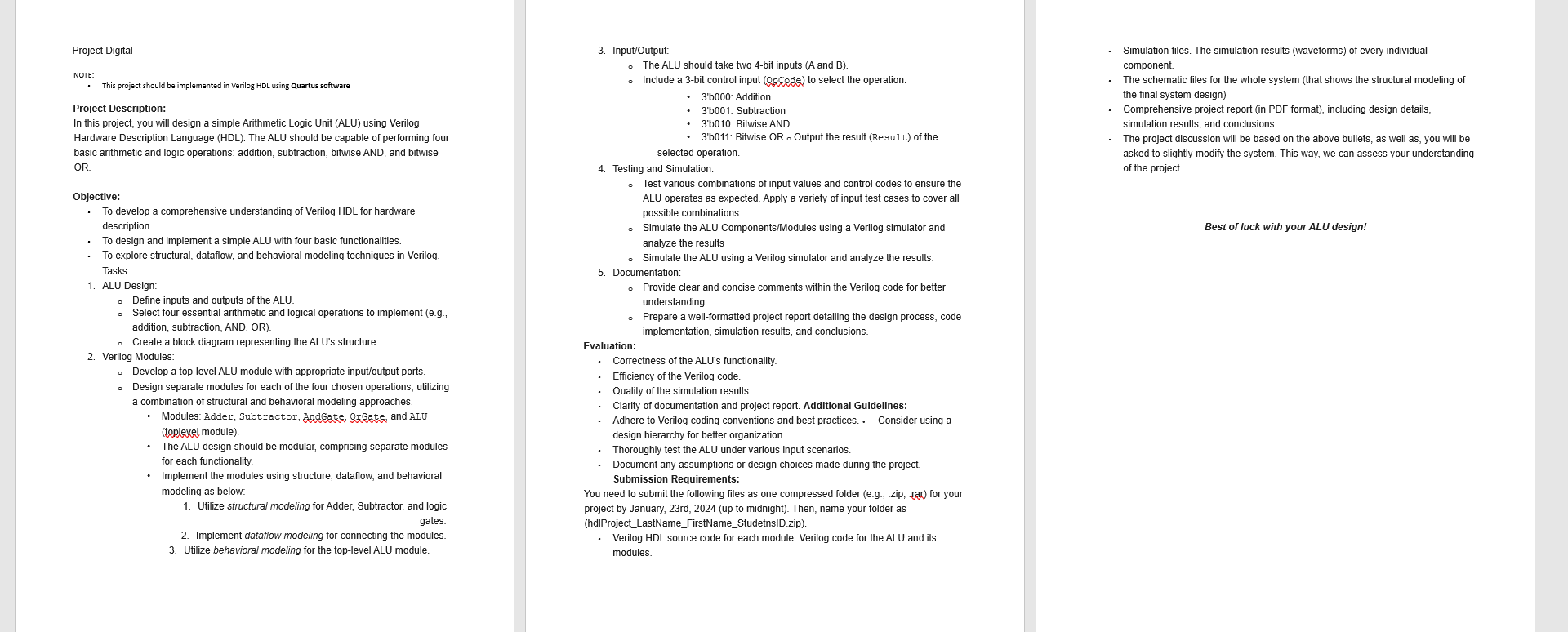
Question: Project Digital NOTE: Project Description: In this project, you will design a simple Arithmetic Logic Unit ( ALU ) using Verilog Hardware Description Language (
Project Digital
NOTE:
Project Description:
In this project, you will design a simple Arithmetic Logic Unit ALU using Verilog
Hardware Description Language HDL The ALU should be capable of performing four
basic arithmetic and logic operations: addition, subtraction, bitwise AND, and bitwise
OR
Objective:
To develop a comprehensive understanding of Verilog HDL for hardware
description.
To design and implement a simple ALU with four basic functionalities.
To explore structural, dataflow, and behavioral modeling techniques in Verilog.
Tasks:
ALU Design:
Define inputs and outputs of the ALU
Select four essential arithmetic and logical operations to implement eg
addition, subtraction, AND, OR
Create a block diagram representing the ALU's structure.
Verilog Modules:
Develop a toplevel ALU module with appropriate inputoutput ports.
Design separate modules for each of the four chosen operations, utilizing
a combination of structural and behavioral modeling approaches.
Modules: Adder, Subtractor, AndGate, OrGate, and ALU
toplexel module
The ALU design should be modular, comprising separate modules
for each functionality.
Implement the modules using structure, dataflow, and behavioral
modeling as below:
Utilize structural modeling for Adder, Subtractor, and logic
gates.
Implement dataflow modeling for connecting the modules.
Utilize behavioral modeling for the toplevel ALU module.
InputOutput
The ALU should take two bit inputs A and B
Include a bit control input pCede to select the operation:
b: Addition
b: Subtraction
b: Bitwise AND
b: Bitwise OR Output the result Result of the
selected operation.
Testing and Simulation
Test various combinations of input values and control codes to ensure the
ALU operates as expected. Apply a variety of input test cases to cover all
possible combinations.
Simulate the ALU ComponentsModules using a Verilog simulator and
analyze the results
Simulate the ALU using a Verilog simulator and analyze the results.
Documentation:
Provide clear and concise comments within the Verilog code for better
understanding.
Prepare a wellformatted project report detailing the design process, code
implementation, simulation results, and conclusions.
Evaluation:
Correctness of the ALU's functionality
Efficiency of the Verilog code.
Quality of the simulation results.
Clarity of documentation and project report. Additional Guidelines:
Adhere to Verilog coding conventions and best practices. Consider using a
design hierarchy for better organization.
Thoroughly test the ALU under various input scenarios.
Document any assumptions or design choices made during the project.
Submission Requirements:
You need to submit the following files as one compressed folder egzip, rar for your
project by January, rdup to midnight Then, name your folder as
hdIProjectLastNameFirstNameStudetnsID.zip
Verilog HDL source code for each module. Verilog code for the ALU and its
modules.
Simulation files. The simulation results waveforms of every individual
component.
The schematic files for the whole system that shows the structural modeling of
the final system design
Comprehensive project report in PDF format including design details,
simulation results, and conclusions.
The project discussion will be based on the above bullets, as well as you will be
asked to slightly modify the system. This way, we can assess your understanding
of the project.
Best of luck with your ALU design!
Step by Step Solution
There are 3 Steps involved in it
1 Expert Approved Answer
Step: 1 Unlock

Question Has Been Solved by an Expert!
Get step-by-step solutions from verified subject matter experts
Step: 2 Unlock
Step: 3 Unlock
 Study Help