Question: Project management In simple terms, a risk is the possibility of something bad happening. Another term used for risk is also uncertainty (50%) You are

Project management
In simple terms, a risk is the possibility of something bad happening. Another term used for risk is also uncertainty"
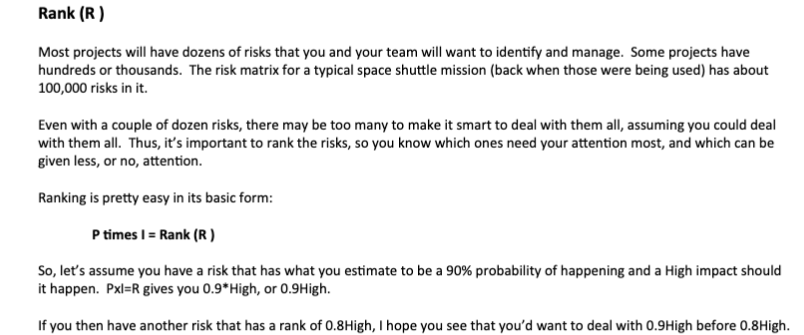
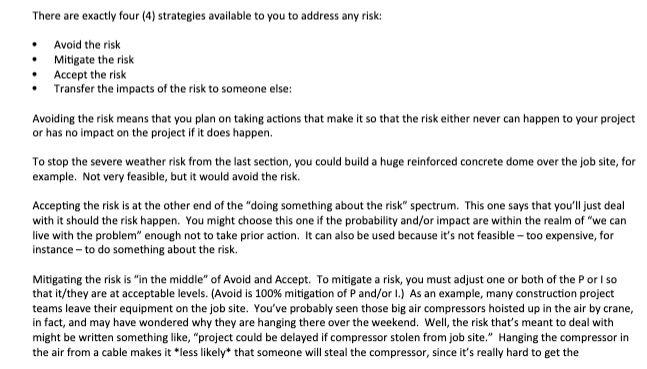
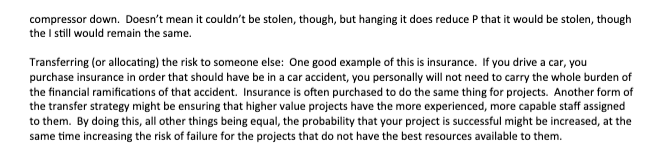
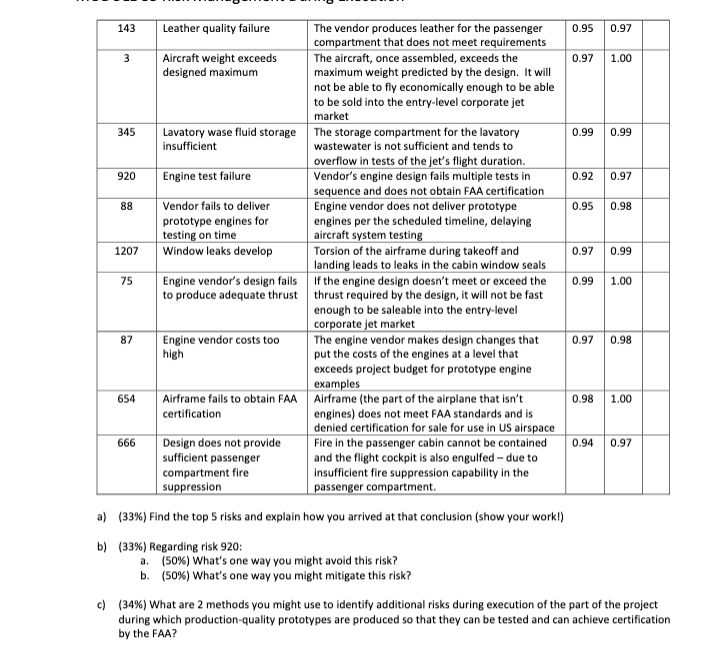
(50%) You are the PM for a project to make a small new passenger jet similar to the Embraer Phenom 100EV. The top 10 risks were identified for the project as follows: Identifier Name Description P . R 0.95 0.97 3 0.97 1.00 0.99 0.99 0.92 0.97 88 0.95 0.98 0.97 0.99 143 Leather quality failure The vendor produces leather for the passenger compartment that does not meet requirements Aircraft weight exceeds The aircraft, once assembled, exceeds the designed maximum maximum weight predicted by the design. It will not be able to fly economically enough to be able to be sold into the entry-level corporate jet market 345 Lavatory wase fluid storage The storage compartment for the lavatory insufficient wastewater is not sufficient and tends to overflow in tests of the jet's flight duration 920 Engine test failure Vendor's engine design fails multiple tests in sequence and does not obtain FAA certification Vendor fails to deliver Engine vendor does not deliver prototype prototype engines for engines per the scheduled timeline, delaying testing on time aircraft system testing 1207 Window leaks develop Torsion of the airframe during takeoff and landing leads to leaks in the cabin window seals 75 Engine vendor's design fails If the engine design doesn't meet or exceed the to produce adequate thrust thrust required by the design, it will not be fast enough to be saleable into the entry-level corporate jet market 87 Engine vendor costs too The engine vendor makes design changes that high put the costs of the engines at a level that exceeds project budget for prototype engine examples 654 Airframe fails to obtain FAA Airframe (the part of the airplane that isn't certification engines) does not meet FAA standards and is denied certification for sale for use in US airspace 666 Design does not provide Fire in the passenger cabin cannot be contained sufficient passenger and the flight cockpit is also engulfed - due to compartment fire insufficient fire suppression capability in the suppression passenger compartment a) (33%) Find the top 5 risks and explain how you arrived at that conclusion (show your work!) 0.99 1.00 0.97 0.98 0.98 1.00 0.94 0.97 b) (33%) Regarding risk 920: a. (50%) What's one way you might avoid this risk? b. (50%) What's one way you might mitigate this risk? c) (34%) What are 2 methods you might use to identify additional risks during execution of the part of the project during which production-quality prototypes are produced so that they can be tested and can achieve certification by the FAA? Rank (R) Most projects will have dozens of risks that you and your team will want to identify and manage. Some projects have hundreds or thousands. The risk matrix for a typical space shuttle mission (back when those were being used) has about 100,000 risks in it. Even with a couple of dozen risks, there may be too many to make it smart to deal with them all, assuming you could deal with them all. Thus, it's important to rank the risks, so you know which ones need your attention most, and which can be given less, or no, attention. Ranking is pretty easy in its basic form: P times I = Rank (R) So, let's assume you have a risk that has what you estimate to be a 90% probability of happening and a High impact should it happen. PxI=R gives you 0.9*High, or 0.9High. If you then have another risk that has a rank of 0.8High, I hope you see that you'd want to deal with 0.9High before 0.8High. There are exactly four (4) strategies available to you to address any risk: Avoid the risk Mitigate the risk Accept the risk Transfer the impacts of the risk to someone else: Avoiding the risk means that you plan on taking actions that make it so that the risk either never can happen to your project or has no impact on the project if it does happen. To stop the severe weather risk from the last section, you could build a huge reinforced concrete dome over the job site, for example. Not very feasible, but it would avoid the risk. Accepting the risk is at the other end of the "doing something about the risk" spectrum. This one says that you'll just deal with it should the risk happen. You might choose this one if the probability and/or impact are within the realm of "we can live with the problem" enough not to take prior action. It can also be used because it's not feasible - too expensive, for instance - to do something about the risk. Mitigating the risk is "in the middle" of Avoid and Accept. To mitigate a risk, you must adjust one or both of the Por so that it/they are at acceptable levels. (Avoid is 100% mitigation of P and/or 1.) As an example, many construction project teams leave their equipment on the job site. You've probably seen those big air compressors hoisted up in the air by crane, in fact, and may have wondered why they are hanging there over the weekend. Well, the risk that's meant to deal with might be written something like, "project could be delayed if compressor stolen from job site." Hanging the compressor in the air from a cable makes it *less likely that someone will steal the compressor, since it's really hard to get the compressor down. Doesn't mean it couldn't be stolen, though, but hanging it does reduce P that it would be stolen, though the I still would remain the same. Transferring (or allocating) the risk to someone else: One good example of this is insurance. If you drive a car, you purchase insurance in order that should have be in a car accident, you personally will not need to carry the whole burden of the financial ramifications of that accident. Insurance is often purchased to do the same thing for projects. Another form of the transfer strategy might be ensuring that higher value projects have the more experienced, more capable staff assigned to them. By doing this, all other things being equal, the probability that your project is successful might be increased, at the same time increasing the risk of failure for the projects that do not have the best resources available to them. (50%) You are the PM for a project to make a small new passenger jet similar to the Embraer Phenom 100EV. The top 10 risks were identified for the project as follows: Identifier Name Description P . R 0.95 0.97 3 0.97 1.00 0.99 0.99 0.92 0.97 88 0.95 0.98 0.97 0.99 143 Leather quality failure The vendor produces leather for the passenger compartment that does not meet requirements Aircraft weight exceeds The aircraft, once assembled, exceeds the designed maximum maximum weight predicted by the design. It will not be able to fly economically enough to be able to be sold into the entry-level corporate jet market 345 Lavatory wase fluid storage The storage compartment for the lavatory insufficient wastewater is not sufficient and tends to overflow in tests of the jet's flight duration 920 Engine test failure Vendor's engine design fails multiple tests in sequence and does not obtain FAA certification Vendor fails to deliver Engine vendor does not deliver prototype prototype engines for engines per the scheduled timeline, delaying testing on time aircraft system testing 1207 Window leaks develop Torsion of the airframe during takeoff and landing leads to leaks in the cabin window seals 75 Engine vendor's design fails If the engine design doesn't meet or exceed the to produce adequate thrust thrust required by the design, it will not be fast enough to be saleable into the entry-level corporate jet market 87 Engine vendor costs too The engine vendor makes design changes that high put the costs of the engines at a level that exceeds project budget for prototype engine examples 654 Airframe fails to obtain FAA Airframe (the part of the airplane that isn't certification engines) does not meet FAA standards and is denied certification for sale for use in US airspace 666 Design does not provide Fire in the passenger cabin cannot be contained sufficient passenger and the flight cockpit is also engulfed - due to compartment fire insufficient fire suppression capability in the suppression passenger compartment a) (33%) Find the top 5 risks and explain how you arrived at that conclusion (show your work!) 0.99 1.00 0.97 0.98 0.98 1.00 0.94 0.97 b) (33%) Regarding risk 920: a. (50%) What's one way you might avoid this risk? b. (50%) What's one way you might mitigate this risk? c) (34%) What are 2 methods you might use to identify additional risks during execution of the part of the project during which production-quality prototypes are produced so that they can be tested and can achieve certification by the FAA? Rank (R) Most projects will have dozens of risks that you and your team will want to identify and manage. Some projects have hundreds or thousands. The risk matrix for a typical space shuttle mission (back when those were being used) has about 100,000 risks in it. Even with a couple of dozen risks, there may be too many to make it smart to deal with them all, assuming you could deal with them all. Thus, it's important to rank the risks, so you know which ones need your attention most, and which can be given less, or no, attention. Ranking is pretty easy in its basic form: P times I = Rank (R) So, let's assume you have a risk that has what you estimate to be a 90% probability of happening and a High impact should it happen. PxI=R gives you 0.9*High, or 0.9High. If you then have another risk that has a rank of 0.8High, I hope you see that you'd want to deal with 0.9High before 0.8High. There are exactly four (4) strategies available to you to address any risk: Avoid the risk Mitigate the risk Accept the risk Transfer the impacts of the risk to someone else: Avoiding the risk means that you plan on taking actions that make it so that the risk either never can happen to your project or has no impact on the project if it does happen. To stop the severe weather risk from the last section, you could build a huge reinforced concrete dome over the job site, for example. Not very feasible, but it would avoid the risk. Accepting the risk is at the other end of the "doing something about the risk" spectrum. This one says that you'll just deal with it should the risk happen. You might choose this one if the probability and/or impact are within the realm of "we can live with the problem" enough not to take prior action. It can also be used because it's not feasible - too expensive, for instance - to do something about the risk. Mitigating the risk is "in the middle" of Avoid and Accept. To mitigate a risk, you must adjust one or both of the Por so that it/they are at acceptable levels. (Avoid is 100% mitigation of P and/or 1.) As an example, many construction project teams leave their equipment on the job site. You've probably seen those big air compressors hoisted up in the air by crane, in fact, and may have wondered why they are hanging there over the weekend. Well, the risk that's meant to deal with might be written something like, "project could be delayed if compressor stolen from job site." Hanging the compressor in the air from a cable makes it *less likely that someone will steal the compressor, since it's really hard to get the compressor down. Doesn't mean it couldn't be stolen, though, but hanging it does reduce P that it would be stolen, though the I still would remain the same. Transferring (or allocating) the risk to someone else: One good example of this is insurance. If you drive a car, you purchase insurance in order that should have be in a car accident, you personally will not need to carry the whole burden of the financial ramifications of that accident. Insurance is often purchased to do the same thing for projects. Another form of the transfer strategy might be ensuring that higher value projects have the more experienced, more capable staff assigned to them. By doing this, all other things being equal, the probability that your project is successful might be increased, at the same time increasing the risk of failure for the projects that do not have the best resources available to them









 Study Help