







Question: project note on all CVP Analysis and Decision-Making . Decision Maximum Contribution is owned from Product WYE. So, WYE should be manufactured by using sub-
project note on all
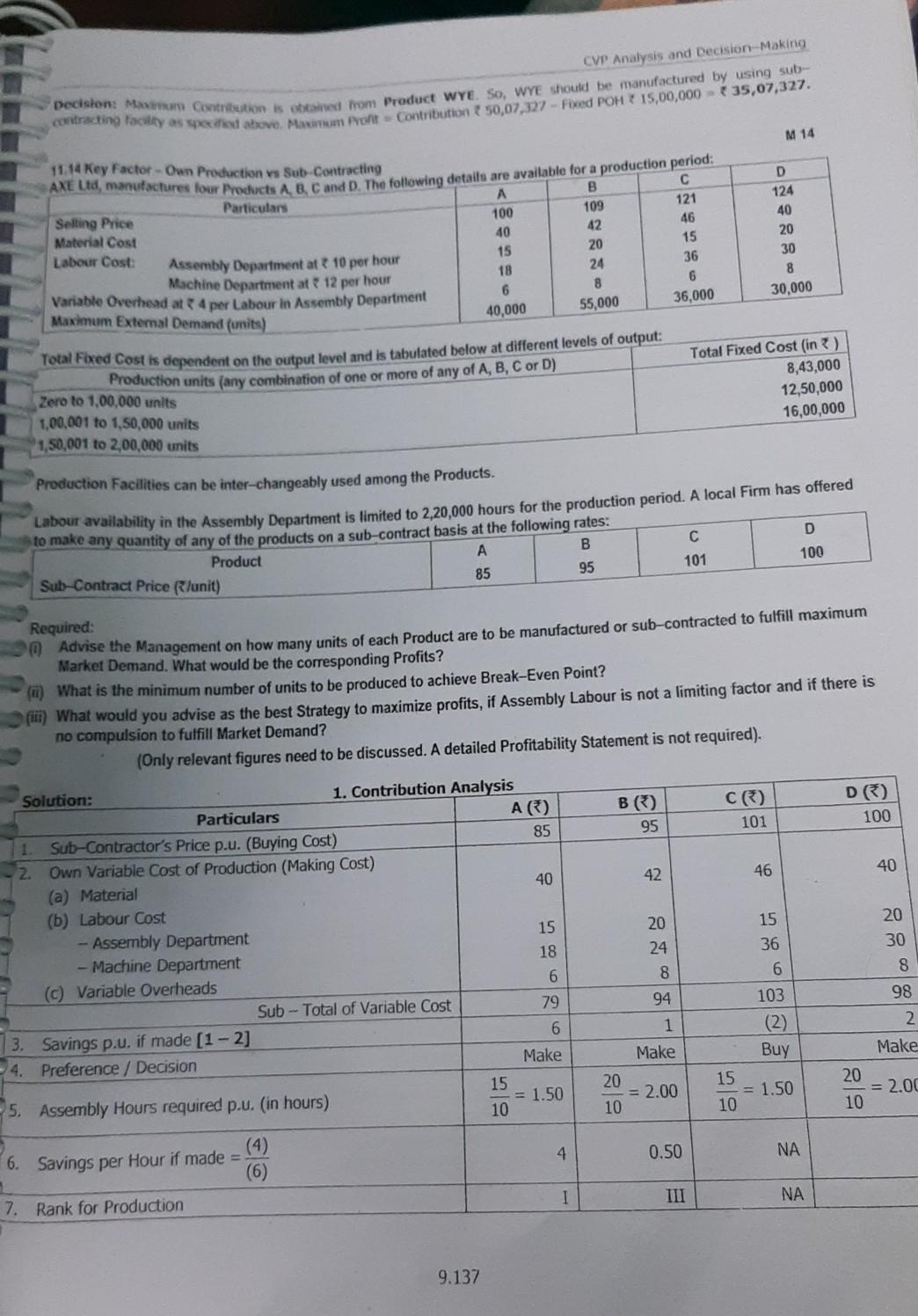
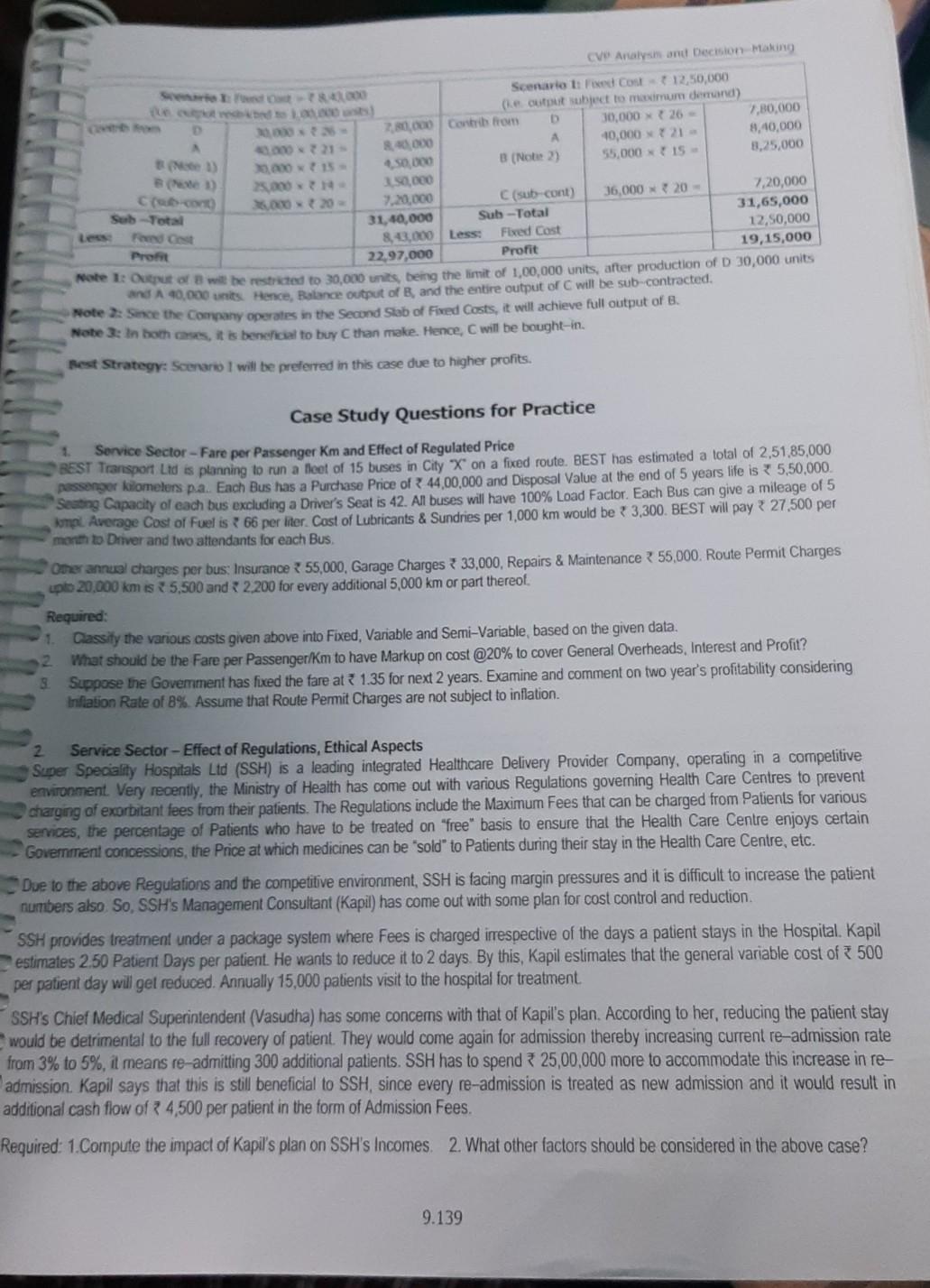
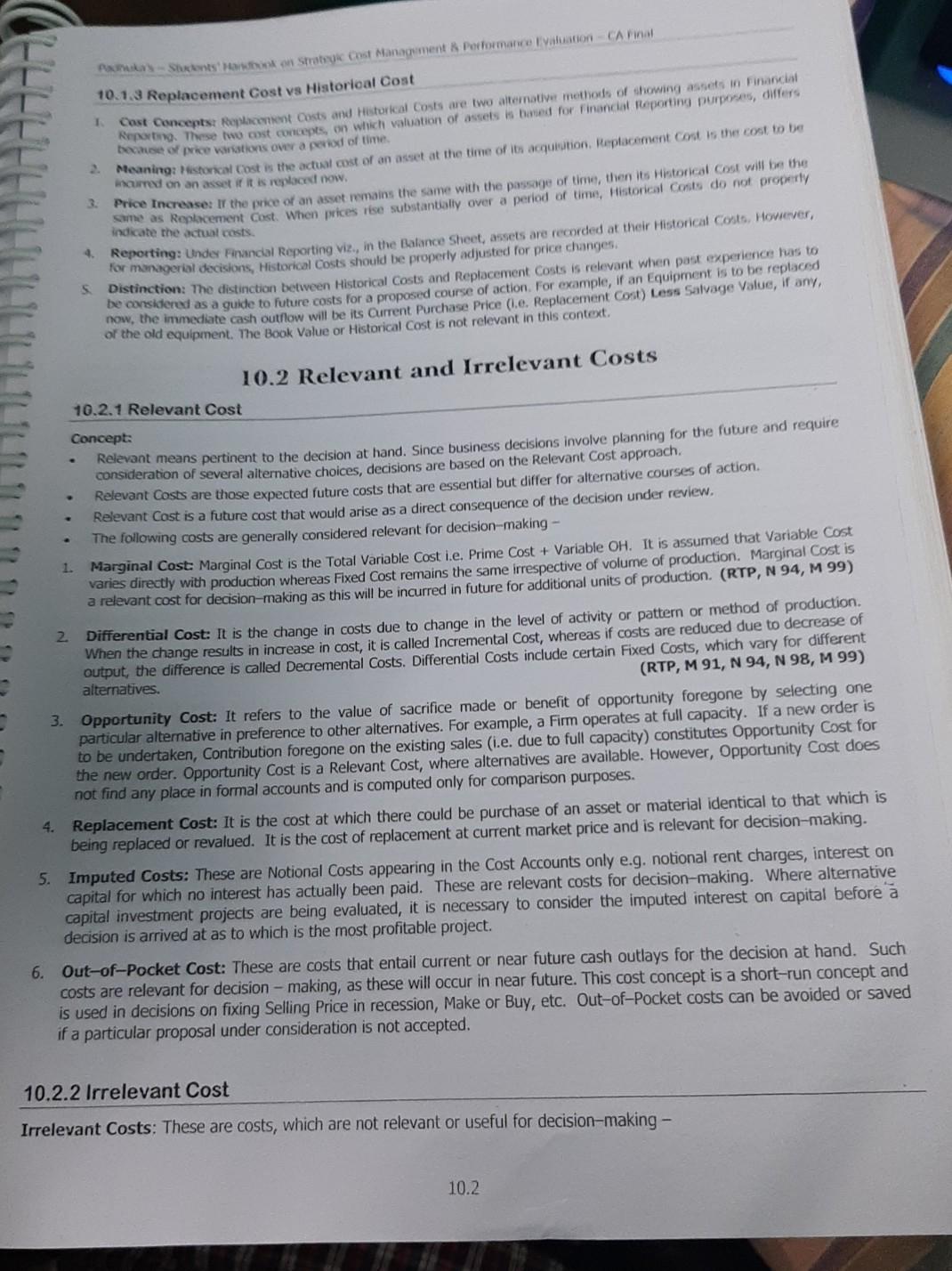
CVP Analysis and Decision-Making . Decision Maximum Contribution is owned from Product WYE. So, WYE should be manufactured by using sub- 36,000 11.14 Key Factor-Own Production vs Sub-Contracting M 14 AXE Ltd, manufactures four Products A, B, C and D. The following details are available for a production period: D B A Particulars Selling Price 124 100 121 109 Material Cost 46 42 40 40 Labour Cost: 20 15 15 Assembly Department at 10 per hour 20 36 30 24 Machine Department at 12 per hour 18 Variable Overhead at 4 per Labour in Assembly Department 8 6 6 8 Maximum External Demand (units) 30,000 40,000 55,000 Total Fixed Cost is dependent on the output level and is tabulated below at different levels of output: Production units (any combination of one or more of any of A, B, C or D) Total Fixed Cost (in) Zero to 1,00,000 units 8,43,000 1,00,001 to 1,50,000 units 12,50,000 1,50,001 to 2,00,000 units 16,00,000 Production Facilities can be inter-changeably used among the Products. Labour availability in the Assembly Department is limited to 2,20,000 hours for the production period. A local Firm has offered to make any quantity of any of the products on a sub-contract basis at the following rates: Product D B 100 A 85 95 101 Sub-Contract Price Rlunit) Required Advise the Management on how many units of each Product are to be manufactured or sub-contracted to fulfill maximum Market Demand. What would be the corresponding Profits? (m) What is the minimum number of units to be produced to achieve Break-Even Point? (ii) What would you advise as the best Strategy to maximize profits, if Assembly Labour is not a limiting factor and if there is no compulsion to fulfill Market Demand? (Only relevant figures need to be discussed. A detailed profitability Statement is not required). B) 95 C) 101 D) 100 46 40 42. 15 20 24 8 36 6 Solution: 1. Contribution Analysis Particulars A() 1 Sub-Contractor's Price p.u. (Buying Cost) 85 2. Own Variable Cost of Production (Making Cost) 40 (a) Material (b) Labour Cost - Assembly Department 15 - Machine Department 18 (C) Variable Overheads 6 Sub - Total of Variable Cost 79 3. Savings p.u. if made [1 -2] 6 4. Preference / Decision Make 15 5. Assembly Hours required p.u. (in hours) = 1.50 10 (4) 6. Savings per Hour if made = 4 (6) 7. Rank for Production 1 94 103 20 30 8 98 2 Make 20 = 2.00 10 1 Make 20 = 2.00 10 (2) Buy 15 = 1.50 10 0.50 NA III NA 9.137 CV Analysis and Decision Making Scenariot Fixed Cost 12,50,000 (ecutput subject to maximum demand) 2000 Contribs from D 30,000 26 7,80.000 2001 40.000 40,000 21 8,40,000 00015 50.000 (Note 2) 55.000 15 3,25,000 150,000 00020 7,20,000 C (sub-cont) 36,000 20 7,20,000 Lees 31, 40.000 Sub-Total 31,65,000 8,43,000 Less Fixed Cost 12,50,000 Pro 22.97,000 Profit 19,15,000 Note : Out of 8 wilt be restricted to 30,000 units, being the limit of 1,00,000 units, after production of D 30,000 units and A40,000 units Hence, Balance output of B, and the entire output of C will be sub-contracted. Note 2: Since the Company operates in the Second Stab of Fixed Costs, it will achieve full output of B. Note 3: In both cases, it is beneficial to buy C than make. Hence, will be bought-in. Rest Strategy: Scenario I will be preferred in this case due to higher profits. C- Sub Total F C Case Study Questions for Practice 1 Service Sector - Fare per Passenger Km and Effect of Regulated Price BEST Transport Lid is planning to run a fleet of 15 buses in City X on a fixed route. BEST has estimated a total of 2,51,85,000 passenger kilometers pa. Each Bus has a Purchase Price of 44,00,000 and Disposal Value at the end of 5 years life is 5,50,000 Sesong Capacity of each bus excluding a Driver's Seat is 42. All buses will have 100% Load Factor. Each Bus can give a mileage of 5 kompl Average Cost of Fuel is ? 66 per liter. Cost of Lubricants & Sundries per 1,000 km would be 3,300. BEST will pay 2 27,500 per month to Driver and two attendants for each Bus Omer annual charges per bus: Insurance ? 55,000, Garage Charges 33,000, Repairs & Maintenance ? 55,000. Route Permit Charges up 20.000 km is 5,500 and 2.200 for every additional 5,000 km or part thereof. Required: 1. Dassity the various costs given above into Fixed, Variable and Semi-Variable based on the given data. What should be the Fare per Passenger/Km to have Markup on cost @20% to cover General Overheads, Interest and Profit? 8 Suppose the Goverment has fixed the fare at * 1.35 for next 2 years. Examine and comment on two year's profitability considering Inflation Rate of 8%. Assume that Route Permit Charges are not subject to inflation. 2 Service Sector-Effect of Regulations, Ethical Aspects Super Speciality Hospitals Ltd (SSH) is a leading integrated Healthcare Delivery Provider Company, operating in a competitive environment. Very recently, the Ministry of Health has come out with various Regulations governing Health Care Centres to prevent charging of exorbitant fees from their patients. The Regulations include the Maximum Fees that can be charged from Patients for various services, the percentage of Patients who have to be treated on "free" basis to ensure that the Health Care Centre enjoys certain Government concessions, the Price at which medicines can be "sold" to Patients during their stay in the Health Care Centre, etc. Due to the above Regulations and the competitive environment, SSH is facing margin pressures and it is difficult to increase the patient numbers also So, SSH's Management Consultant (Kapil) has come out with some plan for cost control and reduction SSH provides treatment under a package system where Fees is charged irrespective of the days a patient stays in the Hospital. Kapil estimates 2.50 Patient Days per patient. He wants to reduce it to 2 days. By this, Kapil estimates that the general variable cost of 500 per patient day will get reduced. Annually 15,000 patients visit to the hospital for treatment SSH's Chief Medical Superintendent (Vasudha) has some concerns with that of Kapil's plan. According to her, reducing the patient stay would be detrimental to the full recovery of patient. They would come again for admission thereby increasing current re-admission rate from 3% to 5%, it means re-admitting 300 additional patients. SSH has to spend 25,00,000 more to accommodate this increase in re- admission. Kapil says that this is still beneficial to SSH, since every re-admission is treated as new admission and it would result in additional cash flow of ? 4,500 per patient in the form of Admission Fees. Required: 1. Compute the impact of Kapil's plan on SSH's Incomes. 2. What other factors should be considered in the above case? 9.139 1 3 mas - Shants Strategic Coast Management Performance Valuation Carina 10.1.3 Replacement Cost vs Historical Cost Cast Concepts: Replacement costs and Historical Costs are two alterative methods of showing assets in Financial Reportna These two cost concepts, on which valuation of assets is bad for Financial Reporting purposes, differs because of price variations over a period of time. Meaning: Historical Costs the actual cost of an asset at the time of its accuration. Replacement Cost is the cost to be incurred on an asset if it is replaced now. Price Increases in the price of an asset remains the same with the passage of time, then its Mntorical cost will be the Same as Renkacement Cost. When prices rise substantially over a period of time, Historical costs do not property Reporting: Under Firmancial Reporting Wiz., in the Balance Sheet, assets are recorded at their Historical costs. However, for managerial decisions, Historical Costs should be properly adjusted for price changes. Distinction: The distinction between Historical Costs and Replacement Costs is relevant when post experience has to be considered as a guide to future costs for a proposed course of action. For example, if an Equipment is to be replaced now, the immediate cash outflow will be its Current Purchase Price (.e. Replacement Cont) Less Salvage Value, if any, of the old equipment. The Book Value or Historical Cost is not relevant in this context indicate the actual costs 4 5 10.2 Relevant and Irrelevant Costs 10.2.1 Relevant Cost 1. Concept: Relevant means pertinent to the decision at hand. Since business decisions involve planning for the future and require consideration of several alternative choices, decisions are based on the Relevant Cost approach. Relevant costs are those expected future costs that are essential but differ for alternative courses of action. Relevant Cost is a future cost that would arise as a direct consequence of the decision under review, The following costs are generally considered relevant for decision-making - Marginal Cost: Marginal Cost is the Total Variable Cost i.e. Prime Cost + Variable OH. It is assumed that Variable cost varies directly with production whereas Fixed Cost remains the same irrespective of volume of production. Marginal Cost is a relevant cost for decision-making as this will be incurred in future for additional units of production. (RTP, N 94, M 99) 2. Differential Cost: It is the change in costs due to change in the level of activity or pattern or method of production. When the change results in increase in cost, it is called Incremental Cost, whereas if costs are reduced due to decrease of output, the difference is called Decremental Costs. Differential Costs include certain Fixed Costs, which vary for different alternatives. (RTP, M 91, N 94, N 98, M 99) 3. Opportunity Cost: It refers to the value of sacrifice made or benefit of opportunity foregone by selecting one particular alternative in preference to other alternatives. For example, a Firm operates at full capacity. If a new order is to be undertaken, Contribution foregone on the existing sales (i.e. due to full capacity) constitutes Opportunity Cost for the new order. Opportunity Cost is a Relevant Cost, where alternatives are available. However, Opportunity Cost does not find any place in formal accounts and is computed only for comparison purposes. 4. Replacement Cost: It is the cost at which there could be purchase of an asset or material identical to that which is being replaced or revalued. It is the cost of replacement at current market price and is relevant for decision-making. 5. Imputed Costs: These are Notional Costs appearing in the Cost Accounts only e.g. notional rent charges, interest on capital for which no interest has actually been paid. These are relevant costs for decision-making. Where alternative capital investment projects are being evaluated, it is necessary to consider the imputed interest on capital before a decision is arrived at as to which is the most profitable project. 6. Out-of-Pocket Cost: These are costs that entail current or near future cash outlays for the decision at hand. Such costs are relevant for decision-making, as these will occur in near future. This cost concept is a short-run concept and is used in decisions on fixing Selling Price in recession, Make or Buy, etc. Out-of-Pocket costs can be avoided or saved if a particular proposal under consideration is not accepted. 10.2.2 Irrelevant Cost Irrelevant Costs: These are costs, which are not relevant or useful for decision-making - 10.2
Step by Step Solution
There are 3 Steps involved in it

Get step-by-step solutions from verified subject matter experts
 Study Help