



Question: Project Risk Management: An Integrated Approach LO 7.3 Explain the Project Risk Analysis and Management (PRAM) process. The European Association for Project Management has developed
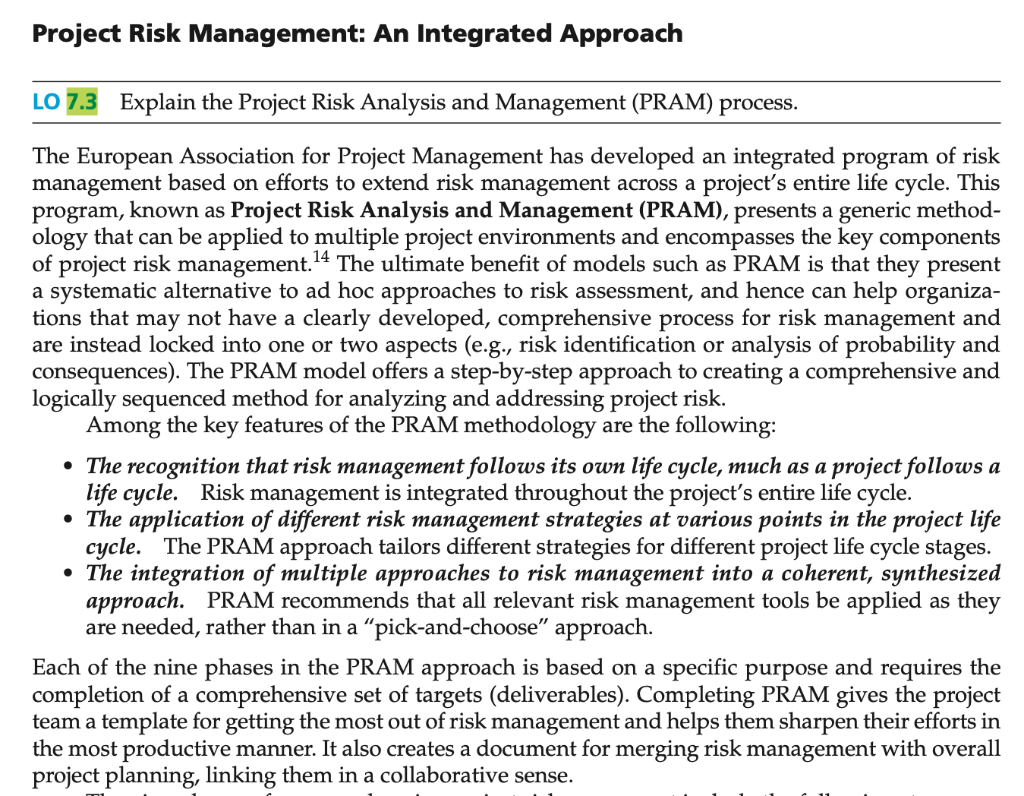

Project Risk Management: An Integrated Approach LO 7.3 Explain the Project Risk Analysis and Management (PRAM) process. The European Association for Project Management has developed an integrated program of risk management based on efforts to extend risk management across a project's entire life cycle. This program, known as Project Risk Analysis and Management (PRAM), presents a generic methodology that can be applied to multiple project environments and encompasses the key components of project risk management. 14 The ultimate benefit of models such as PRAM is that they present a systematic alternative to ad hoc approaches to risk assessment, and hence can help organizations that may not have a clearly developed, comprehensive process for risk management and are instead locked into one or two aspects (e.g., risk identification or analysis of probability and consequences). The PRAM model offers a step-by-step approach to creating a comprehensive and logically sequenced method for analyzing and addressing project risk. Among the key features of the PRAM methodology are the following: - The recognition that risk management follows its own life cycle, much as a project follows a life cycle. Risk management is integrated throughout the project's entire life cycle. - The application of different risk management strategies at various points in the project life cycle. The PRAM approach tailors different strategies for different project life cycle stages. - The integration of multiple approaches to risk management into a coherent, synthesized approach. PRAM recommends that all relevant risk management tools be applied as they are needed, rather than in a "pick-and-choose" approach. Each of the nine phases in the PRAM approach is based on a specific purpose and requires the completion of a comprehensive set of targets (deliverables). Completing PRAM gives the project team a template for getting the most out of risk management and helps them sharpen their efforts in the most productive manner. It also creates a document for merging risk management with overall project planning, linking them in a collaborative sense. Using case 7.3 in your textbook, create a risk register with at least 8 risks identified. Ignore the questions in the case. Use either Google doc or MS Word in a table format or Google sheets or Excel with formated cells. Approach this assignment as if you are the PM. Risk development/content is important but so is format. Use the examples from lecture as a guide. Project Risk Management: An Integrated Approach LO 7.3 Explain the Project Risk Analysis and Management (PRAM) process. The European Association for Project Management has developed an integrated program of risk management based on efforts to extend risk management across a project's entire life cycle. This program, known as Project Risk Analysis and Management (PRAM), presents a generic methodology that can be applied to multiple project environments and encompasses the key components of project risk management. 14 The ultimate benefit of models such as PRAM is that they present a systematic alternative to ad hoc approaches to risk assessment, and hence can help organizations that may not have a clearly developed, comprehensive process for risk management and are instead locked into one or two aspects (e.g., risk identification or analysis of probability and consequences). The PRAM model offers a step-by-step approach to creating a comprehensive and logically sequenced method for analyzing and addressing project risk. Among the key features of the PRAM methodology are the following: - The recognition that risk management follows its own life cycle, much as a project follows a life cycle. Risk management is integrated throughout the project's entire life cycle. - The application of different risk management strategies at various points in the project life cycle. The PRAM approach tailors different strategies for different project life cycle stages. - The integration of multiple approaches to risk management into a coherent, synthesized approach. PRAM recommends that all relevant risk management tools be applied as they are needed, rather than in a "pick-and-choose" approach. Each of the nine phases in the PRAM approach is based on a specific purpose and requires the completion of a comprehensive set of targets (deliverables). Completing PRAM gives the project team a template for getting the most out of risk management and helps them sharpen their efforts in the most productive manner. It also creates a document for merging risk management with overall project planning, linking them in a collaborative sense. Using case 7.3 in your textbook, create a risk register with at least 8 risks identified. Ignore the questions in the case. Use either Google doc or MS Word in a table format or Google sheets or Excel with formated cells. Approach this assignment as if you are the PM. Risk development/content is important but so is format. Use the examples from lecture as a guide
Step by Step Solution
There are 3 Steps involved in it

Get step-by-step solutions from verified subject matter experts