







Question: Project Using this link, we collected the suspended sediment concentration and discharge observations at USGS station 1 2 0 3 1 0 0 0 CHEHALIS
Project
Using this link, we collected the suspended sediment concentration and discharge observations at
USGS station CHEHALIS RIVER AT PORTER, WA The following figure shows the location
of the USGS station.
Let's see what these variables are!
Suspended sediment concentration SSC refers to the amount of solid particles that are
suspended in water. These particles can include silt, clay, sand, and other materials. The
concentration is typically expressed in terms of mass or volume of sediment per unit volume of
water. Common units for SSC include milligrams per liter or parts per million ppm River
discharge refers to the volume of water flowing through a river channel over a specific period of
time. It is typically measured in cubic meters per second or cubic feet per second cfs River
discharge is a fundamental and important hydrological parameter as it reflects the movement of
water within a river system.
See the dataset in the attached excel file. This data is collected at daily time scale from October
to September Here is description of the datasets.
Description
Suspended Sediment Concentration SSC milligrams per liter mgL
Discharge, cubic feet per second cfs
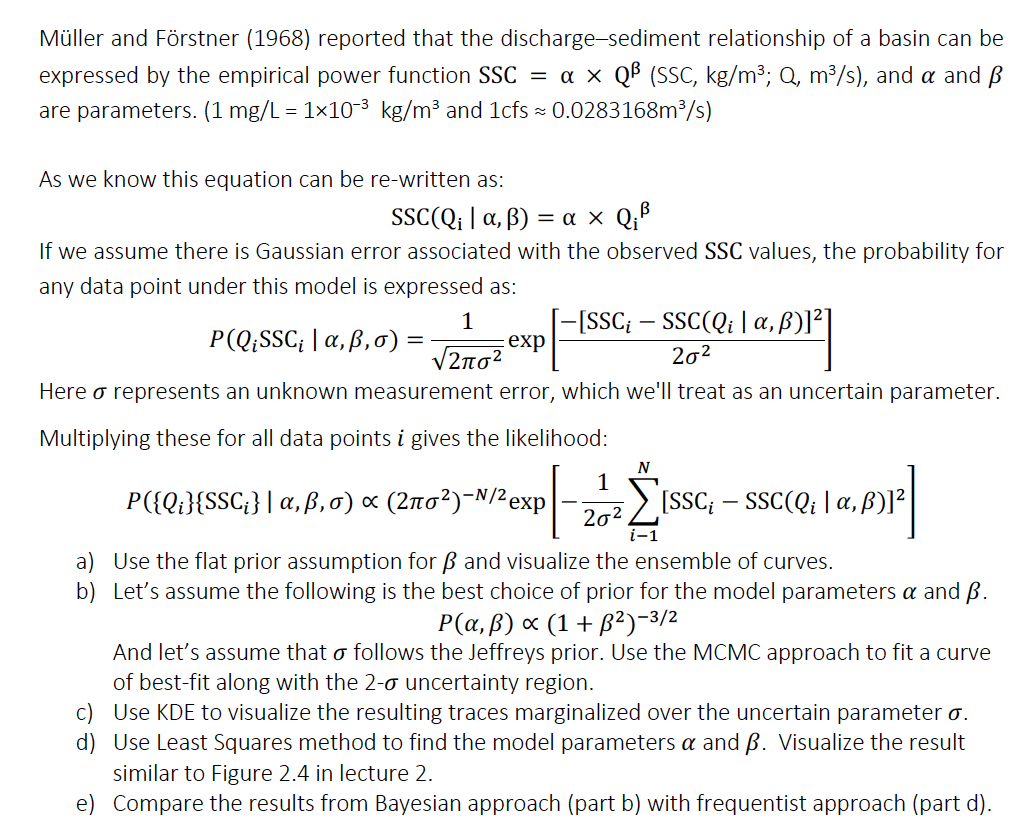
Mller and Frstner reported that the dischargesediment relationship of a basin can be
expressed by the empirical power function SSC SSC:; and and
are parameters. and :~~
As we know this equation can be rewritten as:
If we assume there is Gaussian error associated with the observed SSC values, the probability for
any data point under this model is expressed as:
exp
Here represents an unknown measurement error, which we'll treat as an uncertain parameter.
Multiplying these for all data points i gives the likelihood:
exp
a Use the flat prior assumption for and visualize the ensemble of curves.
b Let's assume the following is the best choice of prior for the model parameters and
And let's assume that follows the Jeffreys prior. Use the MCMC approach to fit a curve
of bestfit along with the uncertainty region.
c Use KDE to visualize the resulting traces marginalized over the uncertain parameter
d Use Least Squares method to find the model parameters and Visualize the result
similar to Figure in lecture
e Compare the results from Bayesian approach part b with frequentist approach part d
Step by Step Solution
There are 3 Steps involved in it
1 Expert Approved Answer
Step: 1 Unlock

Question Has Been Solved by an Expert!
Get step-by-step solutions from verified subject matter experts
Step: 2 Unlock
Step: 3 Unlock
 Study Help