







Question: Projects differ in risk, and risk analysis is a critical component of the capital budgeting process. Consider the case of United Recycling Inc.: United Recycling
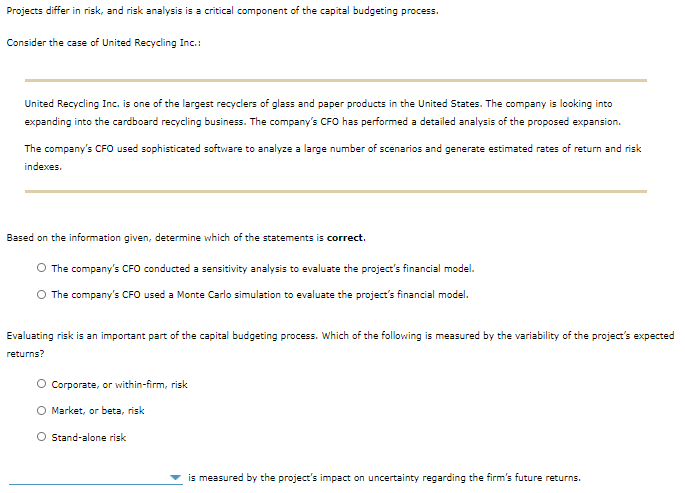
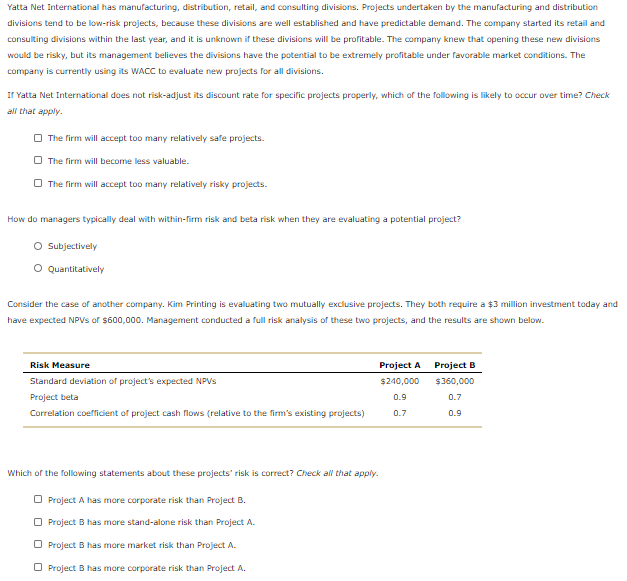
Projects differ in risk, and risk analysis is a critical component of the capital budgeting process. Consider the case of United Recycling Inc.: United Recycling Inc. is one of the largest recyclers of glass and paper products in the United States. The company is looking into expanding into the cardboard recycling business. The company's CFO has performed a detailed analysis of the proposed expansion. The company's CFO used sophisticated software to analyze a large number of scenarios and generate estimated rates of return and risk indexes. Based on the information given, determine which of the statements is correct. The company's CFO conducted a sensitivity analysis to evaluate the project's financial model. The company's CFO used a Monte Carlo simulation to evaluate the project's financial model. Evaluating risk is an important part of the capital budgeting process. Which of the following is measured by the variability of the project's expected returns? O Corporate, or within-firm, risk O Market, or beta, risk O Stand-alone risk is measured by the project's impact on uncertainty regarding the firm's future returns. Yatta Net International has manufacturing, distribution, retail, and consulting divisions. Projects undertaken by the manufacturing and distribution divisions tend to be low-risk projects, because these divisions are well established and have predictable demand. The company started its retail and consulting divisions within the last year, and it is unknown if these divisions will be profitable. The company knew that opening these new divisions would be risky, but its management believes the divisions have the potential to be extremely profitable under favorable market conditions. The company is currently using its WACC to evaluate new projects for all divisions. If Yatta Net International does not risk-adjust its discount rate for specific projects properly, which of the following is likely to occur over time? Check all that apply. The firm will accept too many relatively safe projects. The firm will become less valuable. The firm will accept too many relatively risky projects. How do managers typically deal with within-firm risk and beta risk when they are evaluating a potential project? O Subjectively O Quantitatively Consider the case of another company. Kim Printing is evaluating two mutually exclusive projects. They both require a $3 million investment today and have expected NPVs of $600,000. Management conducted a full risk analysis of these two projects, and the results are shown below. Project A $240,000 Risk Measure Standard deviation of project's expected NPVS Project beta Correlation coefficient of project cash flows (relative to the firm's existing projects) Project B $360,000 0.7 0.9 0.7 0.9 Which of the following statements about these projects' risk is correct? Check all that apply. Project A has more corporate risk than Project B. Project B has more stand-alone risk than Project A. Project B has more market risk than Project A. Project B has more corporate risk than Project A. Projects differ in risk, and risk analysis is a critical component of the capital budgeting process. Consider the case of United Recycling Inc.: United Recycling Inc. is one of the largest recyclers of glass and paper products in the United States. The company is looking into expanding into the cardboard recycling business. The company's CFO has performed a detailed analysis of the proposed expansion. The company's CFO used sophisticated software to analyze a large number of scenarios and generate estimated rates of return and risk indexes. Based on the information given, determine which of the statements is correct. The company's CFO conducted a sensitivity analysis to evaluate the project's financial model. The company's CFO used a Monte Carlo simulation to evaluate the project's financial model. Evaluating risk is an important part of the capital budgeting process. Which of the following is measured by the variability of the project's expected returns? O Corporate, or within-firm, risk O Market, or beta, risk O Stand-alone risk is measured by the project's impact on uncertainty regarding the firm's future returns. Yatta Net International has manufacturing, distribution, retail, and consulting divisions. Projects undertaken by the manufacturing and distribution divisions tend to be low-risk projects, because these divisions are well established and have predictable demand. The company started its retail and consulting divisions within the last year, and it is unknown if these divisions will be profitable. The company knew that opening these new divisions would be risky, but its management believes the divisions have the potential to be extremely profitable under favorable market conditions. The company is currently using its WACC to evaluate new projects for all divisions. If Yatta Net International does not risk-adjust its discount rate for specific projects properly, which of the following is likely to occur over time? Check all that apply. The firm will accept too many relatively safe projects. The firm will become less valuable. The firm will accept too many relatively risky projects. How do managers typically deal with within-firm risk and beta risk when they are evaluating a potential project? O Subjectively O Quantitatively Consider the case of another company. Kim Printing is evaluating two mutually exclusive projects. They both require a $3 million investment today and have expected NPVs of $600,000. Management conducted a full risk analysis of these two projects, and the results are shown below. Project A $240,000 Risk Measure Standard deviation of project's expected NPVS Project beta Correlation coefficient of project cash flows (relative to the firm's existing projects) Project B $360,000 0.7 0.9 0.7 0.9 Which of the following statements about these projects' risk is correct? Check all that apply. Project A has more corporate risk than Project B. Project B has more stand-alone risk than Project A. Project B has more market risk than Project A. Project B has more corporate risk than Project A
Step by Step Solution
There are 3 Steps involved in it

Get step-by-step solutions from verified subject matter experts
 Study Help