







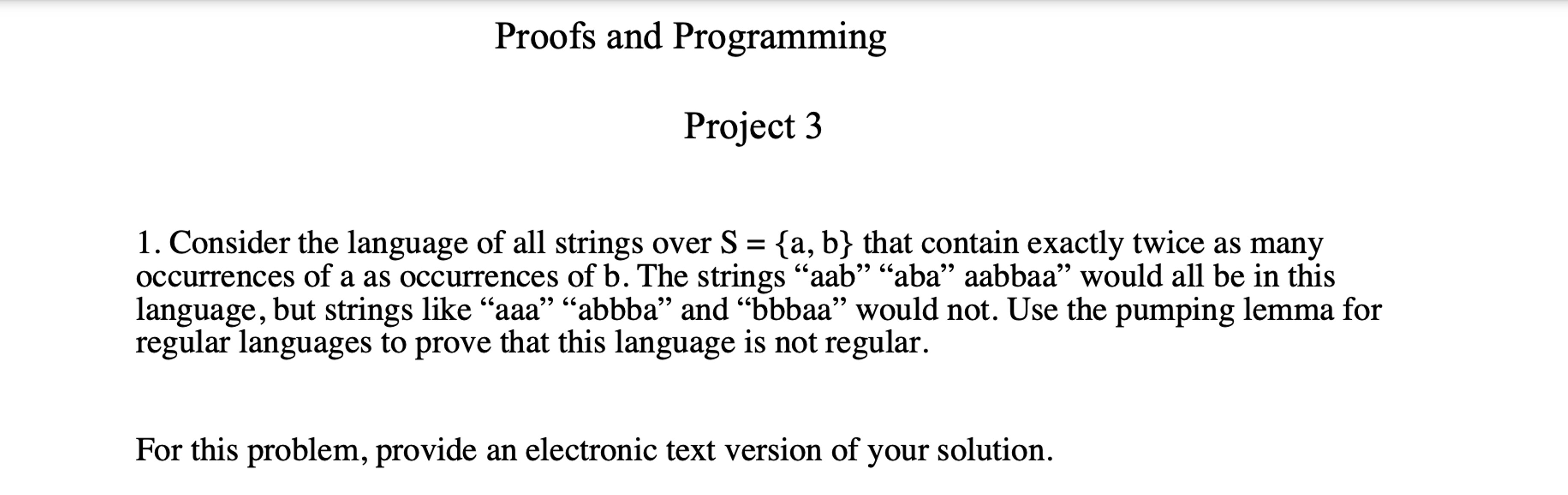
Question: Proofs and Programming 1 . Consider the language of all strings over S = { a , b } that contain exactly twice as many
Proofs and Programming
Consider the language of all strings over S a b that contain exactly twice as many
occurrences of a as occurrences of b The strings aababa aabbaa would all be in this
language, but strings like aaaabbba and bbbaa would not. Use the pumping lemma for
regular languages to prove that this language is not regular.
For this problem, provide an electronic text version of your solution.
Is the class of contextfree languages at least as large as the class of regular languages? To
prove this show that any NFA has an equivalent CFG by writing a program called
nfatocfgcpp
This program will read an NFA description from a file. The NFA will be given in the same
format as in project The NFA will have no more than states and no more than
transitions. The alphabet for the NFA is Sigma a b c You will output an equivalent CFG to
standard out by listing its rules. The CFG production rules must be stored internally in an
ADT of your choice. Do this carefully so the production rules could be easily parsed. The
CFG should use variables with names like V V Vn that way you can have as many
variables as you like V will always be assumed to be the start variable. The CFG need not
be in Chomsky normal form. You will output the CFG using a format like the following:
V V
V a V
V
V b V
V
The string on the right of each rule will be spacedelimited. The is also space delimited.
Rules that have epsilon on the right will simply have empty definitions.
As an example, the NFA given as:
trans a
trans b
trans c
trans a
trans b
trans c
trans b
trans b
trans b
trans a
trans b
final
could produce the CFG this depends on how you handle the start state transitions and how
you choose to number your states:
V a V
V b V
V c V
V a V
V b V
V c V
V b V
V b V
V b V
V a V
V b V
V
So this process is pretty easy. Why? The language accepted by an NFA is regular. A CFG
for a regular language is straightforward because it must only capture iteration and does not
need to capture recursive structures in the language. Begin to think about how you would
convert the above CFG to Chomsky normal form.
Is the class of contextfree languages strictly larger than the class of regular languages?
How can this be shown? Find a known nonregular language and show that it is context free.
How about the language from the first problem above? Show that this language is context
free. You have two choices here; either construct a CFG that describes the language in
problem or construct a PDA that accepts the language in problem Since this language
could not be pumped using the Pumping Lemma for Regular Langauages, as shown in
problem we complete the proof.
For this problem, provide an electronic text version of your solution or a JFLAP file.
Step by Step Solution
There are 3 Steps involved in it
1 Expert Approved Answer
Step: 1 Unlock

Question Has Been Solved by an Expert!
Get step-by-step solutions from verified subject matter experts
Step: 2 Unlock
Step: 3 Unlock
 Study Help