



Question: Proper working capital management requires a manager to focus on a firm's working capital, with a particular emphasis on maintaining an optimal level of cash
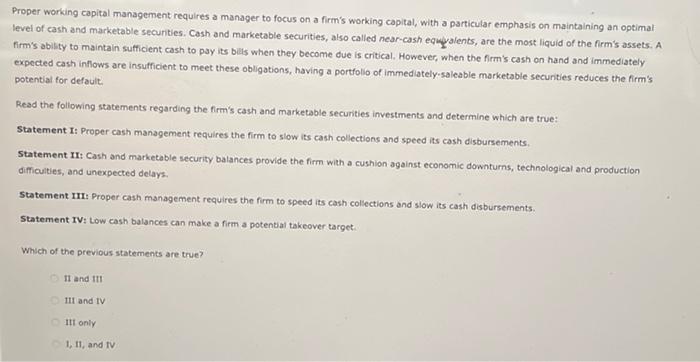
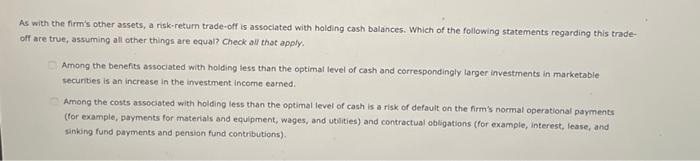
Proper working capital management requires a manager to focus on a firm's working capital, with a particular emphasis on maintaining an optimal level of cash and marketable securities. Cash and marketable securities, also called near-cash equeplents, are the most liquid of the firm's assets. A firm's abihty to maintain sufficient cash to pay its bils when they become due is critical, However, when the firm's cash on hand and immediately expected cash inflows are insufficient to meet these obligations, having a portfolio of immediately-saleable marketable secunities reduces the firm's potential for default. Read the following statements regarding the firm's cash and marketable securities investments and determine which are true: Statement I: Proper cash management requires the firm to slow its cash collections and speed its cash disbursements. Statement II: Cash and marketable security balances provide the firm with a cushion against economic downturns, technological and production difficulties, and unexpected delays. Statement III: Proper cash management requires the firm to speed its cash collections and slow its cash disbursements. Statement rV : Low cash balances can make a firm a potential takeover target. Which of the previous statements are true? tt and ttI tit and TV IIt only 1,11 , and FV s with the firm's other assets, a risk-return trade-off is associated with holding cash balances. Which of the following statements regarding this tradeAf are true, assuming all other things are equal? Check all that apply. Among the benefits associated with holding less than the optimal level of cash and correspondingly larger investments in marketable securities is an incresse in the investment incorne eamed. Among the costs assobated with holding less than the optimal level of cash is a risk of default on the firm's normal operational parments (for example, payments for materials and equipment, wages, and utilities) and contractual obligations (for example, interest, lease, and sinking fund payments and pension fund contributions)
Step by Step Solution
There are 3 Steps involved in it

Get step-by-step solutions from verified subject matter experts