







Question: Proportional Reasoning Some problems adapted from Gibbs' Qualitative Problems for Introductory Physics 1. 100 cm are equivalent to 1 m. How many cm are equivalent
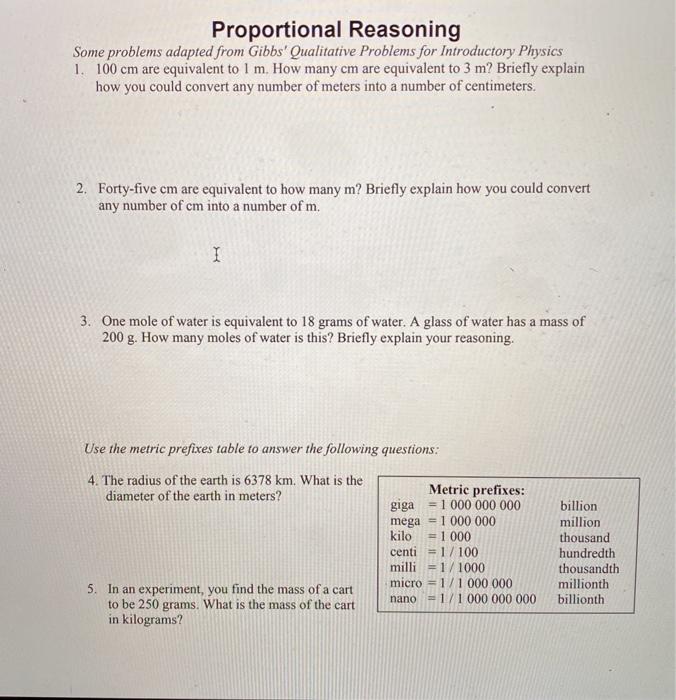
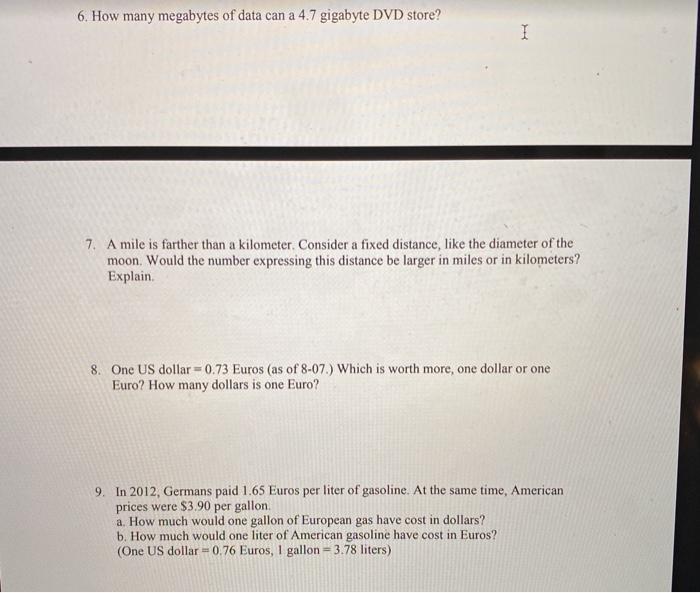
Proportional Reasoning Some problems adapted from Gibbs' Qualitative Problems for Introductory Physics 1. 100 cm are equivalent to 1 m. How many cm are equivalent to 3 m? Briefly explain how you could convert any number of meters into a number of centimeters. 2. Forty-five cm are equivalent to how many m? Briefly explain how you could convert any number of cm into a number of m. I 3. One mole of water is equivalent to 18 grams of water. A glass of water has a mass of 200 g. How many moles of water is this? Briefly explain your reasoning. Use the metric prefixes table to answer the following questions: 4. The radius of the earth is 6378 km. What is the diameter of the earth in meters? Metric prefixes: giga = 1 000 000 000 mega = 1 000 000 kilo = 1 000 centi = 1/100 milli = 1/1000 micro = 1/1 000 000 nano = 1/1 000 000 000 billion million thousand hundredth thousandth millionth billionth 5. In an experiment, you find the mass of a cart to be 250 grams. What is the mass of the cart in kilograms? 6. How many megabytes of data can a 4.7 gigabyte DVD store? I 7. A mile is farther than a kilometer. Consider a fixed distance, like the diameter of the moon. Would the number expressing this distance be larger in miles or in kilometers? Explain 8. One US dollar=0.73 Euros (as of 8-07.) Which is worth more, one dollar or one Euro? How many dollars is one Euro? 9. In 2012, Germans paid 1.65 Euros per liter of gasoline. At the same time, American prices were $3.90 per gallon a. How much would one gallon of European gas have cost in dollars? b. How much would one liter of American gasoline have cost in Euros? (One US dollar -0.76 Euros, I gallon = 3.78 liters)
Step by Step Solution
There are 3 Steps involved in it

Get step-by-step solutions from verified subject matter experts
 Study Help