







Question: Prove that the given argument is valid. First find the form of the argument by defining predicates and expressing the hypotheses ar the conclusion using
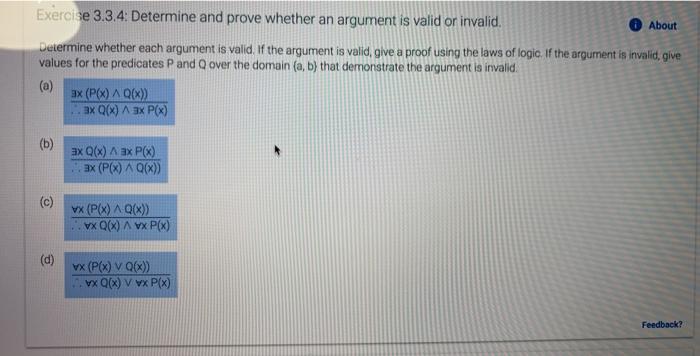
Exercise 3.3.4: Determine and prove whether an argument is valid or invalid. About Determine whether each argument is valid. If the argument is valid, give a proof using the laws of logic. If the argument is invalid, give values for the predicates P and over the domain (a, b) that demonstrate the argument is invalid. ax (P(x) A Q(x)) ax Q(x) () (b) ax Q(x) A ax P(x) ax (P(x) AQ(x vx (P(X) Q(x)) VX Q(x) A vx P(x) (d) vx (P(x) V 0(x)) x Q(x) V vx P(X) Feedback? Exercise 3.3.4: Determine and prove whether an argument is valid or invalid. About Determine whether each argument is valid. If the argument is valid, give a proof using the laws of logic. If the argument is invalid, give values for the predicates P and over the domain (a, b) that demonstrate the argument is invalid. ax (P(x) A Q(x)) ax Q(x) () (b) ax Q(x) A ax P(x) ax (P(x) AQ(x vx (P(X) Q(x)) VX Q(x) A vx P(x) (d) vx (P(x) V 0(x)) x Q(x) V vx P(X) Feedback
Step by Step Solution
There are 3 Steps involved in it

Get step-by-step solutions from verified subject matter experts
 Study Help