







Question: . Prove the Triangle Inequality, (styl |/=] - lull Long Problems . Using truth tables, show that p q = pAd. . Show - he
![. Prove the Triangle Inequality, (styl |/=] - lull Long Problems](https://s3.amazonaws.com/si.experts.images/answers/2024/06/66749991719d2_521667499915cacf.jpg)
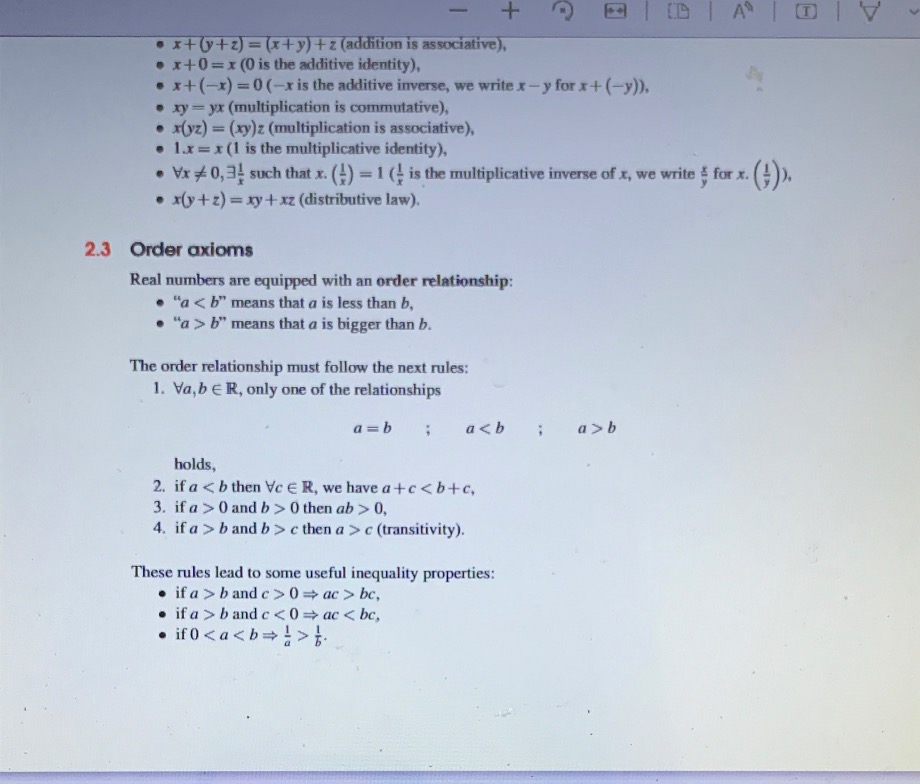
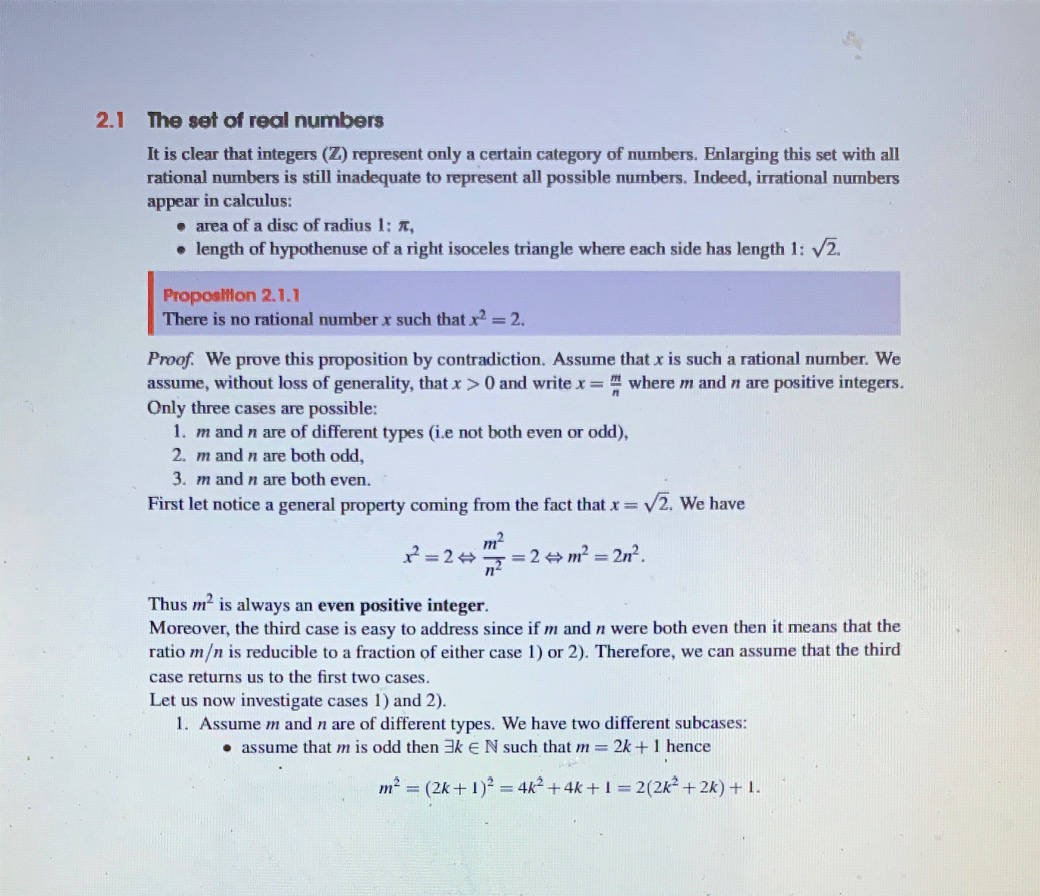
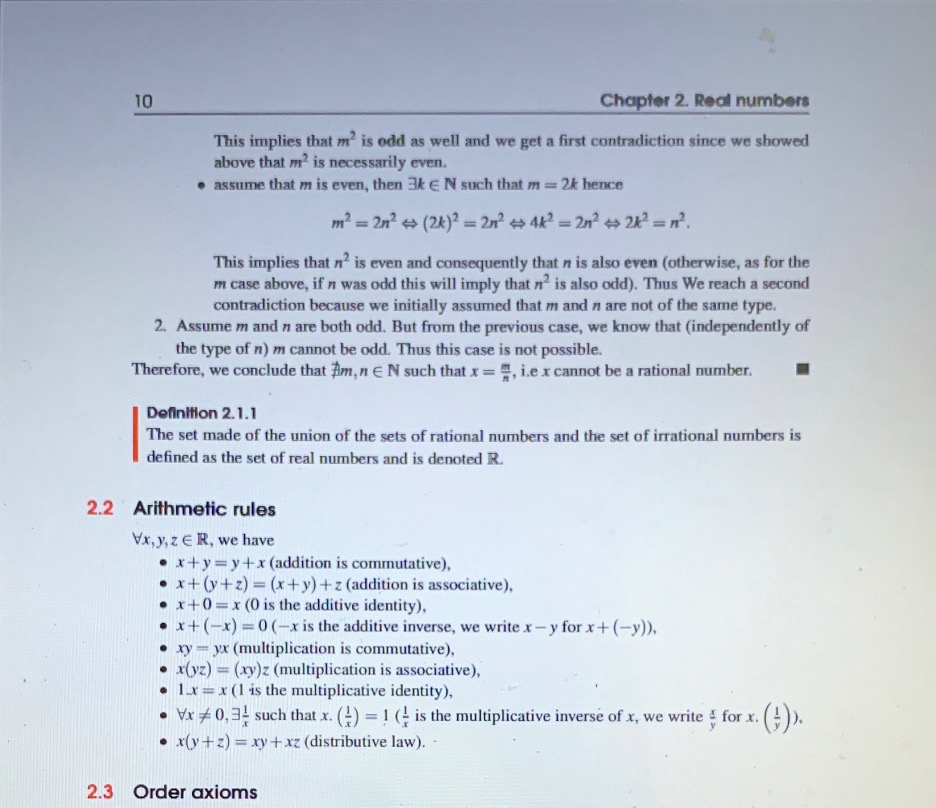
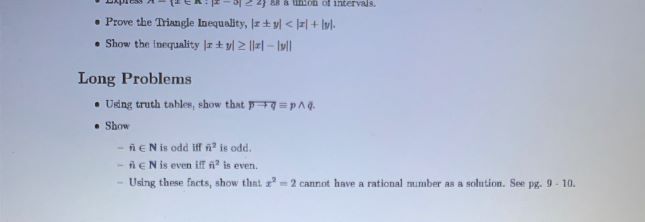
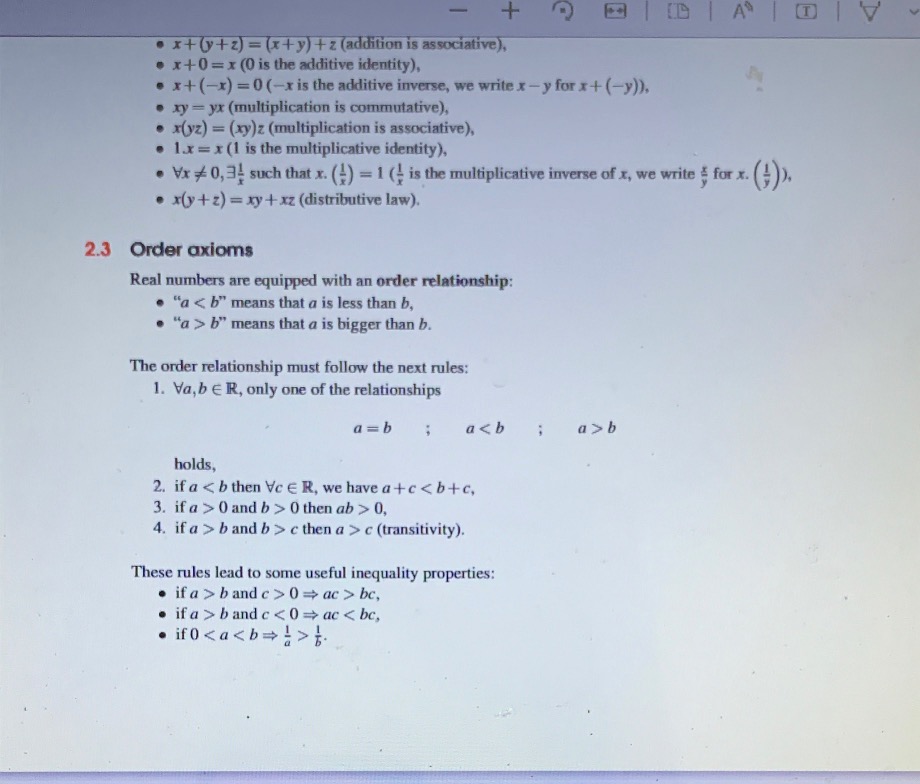
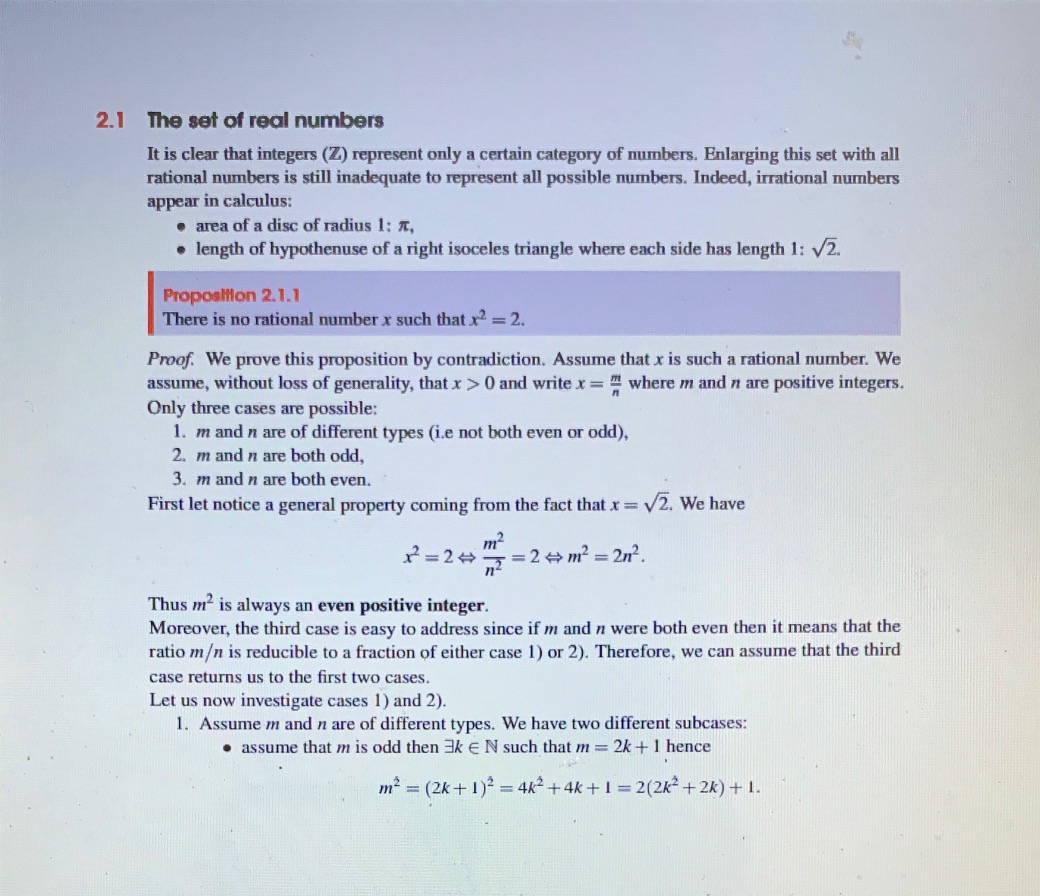
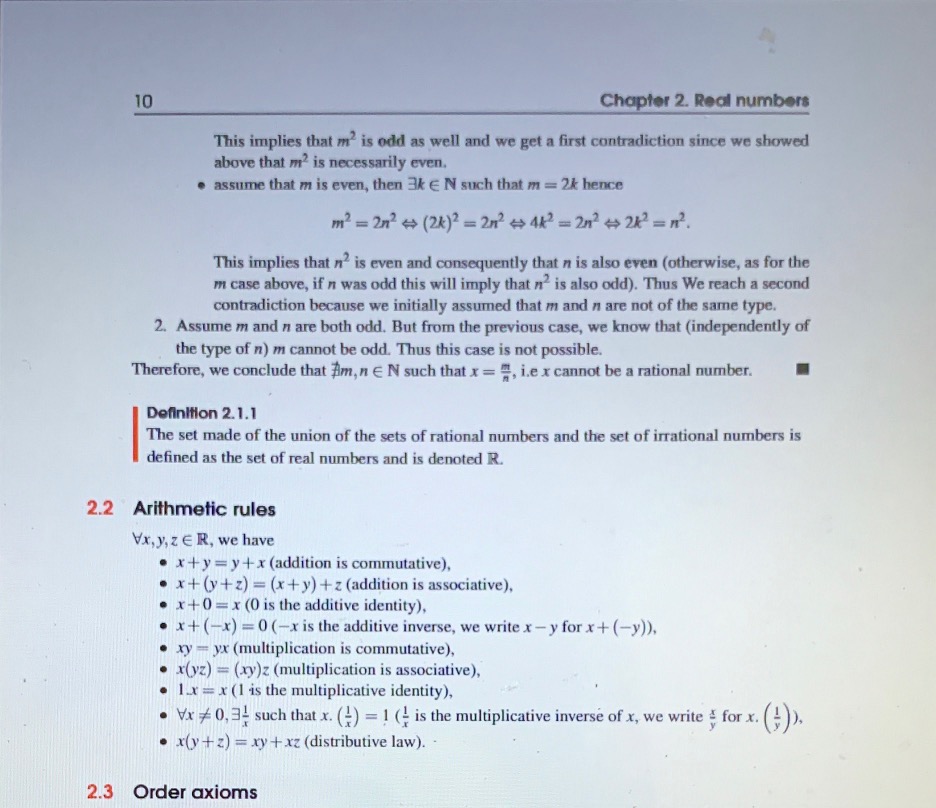
. Prove the Triangle Inequality, (styl |/=] - lull Long Problems . Using truth tables, show that p q = pAd. . Show - he N is odd if a todd. - fe N is even if n is even. Using these facts, show that a? =2 cannot have a rational mimber as a solution. See py. 9 - 10.+ A T V . x+ ()+z) = (x+y) + z (addition is associative), . x+0 = x (0 is the additive identity), . x+ (-x) =0(-x is the additive inverse, we write x - y for x + (-y)). . xy = yx (multiplication is commutative), . x(yz) = (xy)z (multiplication is associative), . 1.x = x (1 is the multiplicative identity), . Vx # 0,34 such that x. () = 1 ( is the multiplicative inverse of x, we write ; for x. ()). . x(y + z) = xy + xz (distributive law). 2.3 Order axioms Real numbers are equipped with an order relationship: . "a b" means that a is bigger than b. The order relationship must follow the next rules: 1. Va, b E R, only one of the relationships a =b acb a>b holds, 2. if a 0 and b > 0 then ab > 0, 4. if a > b and b > c then a > c (transitivity). These rules lead to some useful inequality properties: . if a > b and c > 0 = ac > bc, . if a > band c J.2.1 The set of real numbers It is clear that integers (Z) represent only a certain category of numbers. Enlarging this set with all rational numbers is still inadequate to represent all possible numbers. Indeed, irrational numbers appear in calculus: . area of a disc of radius 1: A, . length of hypothenuse of a right isoceles triangle where each side has length 1: V2. Proposition 2.1.1 There is no rational number x such that x2 = 2. Proof. We prove this proposition by contradiction. Assume that x is such a rational number. We assume, without loss of generality, that x > 0 and write x = " where m and n are positive integers. Only three cases are possible: 1. m and n are of different types (i.e not both even or odd), 2. m and n are both odd, 3. m and n are both even. First let notice a general property coming from the fact that x = v2. We have 12=24- = 24m=2n2. Thus m' is always an even positive integer. Moreover, the third case is easy to address since if m and n were both even then it means that the ratio m is reducible to a fraction of either case 1) or 2). Therefore, we can assume that the third case returns us to the first two cases. Let us now investigate cases 1) and 2). 1. Assume m and n are of different types. We have two different subcases: . assume that m is odd then k E N such that m = 2k + 1 hence m= = (2k + 1)= = 4k2 + 4k + 1 =2(2k=+ 2k) + 1.10 Chapter 2. Real numbers This implies that my is odd as well and we get a first contradiction since we showed above that m' is necessarily even. . assume that m is even, then 3k E N such that m = 2k hence m2 = 2n2 # (2*)2 = 212 # 412 = 212 4212 =12. This implies that n? is even and consequently that n is also even (otherwise, as for the m case above, if n was odd this will imply that n' is also odd). Thus We reach a second contradiction because we initially assumed that m and n are not of the same type. 2. Assume m and n are both odd. But from the previous case, we know that (independently of the type of n) m cannot be odd. Thus this case is not possible. Therefore, we conclude that Am, n E N such that x = #, i.ex cannot be a rational number. Definition 2.1.1 The set made of the union of the sets of rational numbers and the set of irrational numbers is defined as the set of real numbers and is denoted R. 2.2 Arithmetic rules Vx,yzER, we have . x+y = y+ x (addition is commutative), . x+ (y+z) = (x+y) + z (addition is associative), x +0 = x (0 is the additive identity), . x+ (-x) =0 (-x is the additive inverse, we write x - y for x + (-y)), . xy - yx (multiplication is commutative), . x(yz) = (xy)z (multiplication is associative), . I_x = x (1 is the multiplicative identity), . Vr # 0, 34 such that x. (4) = 1 ( is the multiplicative inverse of x, we write ; for x. ()), . x(y + z) = xy + xz (distributive law). 2.3 Order axioms
Step by Step Solution
There are 3 Steps involved in it

Get step-by-step solutions from verified subject matter experts
 Study Help