







Question: Provide 2 takeaways from the attached article: How to provide the takeaways: What were you surprised to learn? Why do you agree/disagree with part of
Provide 2 takeaways from the attached article: How to provide the takeaways: What were you surprised to learn? Why do you agree/disagree with "part of" or whole article?
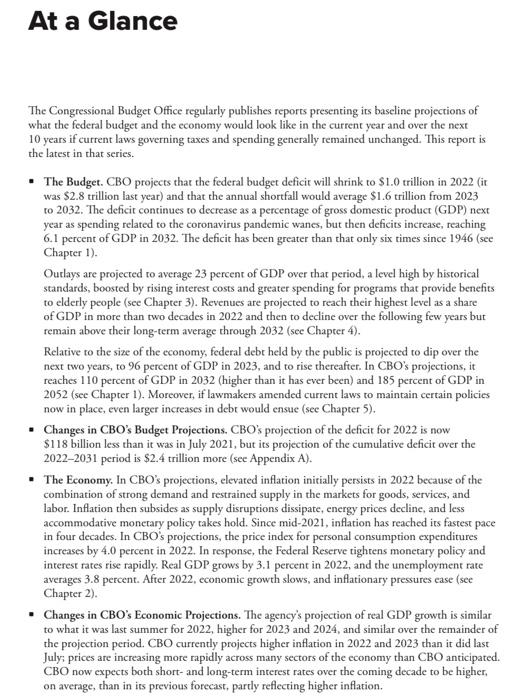
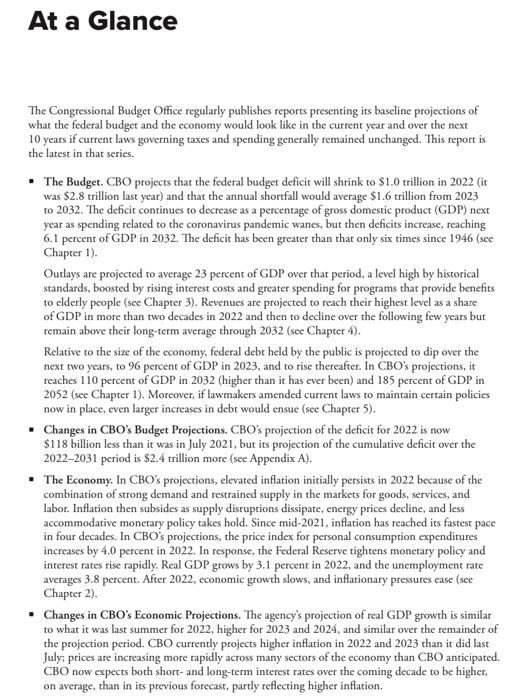
At a Glance The Congressional Budget Office regularly publishes reports presenting its baseline projections of what the federal budget and the economy would look like in the current year and over the next 10 years if current laws governing taxes and spending generally remained unchanged. This report is the latest in that series. " The Budget. CBO projects that the federal budget deficit will shrink to $1.0 trillion in 2022 (it was $2.8 trillion last year) and that the annual shortfall would average $1.6 trillion from 2023 to 2032. The deficit continues to decrease as a percentage of gross domestic product (GDP) next year as spending related to the coronavirus pandemic wanes, but then deficits increase, reaching 6.1 percent of GDP in 2032. The deficit has been greater than that only six times since 1946 (see Chapter 1). Outlays are projected to average 23 percent of GDP over that period, a level high by historical standards, boosted by rising interest costs and greater spending for programs that provide benefits to elderly people (see Chapter 3). Revenues are projected to reach their highest level as a share of GDP in more than two decades in 2022 and then to decline over the following few years but remain above their long-term average through 2032 (see Chapter 4). Relative to the size of the economy, federal debt held by the public is projected to dip over the next two years, to 96 percent of GDP in 2023, and to rise thereafter. In CBO's projections, it reaches 1 10 percent of GDP in 2032 (higher than it has ever been) and 185 percent of GDP in 2052 (see Chapter 1). Moreover, if lawmakers amended current laws to maintain certain policies now in place, even larger increases in debt would ensue (see Chapter 5). " Changes in CBO's Budget Projections. CBO's projection of the deficit for 2022 is now $1 18 billion less than it was in July 2021, but its projection of the cumulative deficit over the 2022-2031 period is $2.4 trillion more (see Appendix A). . The Economy. In CBO's projections, elevated inflation initially persists in 2022 because of the combination of strong demand and restrained supply in the markets for goods, services, and labor. Inflation then subsides as supply disruptions dissipate, energy prices decline, and less accommodation monetary policy takes hold. Since mid-2021, inflation has reached its fastest pace in four decades. In CBO's projections, the price index for personal consumption expenditures increases by 4.0 percent in 2022. In response, the Federal Reserve tightens monetary policy and interest rates rise rapidly. Real GDP grows by 3.1 percent in 2022, and the unemployment rate averages 3.8 percent. After 2022, economic growth slows, and inflationary pressures case (see Chapter 2). " Changes in CBO's Economic Projections. The agency's projection of real GDP growth is similar to what it was last summer for 2022, higher for 2023 and 2024, and similar over the remainder of the projection period. CBO currently projects higher inflation in 2022 and 2023 than it did last July; prices are increasing more rapidly across many sectors of the economy than CBO anticipated. CBO now expects both short- and long-term interest rates over the coming decade to be higher. on average, than in its previous forecast, partly reflecting higher inflation
Step by Step Solution
There are 3 Steps involved in it

Get step-by-step solutions from verified subject matter experts
 Study Help