







Question: Provide responses to the two posts below and cite references: 1) Formal sample size issues are important only in academic (enumerative) statistics. In analytic statistics,
Provide responses to the two posts below and cite references:
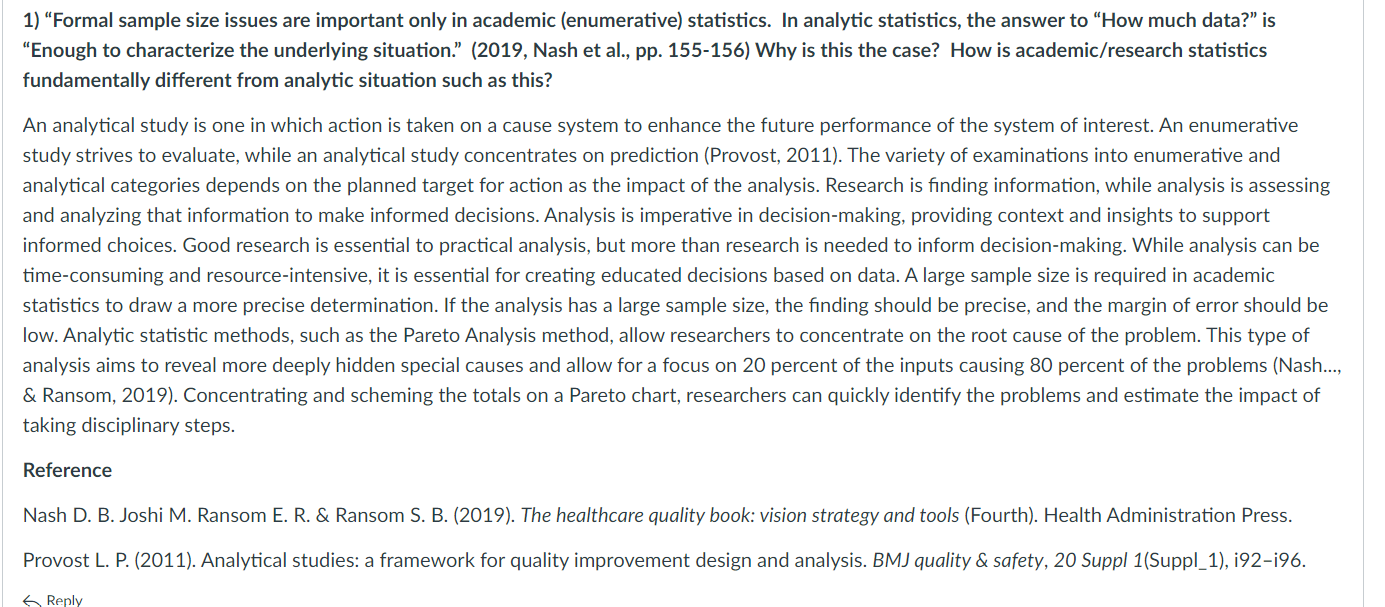
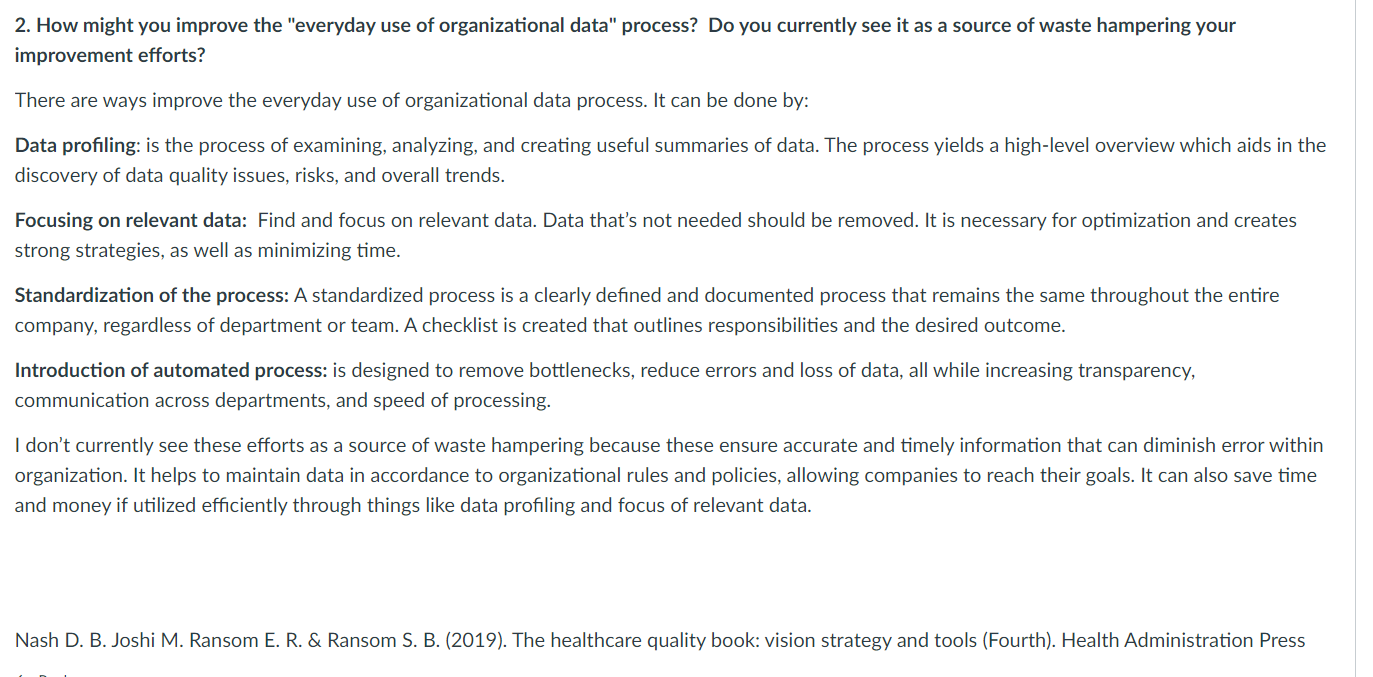
1) \"Formal sample size issues are important only in academic (enumerative) statistics. In analytic statistics, the answer to "How much data?" is "Enough to characterize the underlying situation.\" (2019, Nash et al., pp. 155-156) Why is this the case? How is academic/research statistics fundamentally different from analytic situation such as this? An analytical study is one in which action is taken on a cause system to enhance the future performance of the system of interest. An enumerative study strives to evaluate, while an analytical study concentrates on prediction (Provost, 2011). The variety of examinations into enumerative and analytical categories depends on the planned target for action as the impact of the analysis. Research is nding information, while analysis is assessing and analyzing that information to make informed decisions. Analysis is imperative in decision-making, providing context and insights to support informed choices. Good research is essential to practical analysis, but more than research is needed to inform decision-making. While analysis can be time-consuming and resource-intensive. it is essential for creating educated decisions based on data. A large sample size is required in academic statistics to draw a more precise determination. If the analysis has a large sample size, the finding should be precise, and the margin of error should be low. Analytic statistic methods. such as the Pareto Analysis method, allow researchers to concentrate on the root cause of the problem. This type of analysis aims to reveal more deeply hidden special causes and allow for a focus on 20 percent of the inputs causing 80 percent of the problems (Nash..., & Ransom, 2019). Concentrating and scheming the totals on a Pareto chart, researchers can quickly identify the problems and estimate the impact of taking disciplinary steps. Reference Nash D. B. Joshi M. Ransom E. R. & Ransom S. B. {2019). The healthcare quality book: vision strategy and tools (Fourth). Health Administration Press. Provost L. P. {2011). Analytical studies: a framework for quality improvement design and analysis. BMJ quality & safety, 20 Suppl ilSuple), i92-i96. ex RPnlv 2. How might you improve the "everyday use of organizational data" process? Do you currently see it as a source of waste hampering your improvement efforts? There are ways improve the everyday use of organizational data process. It can be done by: Data profiling: is the process of examining, analyzing, and creating useful summaries of data. The process yields a high-level overview which aids in the discovery of data quality issues, risks, and overall trends. Focusing on relevant data: Find and focus on relevant data. Data that's not needed should be removed. It is necessary for optimization and creates strong strategies, as well as minimizing time. Standardization of the process: A standardized process is a clearly defined and documented process that remains the same throughout the entire company, regardless of department or team. A checklist is created that outlines responsibilities and the desired outcome. Introduction of automated process: is designed to remove bottlenecks, reduce errors and loss of data, all while increasing transparency, communication across departments, and speed of processing. I don't currently see these efforts as a source of waste hampering because these ensure accurate and timely information that can diminish error within organization. It helps to maintain data in accordance to organizational rules and policies, allowing companies to reach their goals. It can also save time and money if utilized efficiently through things like data profiling and focus of relevant data. Nash D. B. Joshi M. Ransom E. R. & Ransom S. B. (2019). The healthcare quality book: vision strategy and tools (Fourth). Health Administration Press
Step by Step Solution
There are 3 Steps involved in it

Get step-by-step solutions from verified subject matter experts
 Study Help