



Question: 1. (7 points, suggested time 13 minutes) Two blocks A and B of equal mass m are on a frictionless track , as shown in
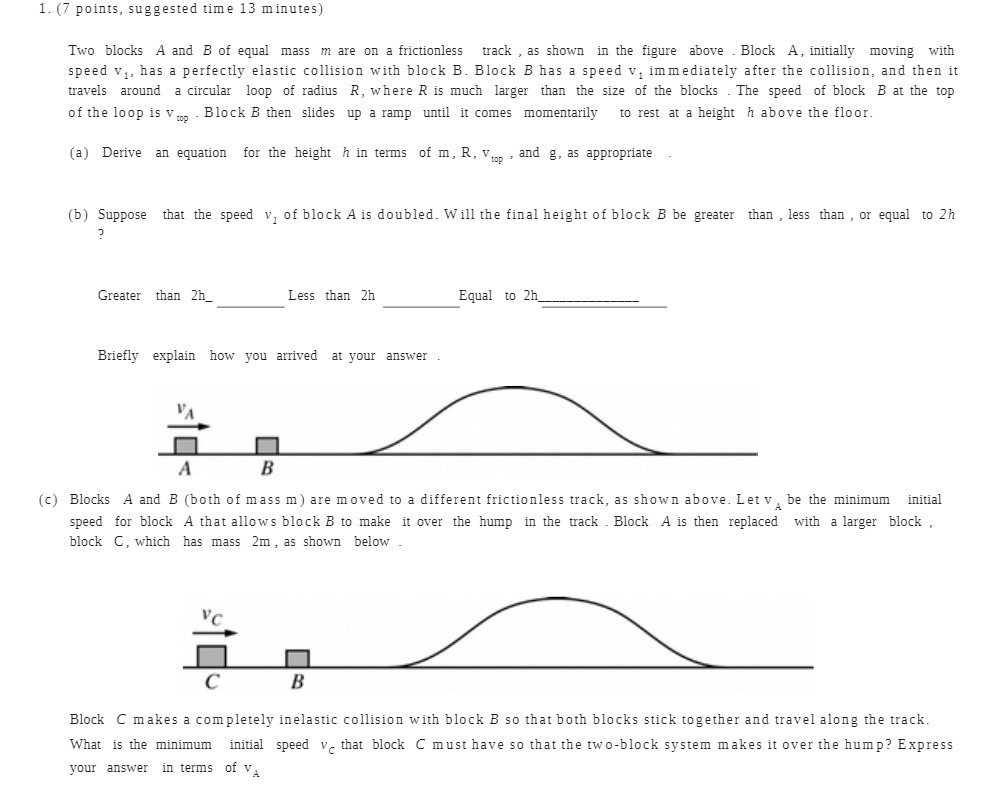
1. (7 points, suggested time 13 minutes) Two blocks A and B of equal mass m are on a frictionless track , as shown in the figure above . Block A, initially moving with speed v,, has a perfectly elastic collision with block B. Block B has a speed v, immediately after the collision, and then it travels around a circular loop of radius R, where R is much larger than the size of the blocks . The speed of block B at the top of the loop is v., . Block B then slides up a ramp until it comes momentarily to rest at a height h above the floor. (a) Derive an equation for the height h in terms of m, R, V., , and g, as appropriate (b) Suppose that the speed v, of block A is doubled. Will the final height of block B be greater than , less than , or equal to 2h Greater than 2h_ Less than 2h Equal to 2h_ Briefly explain how you arrived at your answer B (c) Blocks A and B (both of mass m ) are moved to a different frictionless track, as shown above. Let v, be the minimum initial speed for block A that allows block B to make it over the hump in the track . Block A is then replaced with a larger block block C, which has mass 2m , as shown below B Block C makes a completely inelastic collision with block B so that both blocks stick together and travel along the track. What is the minimum initial speed v that block C must have so that the two-block system makes it over the hump? Express your answer in terms of VA
Step by Step Solution
There are 3 Steps involved in it

Get step-by-step solutions from verified subject matter experts