







Question: Provided code solve where says add code: package assignments2018.a2template; import java.math.BigInteger; public class Polynomial { private SLinkedList polynomial; public int size() { return polynomial.size(); }
 Provided code solve where says add code:
package assignments2018.a2template;
import java.math.BigInteger;
public class Polynomial { private SLinkedList
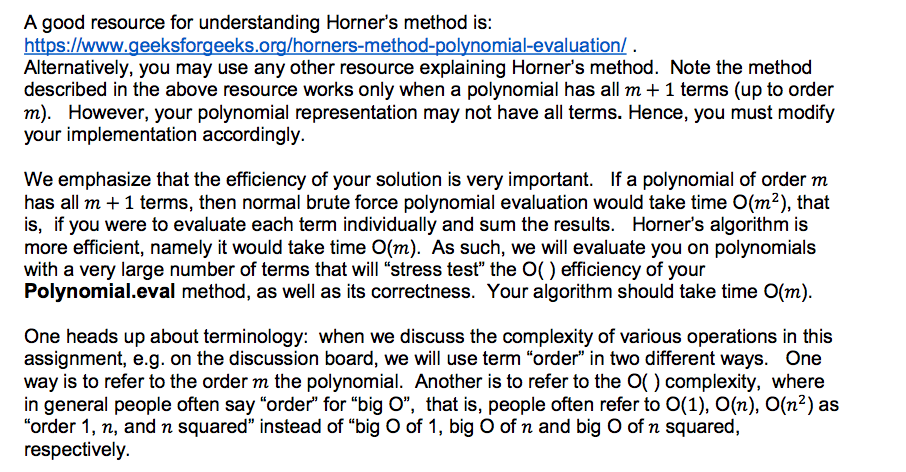
/**** ADD CODE HERE ****/ return null; } //TODO: multiply this polynomial by a given term. private void multiplyTerm(Term t) { /**** ADD CODE HERE ****/ } //TODO: multiply two polynomials public static Polynomial multiply(Polynomial p1, Polynomial p2) { /**** ADD CODE HERE ****/ return null; } //TODO: evaluate this polynomial. // Hint: The time complexity of eval() must be order O(m), // where m is the largest degree of the polynomial. Notice // that the function SLinkedList.get(index) method is O(m), // so if your eval() method were to call the get(index) // method m times then your eval method would be O(m^2). // Instead, use a Java enhanced for loop to iterate through // the terms of an SLinkedList.
public BigInteger eval(BigInteger x) { /**** ADD CODE HERE ****/ return new BigInteger("0"); } // Checks if this polynomial is same as the polynomial in the argument public boolean checkEqual(Polynomial p) { if (polynomial == null || p.polynomial == null || size() != p.size()) return false; int index = 0; for (Term term0 : polynomial) { Term term1 = p.getTerm(index); if (term0.getExponent() != term1.getExponent() || term0.getCoefficient().compareTo(term1.getCoefficient()) != 0 || term1 == term0) return false; index++; } return true; } // This method blindly adds a term to the end of LinkedList polynomial. // Avoid using this method in your implementation as it is only used for testing. public void addTermLast(Term t) { polynomial.addLast(t); } // This is used for testing multiplyTerm public void multiplyTermTest(Term t) { multiplyTerm(t); } @Override public String toString() { if (polynomial.size() == 0) return "0"; return polynomial.toString(); } }
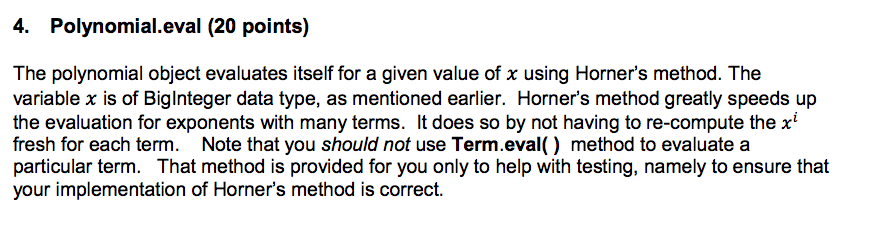
4. Polynomial.eval (20 points) The polynomial object evaluates itself for a given value of x using Horner's method. The variable x is of BigInteger data type, as mentioned earlier. Horner's method greatly speeds up the evaluation for exponents with many terms. It does so by not having to re-compute the x fresh for each term. Note that you should not use Term.eval() method to evaluate a particular term. That method is provided for you only to help with testing, namely to ensure that your implementation of Horner's method is correct. 4. Polynomial.eval (20 points) The polynomial object evaluates itself for a given value of x using Horner's method. The variable x is of BigInteger data type, as mentioned earlier. Horner's method greatly speeds up the evaluation for exponents with many terms. It does so by not having to re-compute the x fresh for each term. Note that you should not use Term.eval() method to evaluate a particular term. That method is provided for you only to help with testing, namely to ensure that your implementation of Horner's method is correct
Step by Step Solution
There are 3 Steps involved in it

Get step-by-step solutions from verified subject matter experts
 Study Help