



Question: PS. Topic:Purposive Communication Direction: Read the question in each number. Then, circle the item that corresponds to your answer. 1. Which is true? a. Environments
PS. Topic:Purposive Communication
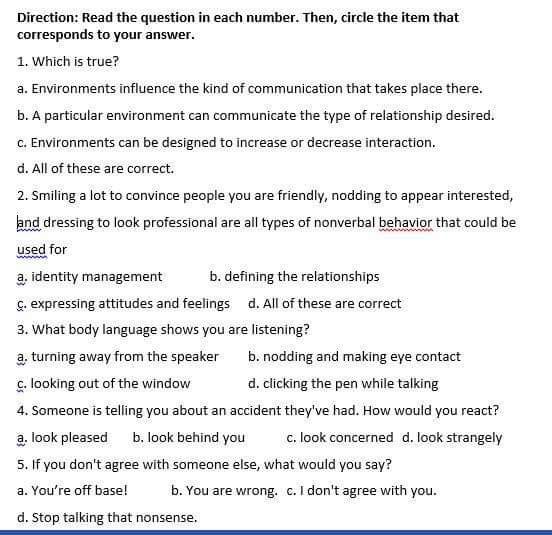
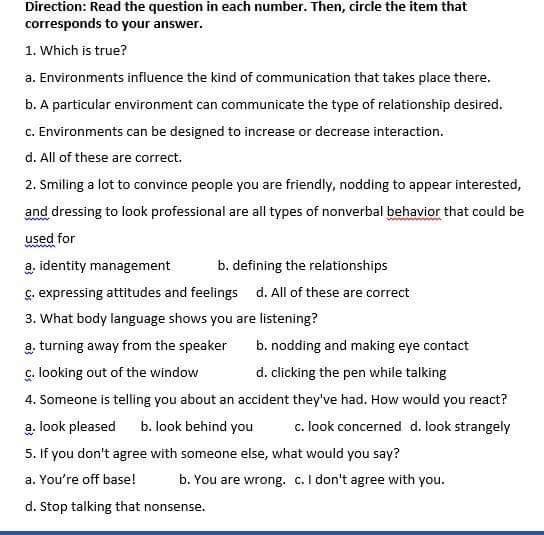
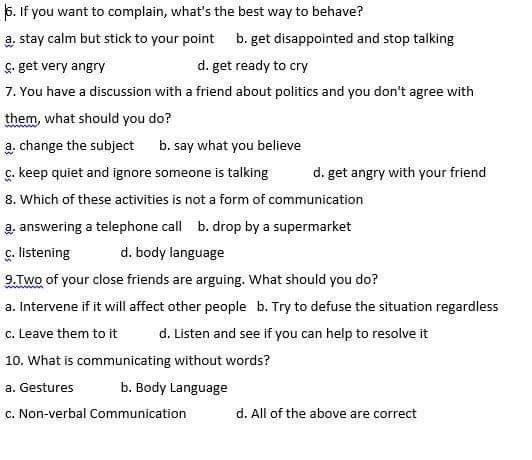
Direction: Read the question in each number. Then, circle the item that corresponds to your answer. 1. Which is true? a. Environments influence the kind of communication that takes place there. b. A particular environment can communicate the type of relationship desired. c. Environments can be designed to increase or decrease interaction. d. All of these are correct. 2. Smiling a lot to convince people you are friendly, nodding to appear interested, land dressing to look professional are all types of nonverbal behavior that could be used for a. identity management b. defining the relationships $. expressing attitudes and feelings d. All of these are correct 3. What body language shows you are listening? a. turning away from the speaker b. nodding and making eye contact c. looking out of the window d. clicking the pen while talking 4. Someone is telling you about an accident they've had. How would you react? a. look pleased b. look behind you c. look concerned d. look strangely 5. If you don't agree with someone else, what would you say? a. You're off base! b. You are wrong. c. I don't agree with you. d. Stop talking that nonsense. Direction: Read the question in each number. Then, circle the item that corresponds to your answer. 1. Which is true? a. Environments influence the kind of communication that takes place there, b. A particular environment can communicate the type of relationship desired. C. Environments can be designed to increase or decrease interaction. d. All of these are correct. 2. Smiling a lot to convince people you are friendly, nodding to appear interested, and dressing to look professional are all types of nonverbal behavior that could be used for a. identity management b. defining the relationships 4. expressing attitudes and feelings d. All of these are correct 3. What body language shows you are listening? a. turning away from the speaker b. nodding and making eye contact C. looking out of the window d. clicking the pen while talking 4. Someone is telling you about an accident they've had. How would you react? a. look pleased b. look behind you c. look concerned d. look strangely 5. If you don't agree with someone else, what would you say? a. You're off base! b. You are wrong. c. I don't agree with you. d. Stop talking that nonsense. 16. If you want to complain, what's the best way to behave? a. stay calm but stick to your point b. get disappointed and stop talking c. get very angry d.get ready to cry 7. You have a discussion with a friend about politics and you don't agree with them, what should you do? a. change the subject b.say what you believe C. keep quiet and ignore someone is talking d. get angry with your friend 8. Which of these activities is not a form of communication a. answering a telephone call b. drop by a supermarket c. listening d. body language 9.Two of your close friends are arguing. What should you do? a. Intervene if it will affect other people b. Try to defuse the situation regardless c. Leave them to it d. Listen and see if you can help to resolve it 10. What is communicating without words? a. Gestures b. Body Language C. Non-verbal communication d. All of the above are correctStep by Step Solution
There are 3 Steps involved in it
1 Expert Approved Answer
Step: 1 Unlock

Question Has Been Solved by an Expert!
Get step-by-step solutions from verified subject matter experts
Step: 2 Unlock
Step: 3 Unlock