







Question: Pt.1 It is time to start adding rows together to arrive at the total net cash flows tied to this project. We will start by
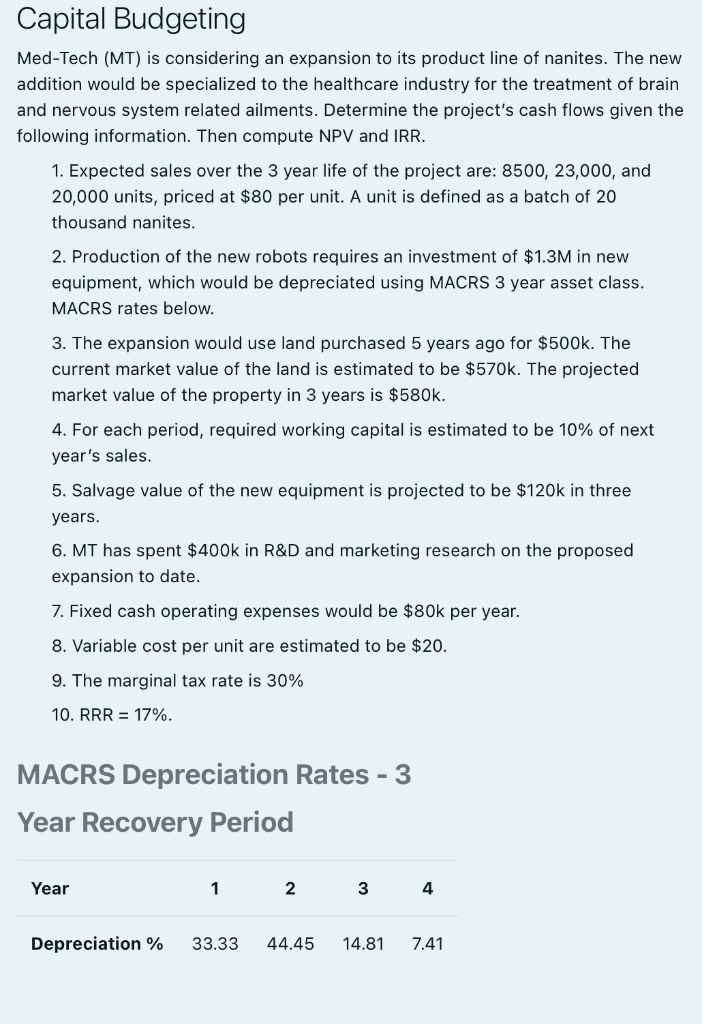
Pt.1 It is time to start adding rows together to arrive at the total net cash flows tied to this project. We will start by calculating NINV (Net Investment), which in reality is simply the Net Cash Flows of the project at time zero (t=0). What are the net cash flows at t=0? (Note - you shouldn't see any operating expenses yet, as the project has not "started" outside of prep. You should only be seeing expenses tied to capital investments and working capital)
Pt.2 Now the project starts at t=1. Again, we've already done all of the real work - we just need to add our previously calculated cash flows. This time we are looking at the first year of operating cash flows and the second year of working capital cash flows.
What are the net cash flows for t=1?
Capital Budgeting Med-Tech (MT) is considering an expansion to its product line of nanites. The new addition would be specialized to the healthcare industry for the treatment of brain and nervous system related ailments. Determine the project's cash flows given the following information. Then compute NPV and IRR. 1. Expected sales over the 3 year life of the project are: 8500, 23,000, and 20,000 units, priced at $80 per unit. A unit is defined as a batch of 20 thousand nanites. 2. Production of the new robots requires an investment of $1.3M in new equipment, which would be depreciated using MACRS 3 year asset class. MACRS rates below. 3. The expansion would use land purchased 5 years ago for $500k. The current market value of the land is estimated to be $570k. The projected market value of the property in 3 years is $580k. 4. For each period, required working capital is estimated to be 10% of next year's sales. 5. Salvage value of the new equipment is projected to be $120k in three years. 6. MT has spent $400k in R&D and marketing research on the proposed expansion to date. 7. Fixed cash operating expenses would be $80k per year. 8. Variable cost per unit are estimated to be $20. 9. The marginal tax rate is 30% 10. RRR = 17%. MACRS Depreciation Rates - 3 Year Recovery Period Year 1 2 3 4 Depreciation % 33.33 44.45 14.81 7.41
Step by Step Solution
There are 3 Steps involved in it

Get step-by-step solutions from verified subject matter experts
 Study Help