







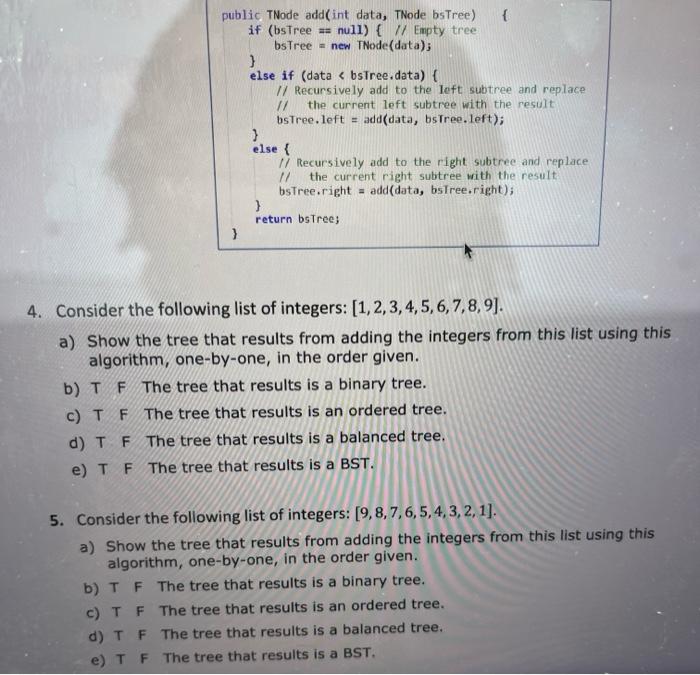
Question: public, TNode add(int data, TNode bsTree) { if (bsTree == null) { // Empty tree. bsTree = new TNode(data); } else if (data 6.
![6. Consider the following list of integers: [68, 88, 61, 89, 94, 50, 4, 76, 66, 82]. a) Show the tree that](https://dsd5zvtm8ll6.cloudfront.net/questions/2024/01/65ae57df533e2_57465ae57deed134.jpg)
public, TNode add(int data, TNode bsTree) { if (bsTree == null) { // Empty tree. bsTree = new TNode(data); } else if (data 6. Consider the following list of integers: [68, 88, 61, 89, 94, 50, 4, 76, 66, 82]. a) Show the tree that results from adding the integers from this list using this algorithm, one-by-one, in the order given. b) T F The tree that results is a binary tree. c) T F The tree that results is an ordered tree. d) T F The tree that results is a balanced tree. e) T F The tree that results is a BST.
Step by Step Solution
3.45 Rating (158 Votes )
There are 3 Steps involved in it
The detailed answer for the above question is provided below Lets analyze each part of the code and answer the questions Part 4 List 1 2 3 4 5 6 7 8 9 a The tree that results from adding the integers ... View full answer

Get step-by-step solutions from verified subject matter experts
 Study Help